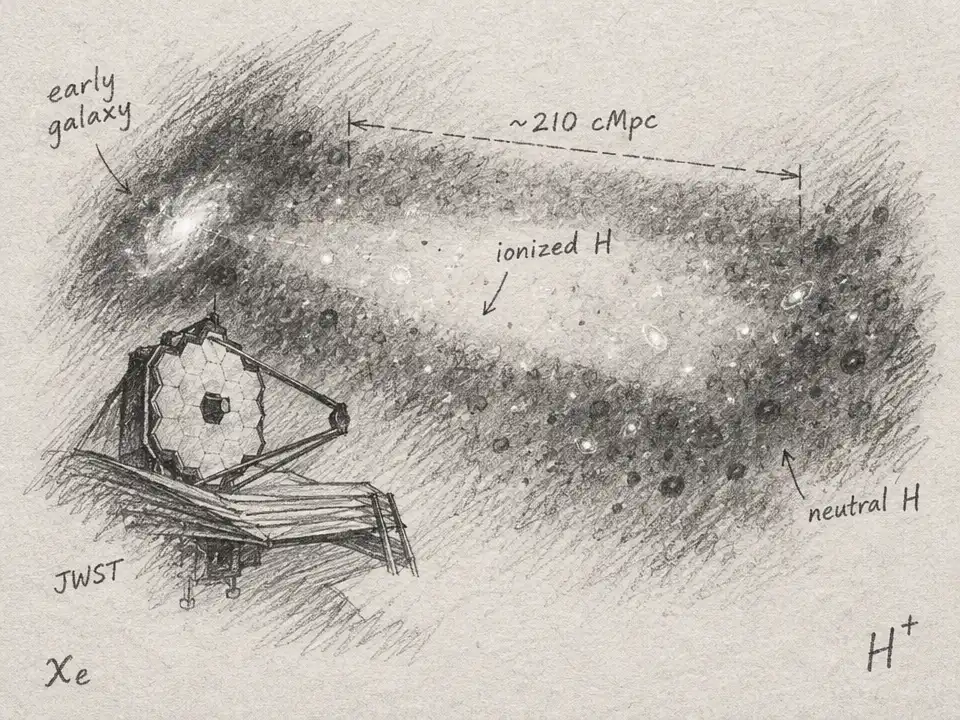
For a time, the young universe was filled with neutral hydrogen: a cosmic fog that swallowed many kinds of light. Then something changed. Radiation from the first stars and galaxies began stripping electrons from hydrogen atoms, gradually making the universe transparent. Astronomers know this transformation happened, but the suspects are harder to identify. Were the main agents tiny, abundant galaxies—or brighter systems capable of producing a more powerful flood of light?
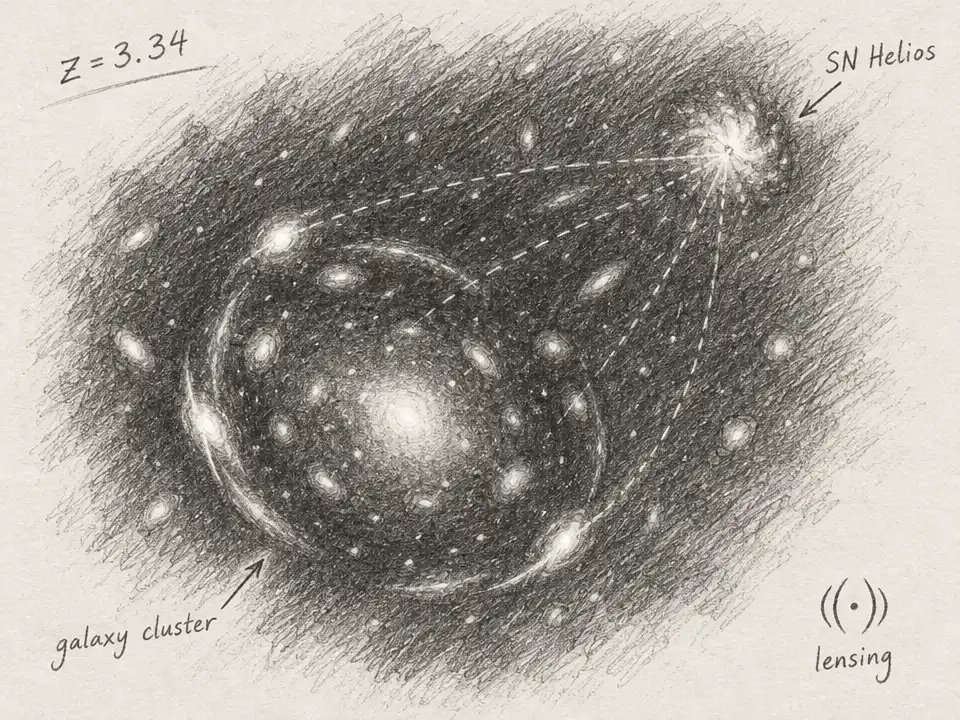
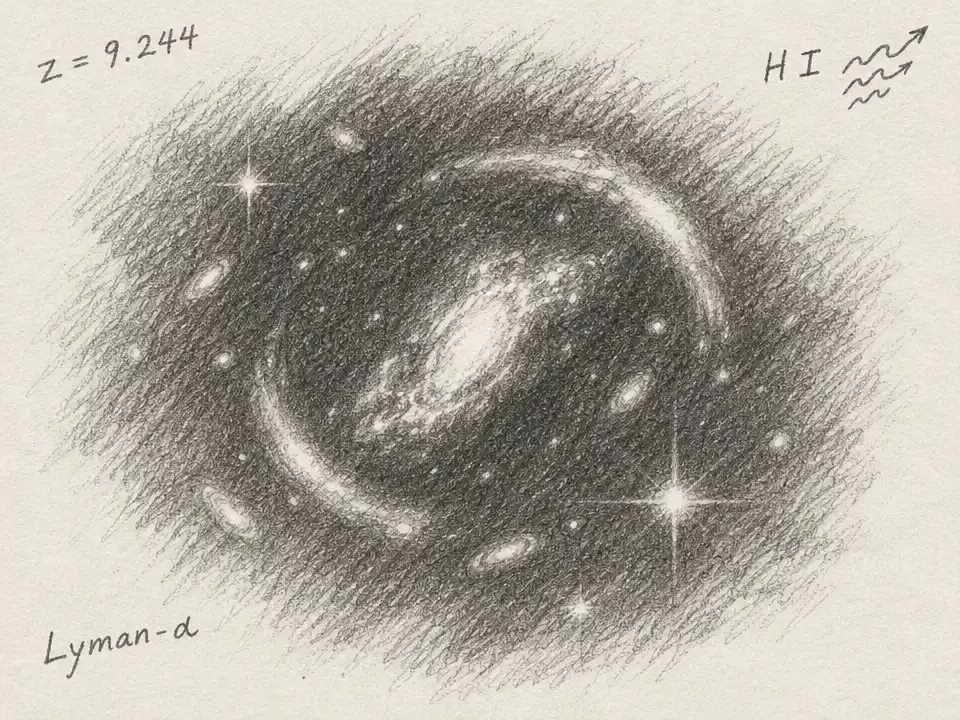
A galaxy called EBG-1 offers a new clue. Its light has traveled from a time when the universe was still young, and a foreground galaxy cluster magnifies it like a lens. In a new study, astronomers used 14 hours of observations with JWST’s NIRSpec instrument to examine that light in detail. They found a remarkably blue ultraviolet spectrum, along with spectral features that point to an intriguing possibility: this galaxy may have let most of its hydrogen-ionizing radiation escape.
The detail that makes the case puzzling is not simply that EBG-1 is bright. Its ultraviolet slope, β = −2.99 ± 0.15, puts it among the bluest galaxies observed at redshift greater than 9. A very blue spectrum can signal a young, metal-poor population of stars. But it can also hint that the galaxy’s gas is not catching and reprocessing much of the stars’ most energetic light.
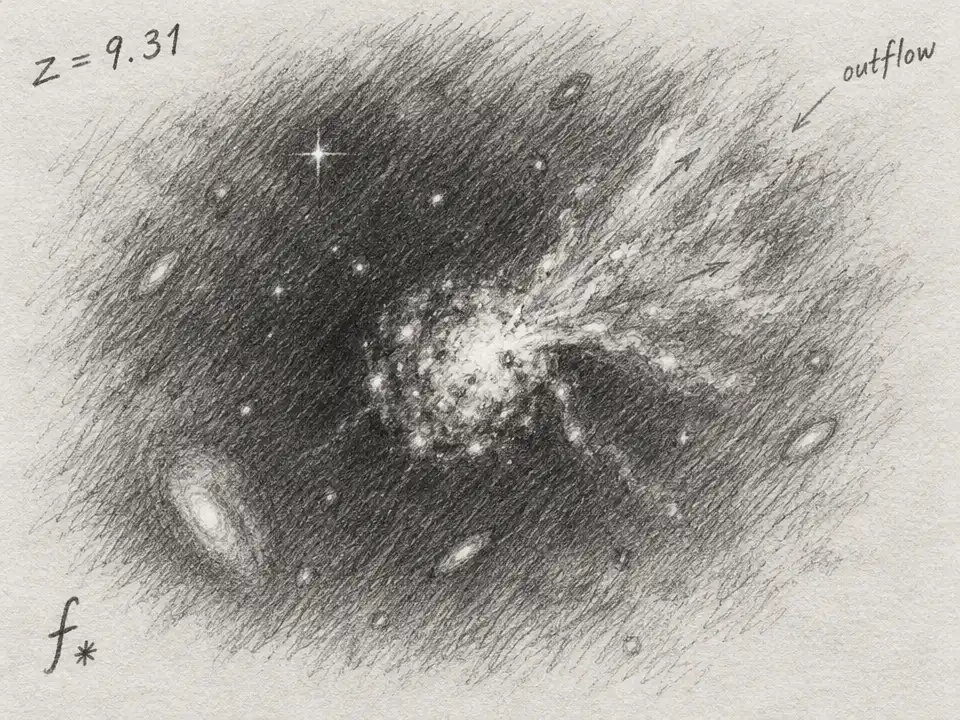
That distinction matters. Young stars produce ultraviolet photons energetic enough to ionize hydrogen. When gas inside a galaxy absorbs those photons, it glows in characteristic emission lines. When more of the photons escape, the galaxy’s internal gas has fewer chances to produce that glow. Astronomers call the escaping share the escape fraction, written fesc. These photons cannot be counted directly in EBG-1; the team inferred their likely escape by comparing the galaxy’s colors and emission lines with models of stars and gas.
The spectrum supplied several clues, but not all with equal clarity. The team detected [O III] at 5007 angstroms at 5σ, while the Hβ line appeared at roughly 2σ—suggestive, but tentative. They did not detect C III]; instead, they set a 3σ upper limit on its strength. The [O III] line is prominent, so the galaxy is not simply featureless. The question is whether the full pattern, including the blue continuum and the weaker-than-expected lines, can be explained if many ionizing photons slip out.
To test that idea, the researchers compared the measurements with BEAGLE photoionization models at the galaxy’s estimated metallicity. In their model grid, escape fractions of 0.5 or less could not reproduce the observed properties together. Models with fesc at or above 0.75 fit better, with about 0.85 providing the best overall match. In plain language, the favored model lets roughly 85 percent of the relevant photons leave the galaxy rather than be absorbed inside it.
This is an inference, not a direct measurement of photons streaming into intergalactic space. The answer depends on the models and assumptions used to interpret the spectrum, and the Hβ detection is marginal. The researchers also assume a constant star-formation history for the model tracks. Better observations could sharpen the lines, and different assumptions about the galaxy’s recent history could change how the clues fit together. The 85 percent figure is compelling precisely because several diagnostics point in the same direction—but it is not a final verdict.
The galaxy’s chemistry offers another clue, and briefly raises a different suspect: the universe’s first generation of stars. EBG-1 has an estimated oxygen abundance of about 3 percent of the Sun’s, and its carbon-to-oxygen ratio is low. Some models of very early stars predict a different chemical signature, including elevated carbon relative to oxygen. The measured limit does not show that signature. Instead, the authors find EBG-1 broadly consistent with a familiar pattern in which massive stars enrich their surroundings through core-collapse supernovae. The galaxy is chemically primitive, but its abundance pattern does not require a special explanation from the earliest, metal-free stars.
Then comes the scale of the mystery. EBG-1 is relatively UV-luminous: at the same brightness, it produces about 30 times more ultraviolet light than galaxies fainter than an absolute magnitude of −16. Some accounts of reionization rely on vast numbers of such faint galaxies, each contributing a little. EBG-1 suggests another possibility: a smaller fraction of brighter galaxies could matter greatly if they leak radiation unusually efficiently.
The paper estimates that galaxies with EBG-1-like ionizing properties might need to contribute only about 5 percent of the total ultraviolet luminosity density to match the escaping ionizing output expected from a typical population. That is a striking calculation, but it hinges on how common such galaxies are. One exceptionally efficient leaker cannot tell us whether the early universe contained a few of them or enough to change the overall photon budget. Nor is EBG-1 confirmed to be a Lyman-alpha emitter; its Lyman-alpha properties remain unknown.
So the puzzle remains open, but it has become more sharply framed. The universe may have cleared its hydrogen fog through countless small sources, through especially leaky luminous galaxies, or through a mixture that changed over time. EBG-1 is a clue to the second possibility, not proof that it dominated. The next tests are practical: deeper spectroscopy to firm up the uncertain lines, and a census of neighboring galaxies to reveal whether EBG-1 sits alone or inside a larger ionizing neighborhood. Until then, this distant blue speck leaves one question hanging: how many galaxies like it did the early universe need?