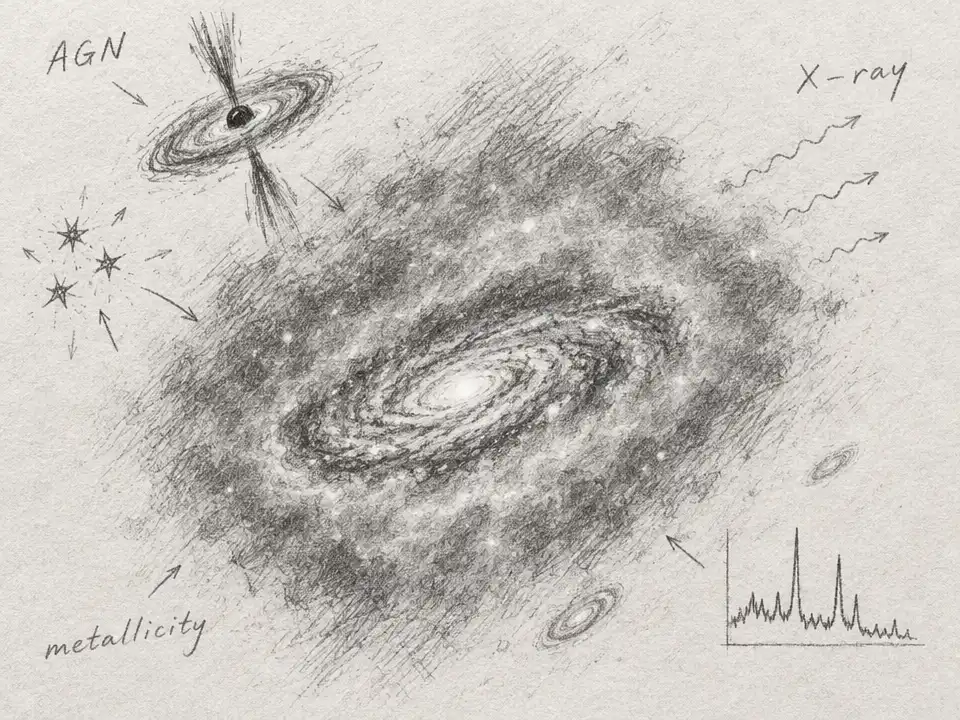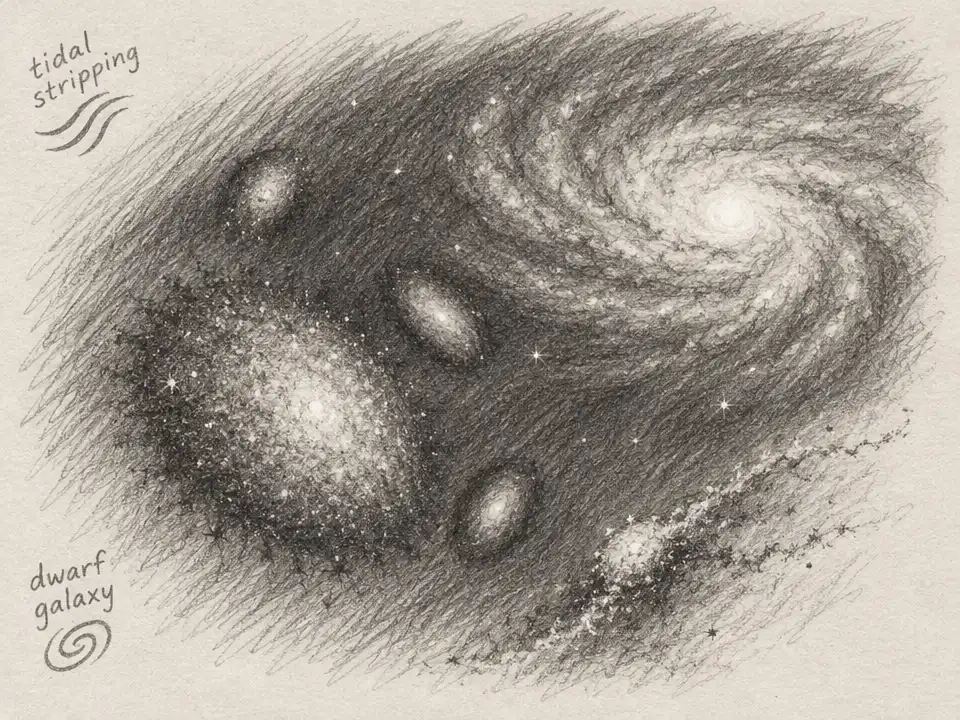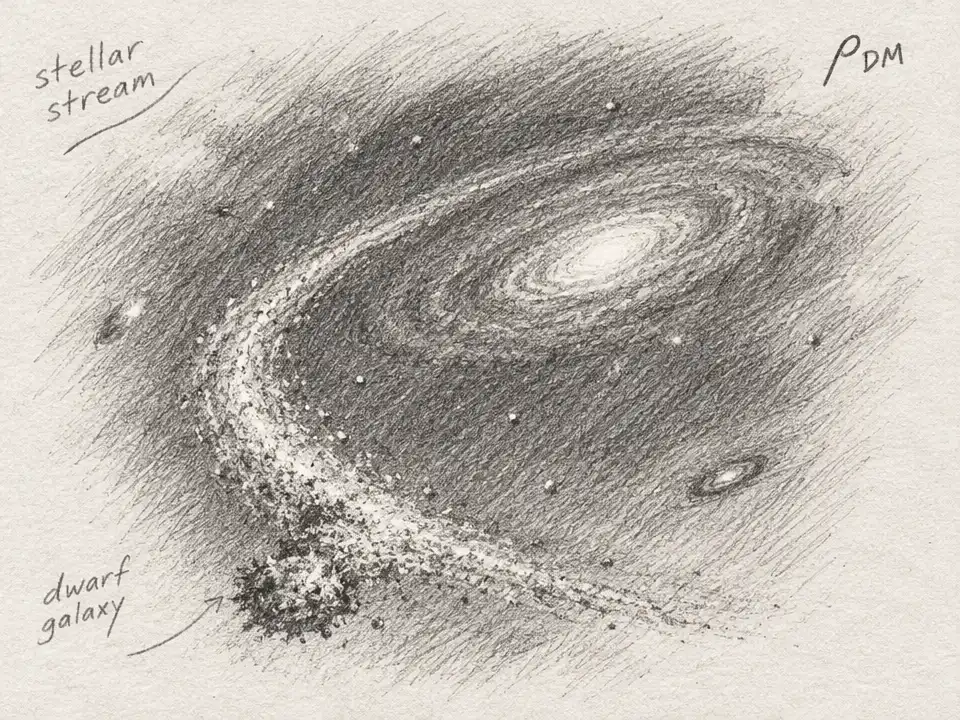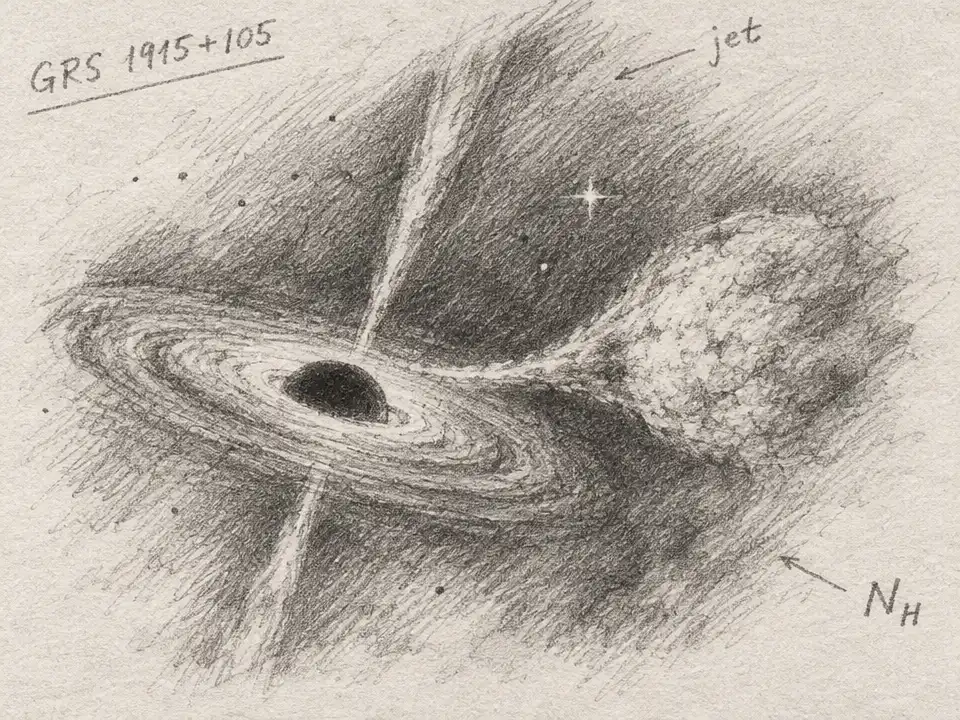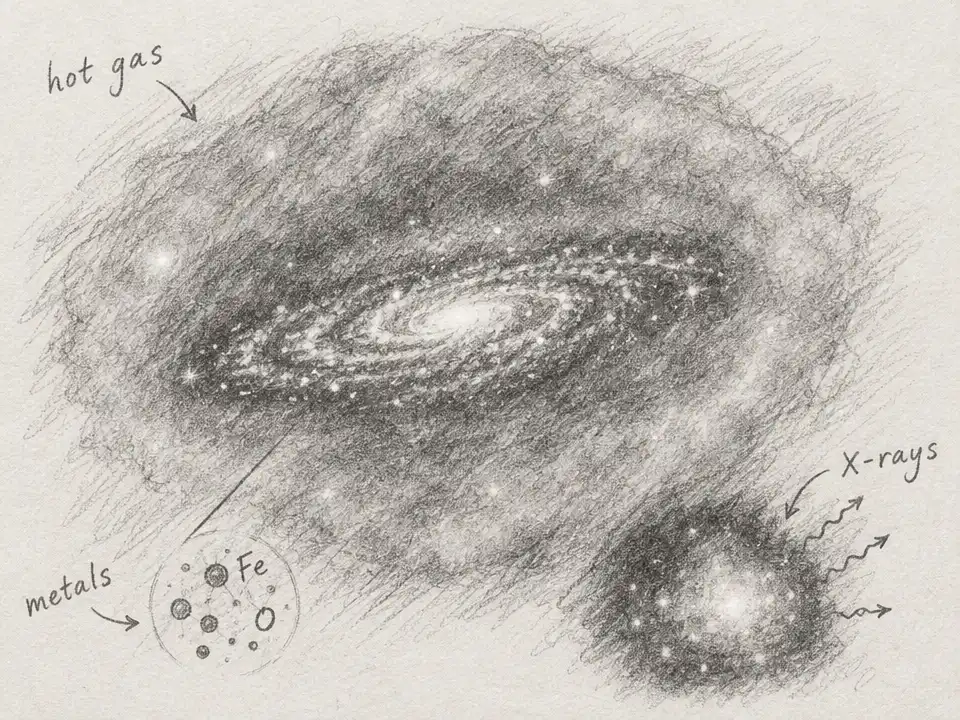
Imagine seeing the Milky Way from far outside its bright, star-filled disk. The familiar spiral would be only the center of a much larger structure, wrapped in gas so hot and thin that it is almost invisible. This surrounding region, called the circumgalactic medium, can reveal itself through X-rays. But a new set of galaxy simulations points to a catch: the halo’s glow does not simply tell us how much gas is there. Its chemistry matters, too.
The study, posted to arXiv on October 27, 2026, examines simulated galaxies with masses broadly comparable to the Milky Way. The researchers traced the gas around them and modeled its emission in the soft X-ray band, from 0.5 to 2.0 keV. They focused on gas hotter than 105.5 K—a component that can extend well beyond the bright disk, yet is difficult to study directly.
At first, the signal seems like a straightforward inventory. A halo with more hot gas tends to produce more X-rays. Across the simulated galaxies, the researchers found a strong relationship between the amount of hot gas and its X-ray emission. If that were the whole story, astronomers might use the glow as a kind of scale: brighter halo, larger store of hot gas.
To test what else could shape that light, the team turned to a set of eight simulations built from four Milky Way-mass galaxy models. The models were designed for comparisons: each had a counterpart run without black-hole physics. The researchers could examine how changes in a galaxy’s history—especially energy released by stars and its central supermassive black hole—affected the gas around it.
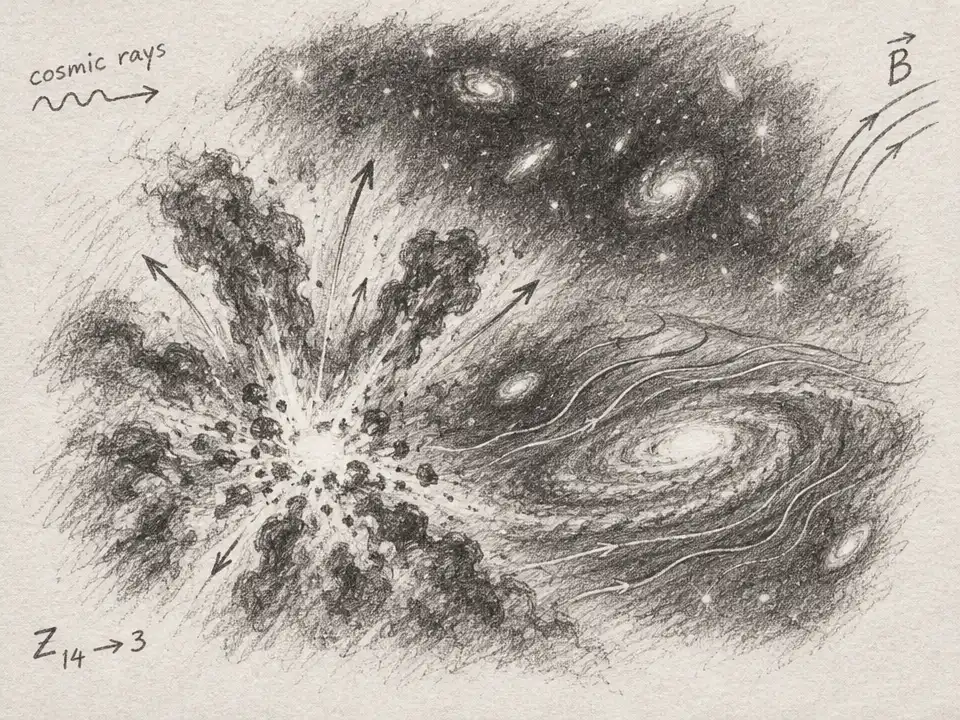
The simulations linked the amount of hot halo gas to the combined energy injected by stars and black-hole activity over a galaxy’s history. Neither source alone emerged as the universal driver. In some models, black-hole feedback helped heat gas and push material outward; in others, the energy from star formation also contributed. Where galaxies had received less such energy, they tended to contain less hot gas and emit less X-ray light.
Then came the subtler clue. Two halos with similar amounts of hot gas could still shine differently if one contained more heavy elements. In astronomy, “metals” means elements heavier than helium. Stars forge many of these elements and can send them out into their surroundings. In the simulations, feedback was associated with both heating the halo and carrying these elements away from the galaxy’s disk.
Why should that change the glow? Hot gas produces X-rays as charged particles interact. The researchers found that a higher metal content can change the gas’s X-ray output and the shape of its spectrum, even when the hot-gas mass is similar. Temperature matters as well: in the broader simulated galaxy sample, the metal-rich halos also tended to be hotter. So a halo’s X-ray brightness carries information about its heat and chemistry, not just its quantity of gas.
This distinction is important because an observer sees the light, not the simulation’s internal accounting. A brighter X-ray halo could contain more hot gas—or gas with properties that make it more luminous. Treating brightness as a direct measure of gas mass could therefore make two halos seem more different than they are, or obscure how their histories differ.
The result is not a claim that astronomers have found a hidden chemical signature in every observed galaxy. This is a study of simulations, and the authors note that their models do not include a full treatment of metal-line cooling. Their calculations also do not apply all the effects involved in turning a simulated halo into an actual telescope observation. Comparing models with X-ray data remains essential.
Still, the study offers a useful shift in perspective. The halo is not merely a faint reservoir surrounding the galaxy; its glow is shaped by the galaxy’s past. Stars and a central black hole can help heat the gas and redistribute the elements mixed into it, leaving an X-ray signal that reflects both. Read carefully, that light may tell astronomers not only how much material lies beyond the disk, but what the galaxy has done to it.