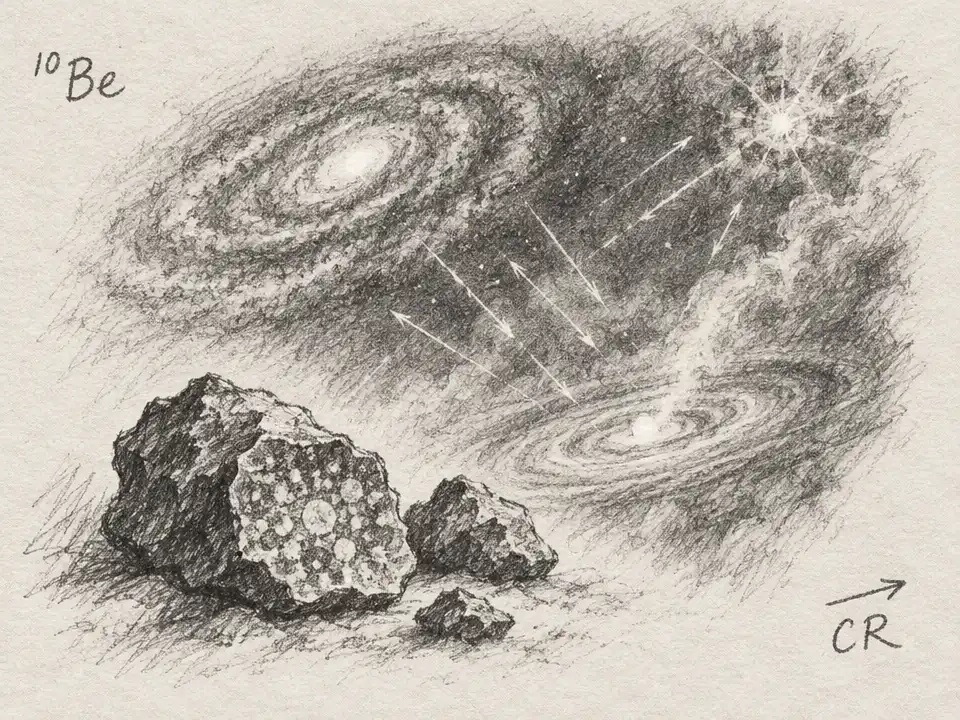
A meteorite can be a time capsule with a peculiar kind of ink: radioactive atoms made by cosmic rays. Locked into tiny, ancient mineral inclusions, those atoms may record not just the birth of the Solar System, but the energetic neighborhood in the Milky Way where the Sun took shape. A new set of galaxy-scale simulations suggests that one stubborn isotopic clue may not require a nearby cosmic catastrophe after all.
The clue is beryllium-10, an unstable form of beryllium with a half-life of 1.387 million years. Unlike some radioactive elements found in meteorites, it is not made inside stars. Instead, energetic cosmic rays smash into atoms such as carbon, nitrogen, and oxygen, breaking them into smaller pieces that can include beryllium-10. The isotope decays away quickly on cosmic timescales, so finding it in the earliest Solar System materials points to production not long before those materials formed.
That makes the meteorite record an intriguing puzzle. In almost 60 calcium-aluminum-rich inclusions—some of the oldest known solids in the Solar System—the starting ratio of beryllium-10 to stable beryllium-9 clusters around 7 × 10⁻⁴, with little variation beyond measurement uncertainty. If the young Sun itself had generated the isotope by irradiating its surrounding disk, the amount should have varied with distance from the Sun and over time. The observed consistency instead points toward beryllium-10 already mixed into the cloud that formed the Sun.
But the ordinary cosmic-ray background seemed too weak to explain the meteorites. Earlier estimates based on the average interstellar environment produced a ratio around 10−4—well below the value recorded in the inclusions. That shortfall encouraged alternatives: perhaps a nearby supernova remnant supplied extra cosmic rays, or the young Sun irradiated its disk. The challenge is to test the background explanation in a galaxy that has moving gas, star formation, supernovae, and cosmic rays that spread unevenly.
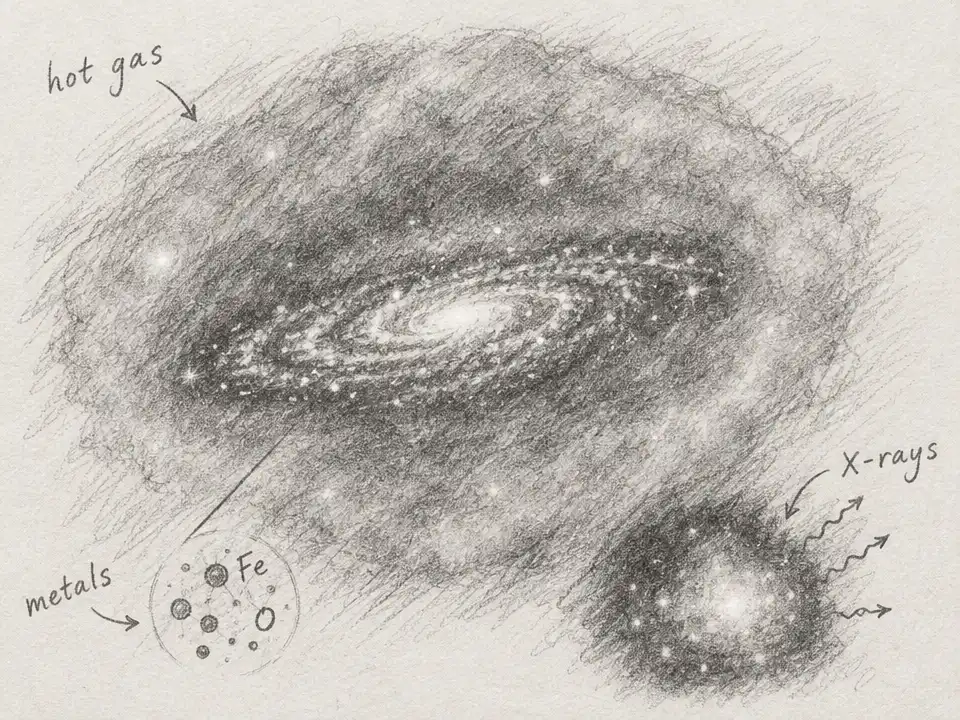
Yusuke Fujimoto and colleagues tackled that challenge with three-dimensional simulations of a Milky Way-like disk. Their model follows gas as it cools, gathers into star-forming regions, and responds to stellar feedback, while cosmic rays are injected by supernovae and diffuse through the galaxy. The researchers tracked where beryllium-10 is produced, how it moves with the gas, and how it decays. The finest regions of the simulation were resolved to 10 parsecs—small enough to distinguish star-forming neighborhoods from the broader galactic environment, though not the final collapse of an individual protostar.
The key insight is a matter of perspective. A typical point in the galaxy does not experience the same cosmic-ray environment as a place where a star is being born. Supernovae both supply cosmic rays and occur in regions where stars form. The gas that goes on to make new stars is therefore more likely to be near fresh cosmic-ray sources than the average gas in the disk. In one of the models, the beryllium-10 ratio inherited by new stars near the Sun’s present galactic radius is about five times the volume-weighted average there.
That local boost changes the accounting. Across the models, galactic cosmic rays—not beryllium-10 made inside supernova remnants—provide most of the isotope inherited by new stars. The supernova-remnant contribution ranges from below one percent to about ten percent, depending on the assumed cosmic-ray transport. The result offers a way for the background process to meet the meteoritic evidence: the relevant background is not a smooth, galaxy-wide average, but the cosmic-ray-rich gas in which stars actually form.
The team also tested a deliberately severe obstacle. Low-energy cosmic rays, which are especially important for making beryllium-10, may have trouble penetrating dense molecular clouds. In one sensitivity test, the researchers cut beryllium-10 production by a factor of ten in dense gas. Even then, the simulations could reach the meteoritic ratio in the inner galaxy; farther out, they fell short by only a factor of a few. The test strengthens the case that the cosmic-ray explanation can work, but it is not a direct simulation of how cosmic rays lose energy and move through every cloud.
Could the isotope then reveal the Sun’s original address? Not yet. To compare the simulations with the Solar System, the researchers allowed for a star-formation rate about twice today’s at the time the Sun formed, 4.6 billion years ago. That is a reasonable scenario explored in the paper, not a direct measurement of the ancient cosmic-ray environment. The inferred birth radius also shifts with the assumed cosmic-ray diffusion rate. Depending on the model, the meteoritic ratio fits a birth radius around 3–5 kiloparsecs, around 7–8 kiloparsecs, or—in the strongest dense-gas suppression test—around 2 kiloparsecs. One kiloparsec is about 3,260 light-years.
Those different answers are the price of turning a tiny isotope into a galactic compass. The simulation treats the cosmic-ray population in simplified fashion, rather than following the detailed energy spectrum of every particle. That matters because the particles that dominate the galaxy’s total cosmic-ray energy are not exactly the ones most effective at making beryllium-10. The model also leaves out some energy losses and cannot resolve the final stages when a collapsing cloud becomes isolated from the surrounding cosmic rays. Those uncertainties mainly weaken attempts to pinpoint the Sun’s birthplace, especially in the inner galaxy.
There is another reason to be precise about what this clue can—and cannot—tell us. Beryllium-10 is valuable here as a tracer of the cosmic-ray environment, not as a major heater of the early Solar System. The paper estimates its heating effect was about 10−5 that of aluminum-26, a different radioactive isotope found in early Solar System material. The two isotopes can preserve complementary information: one may trace the broader cosmic-ray conditions, while the other is more closely tied to local stellar activity.
The frontier is not a definitive map with a pin marking the Sun’s cradle. It is a more realistic way to read the chemical evidence: compare ancient grains with models that connect cosmic rays, star-forming gas, and the Milky Way’s evolving structure. If future work can better model how low-energy particles travel through dense clouds, the meteorites may help narrow the Sun’s birthplace and reconstruct the environment its first building blocks shared. For now, they point to a surprising possibility: the Solar System’s radioactive signature could be inherited from the ordinary, unevenly energetic life of the galaxy.