For years, one of the Milky Way’s most restless black holes seemed to disappear in the wrong order. Its X-rays faded behind a veil of gas, but its radio signal kept blazing—evidence that the hidden engine might still be feeding a powerful jet. Then the radio began to fade, too. Is GRS 1915+105 finally running out of steam, or has another layer of cosmic fog simply concealed the evidence?
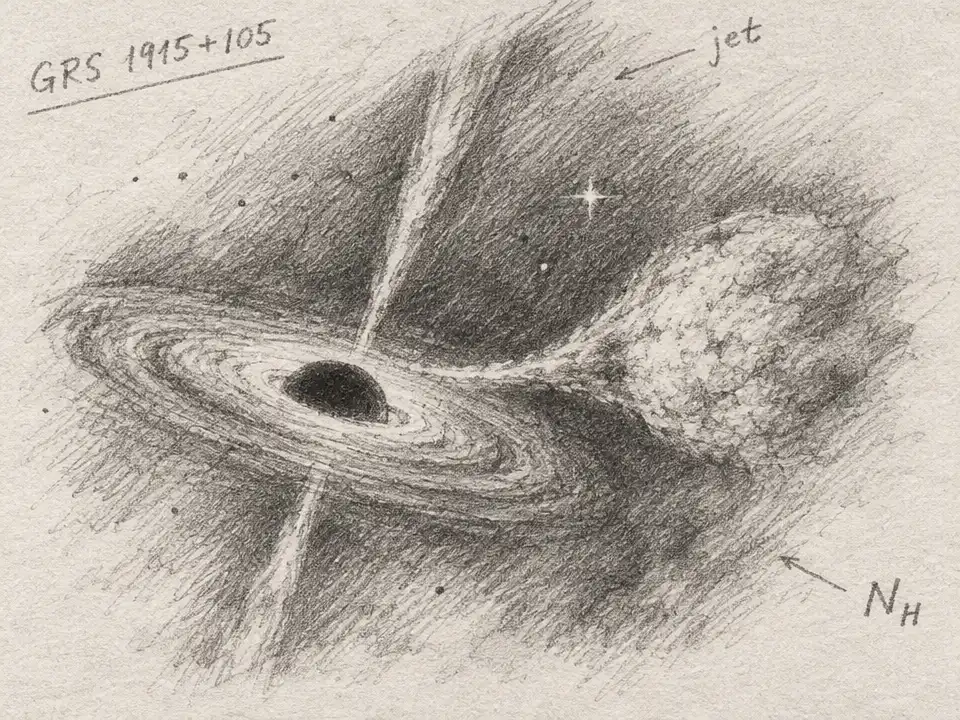
The system is a partnership between a black hole and an evolved giant star. Gas pulled from the star swirls into a disk before falling toward the black hole; some of that energy also powers jets that shine in radio waves. GRS 1915+105 first erupted in 1992 and stayed astonishingly active for decades, often near the maximum rate at which a black hole can radiate. Its 33.85-day orbit makes it an unusually spacious binary, with a large disk that can store fuel.
In 2019, the system entered a new, obscured phase. A dense screen of material along our line of sight absorbed much of its X-ray light. That made the usual view of the accretion flow—hot gas spiraling close to the black hole—hard to read. The radio offered a different clue. X-rays are readily absorbed by this sort of material; the radio signal from the jet is not. And GRS 1915+105 remained radio-bright, occasionally flaring to enormous levels. The simplest early reading was that the engine was still working behind the screen.
But a black hole’s fuel supply cannot stay inexhaustible. The new study assembles years of radio monitoring and follows the source through its latest decline. After a final flare in early 2025, the 1.28-gigahertz signal fell steadily: to about 1.1 millijanskys in October, roughly 0.55 millijanskys in January 2026, and about 0.2–0.4 millijanskys by March. After May 9, routine ten-minute observations no longer registered it.
A nondetection is not the same as a vanished source. To look deeper, the researchers used South Africa’s MeerKAT radio telescope for about eight hours in each of two frequency bands in July 2026. The signal reappeared, barely: about 150 microjanskys in the lower-frequency band and 90 microjanskys in the higher-frequency band. These were the faintest radio measurements ever recorded from the system. The source also showed no measurable change over the six-day observing campaign. The clue was not a sudden switch flipped off, but a long, remarkably steady dimming.
That trend matters because the chief rival explanation is still plausible at first glance: perhaps the black hole is as active as ever, but an even thicker absorber has hidden its X-rays. The all-sky X-ray monitors could not settle the question. Their last soft-X-ray detection came in April 2025 and their last hard-X-ray detection in September. Yet those measurements, too, were made through the obscuring material. By themselves, they cannot tell whether the engine weakened or the screen grew denser.
The radio decline breaks part of that tie. Since radio waves provide a view less affected by the X-ray-absorbing screen, their sustained fall is direct evidence that the central engine itself is fading, the team argues. To explain the missing X-rays with absorption alone, a fully covering screen would need to become extraordinarily thick—more than ten times the earlier effective column in one analysis cited by the authors. Such a screen should also reradiate energy in the infrared; the expected signal was not seen. A genuine drop in the engine’s power fits the clues more simply.
Other clues point toward a transition into quiescence, the low-activity phase between major outbursts. The July radio brightness is consistent with what astronomers see from quiet black-hole binaries with similar orbital periods. And models of GRS 1915+105’s disk predict that its long outburst could last roughly 20–100 years before the stored material is depleted. A 34-year run falls comfortably within that range. If the system has entered quiescence, models suggest the lull could last around 10,000 years.
Still, the radio signal carries a twist. The July measurements imply a steep radio spectrum, unlike the flat or slightly rising spectrum usually associated with a compact, actively fed jet. One explanation is that the radio glow comes mainly from older, expanding material ejected during the preceding activity. In other words, the telescope may be hearing the fading afterglow of the engine’s last busy period, not the engine itself. The data allow for a compact jet core beneath that glow, but do not require one; if present, it contributes no more than about 70 percent of the lower-frequency signal.
Nor does the X-ray silence provide a clean final answer. Einstein Probe observations in June, July, and August 2026 did not detect the source, but the researchers caution that the X-ray limit is tentative: the actual absorber could still hide a weak source. A relationship between radio and X-ray brightness suggests the hidden engine might retain some modest power, with substantial uncertainty. So the evidence favors a shutdown of the long outburst, not a definitive proof that every part of the system has gone quiet.
That distinction is the puzzle’s payoff. A black hole does not announce the end of an outburst with a visible curtain call. Astronomers have to infer it from traces that can linger, fade, or be blocked: the radio glow of a jet, the missing X-rays, and the expected behavior of a disk running short on fuel. GRS 1915+105 may be settling into a long sleep. If so, the rare chance to watch such a famously persistent system wind down is happening now—and the radio is the clue that let us notice.