A small galaxy can lose much of itself without looking much different. That is the unsettling possibility raised by a new study of the Milky Way’s satellite galaxies: some dwarfs that seem intact may have already shed stars into the space around them. The puzzle is that computer simulations predict more tidal destruction than astronomers have clearly seen. Are the missing signs hiding in the observations—or are the simulations taking apart too many galaxies?
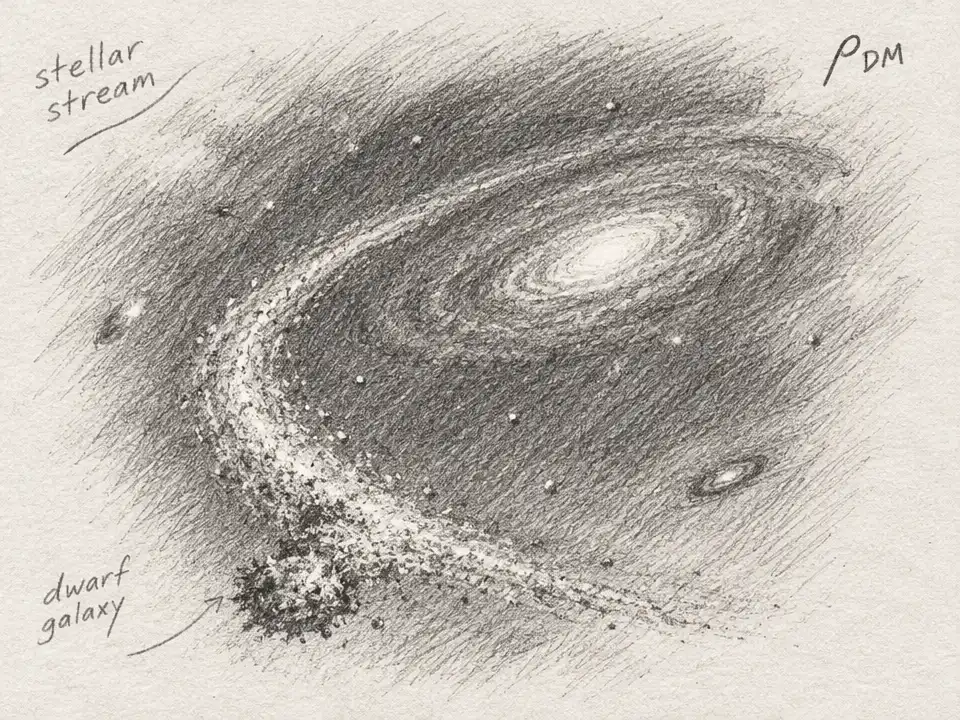
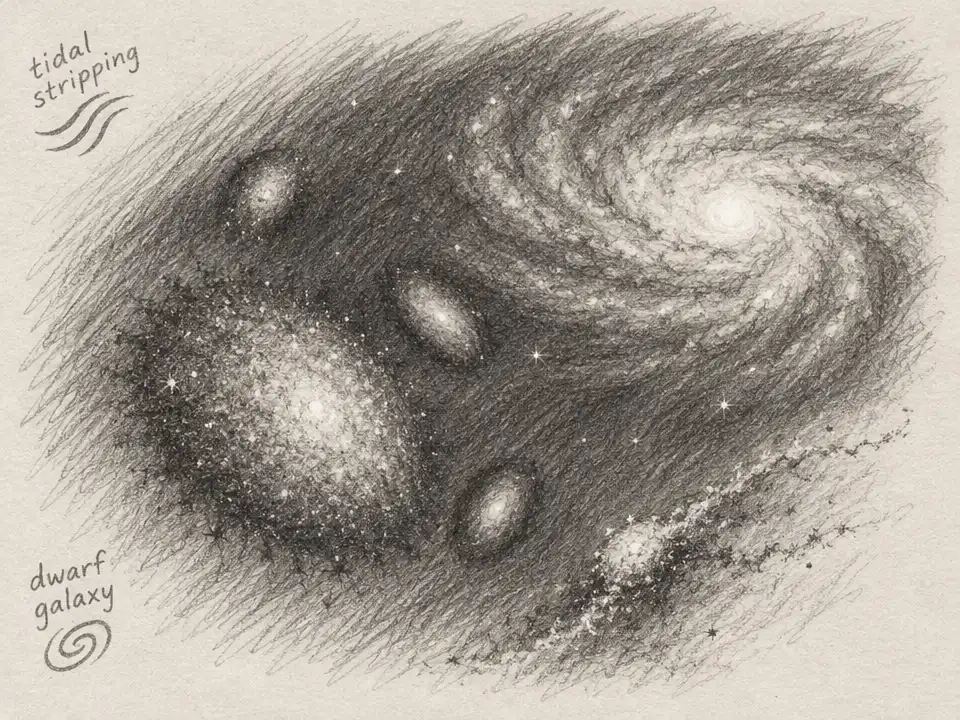
Tides offer a straightforward reason for a dwarf galaxy to come undone. As it orbits the Milky Way, the host galaxy’s gravity pulls unevenly across it. Stars near the dwarf’s outskirts are more vulnerable than stars near its center, and can be drawn away into faint streams or scattered debris. If enough stars escape, the satellite gradually becomes a remnant of its former self.
But streams are hard to spot. They can be spread across enormous areas of sky and fade into the foreground stars. So a lack of an obvious tail does not settle the question. Astronomers often look for other clues: a dwarf’s size, its shape, or whether its long axis points along its motion. If tides are stretching a galaxy, these seem like sensible things to check. The researchers, led by Gray Thoron, tested those clues against simulations where the galaxies’ histories are known.
The team examined 141 satellite galaxies in six Milky Way-mass hosts simulated with the Auriga project. In a simulation, researchers can distinguish stars still held by a dwarf’s own gravity from stars that have escaped. That gives them a record of how much each galaxy has lost—something astronomers cannot directly read from a photograph of a real one.
The first clues led to a dead end. In these simulations, a stripped dwarf can sit on the same relationship between size and remaining stellar mass as a smaller dwarf that was never heavily stripped. Tides do change a galaxy’s structure over time, but the changes do not track mass loss in a simple way. Many satellites first swell and later contract; the timing depends on their history. Take away that history, and a present-day size measurement cannot tell the whole story.
Shape fares no better. Some might expect a battered dwarf to look stretched, but the simulated galaxies generally become rounder after falling into their host, whether they lose many stars or few. A stretched shape, or one aligned with a galaxy’s motion, does not reliably identify a heavily stripped system. The clue that feels most obvious is not necessarily the most revealing.
Instead, the researchers looked farther out. They compared the stars in a broad outer zone—between three and ten times a dwarf’s half-light radius, the radius enclosing half its light—with those in the bright inner region. In the simulations, a larger share of stars in this outer zone tends to accompany a lower fraction of stars still bound to the satellite. The outer stars act like a faint record of the galaxy’s tidal encounters.
Even this clue needs careful reading. An undisturbed galaxy’s ordinary stellar profile can place stars in the outskirts, too; the paper estimates that a simple intact model would have about one-fifth as much mass in the outer zone as in the inner one. And galaxies with similar outer-star measurements can have quite different amounts of remaining bound material. The new measure, which the authors call the extended mass ratio, is a promising indicator across a population—not a reliable verdict on any single dwarf.
When the team compared the simulations with observations, all eight Milky Way satellites in their sample had extended-star counts that fell within the range seen among substantially disrupted simulated galaxies. That is intriguing, but the sample was chosen because these eight dwarfs already had detected stars at large distances. It is not a representative census of all Milky Way satellites. Nor can star counts alone prove that distant stars were stripped: some may belong to a bound stellar halo or may have arrived with a smaller companion galaxy.
So the original mismatch remains, with two explanations still on the table. Perhaps many Milky Way satellites are losing stars in ways that surveys have not yet revealed. Or perhaps the simulations overestimate how readily such galaxies are disrupted. The latter possibility is not a footnote: the simulated dwarfs are generally larger than observed Milky Way dwarfs at the same mass, and limited numerical resolution may affect their evolution. The researchers argue that either explanation deserves scrutiny, and both could contribute.
Resolving the puzzle matters beyond drawing better maps of faint stars. Astronomers use dwarf satellites to study galaxy formation and dark matter. If escaping stars are mistaken for stars still bound to a dwarf, measurements that assume the system is in equilibrium can be biased. But the paper does not claim that every such measurement is wrong; the size of the effect depends on each system and remains debated.
The next decisive clue will come from combining wide, deep surveys with measurements of stellar motion. A faint halo of stars might be bound, stripped, or a mixture; their velocities can help tell those stories apart. The authors stress that they cannot yet infer the disruption state of individual Milky Way dwarfs from the comparison. For now, the mystery is not whether tides can erase a satellite’s past, but whether the quiet-looking galaxies above our heads are carrying that history in stars we have only just begun to count.