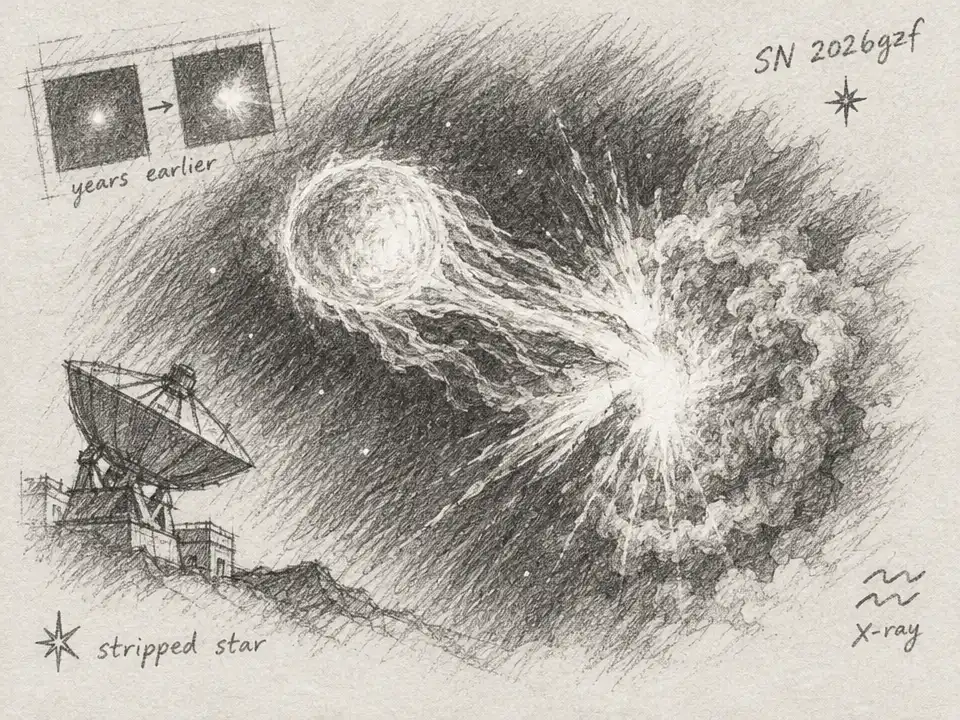
At 12:23 UTC on March 21, 2026, a space telescope caught a brief flash of soft X-rays from a nearby galaxy. Just 1.25 hours later, telescopes on Earth were watching the same patch of sky. A faint point of light was already brightening. In the hours that followed, it grew bluer and brighter—a star’s final act, observed almost as it began.
The explosion, named SN 2026gzf, turned out to be a broad-lined Type Ic supernova: the collapse of a massive star that had shed its outer layers of hydrogen and helium. But the first light posed a puzzle. The X-ray flash suggested the blast wave had met gas around the star. Then the early optical glow proved brighter than expected, hinting that the gas was doing more than merely surrounding the scene.
To work out what had happened, researchers had to follow two trails at once: the light arriving after the explosion and faint changes recorded in old images. The first trail began with the X-rays. The initial telescope exposure lasted only about 432 seconds before the spacecraft redirected itself to observe the new source. Follow-up measurements found a rapidly fading, very hot X-ray signal, consistent with a shock wave breaking out through surrounding material rather than emerging from the surface of a bare, compact star.
Ground-based observations caught the optical counterpart in the act of rising. Within about five hours, its brightness in one visible-light band had increased by roughly half a magnitude. The blue color and rapid rise marked a source still emerging from the high-energy flash. Later spectra identified the event as a supernova, but the early light still needed an explanation.
One familiar source of a supernova’s glow is radioactive nickel forged in the blast. As it decays, it helps power the later rise to the main peak. Models using that energy source fit the main light curve, but missed the first hours: SN 2026gzf was more than 1 magnitude brighter than expected. A different possibility, cooling of the outer layers heated by the shock, can add early light too. Yet for the compact stars that produce Type Ic supernovae, that glow is expected to fade quickly and remain faint.
The researchers tested a third clue: what if the expanding debris collided with gas shed by the star before it died? In their hydrodynamic model, interaction with about 0.02 M⊙ of surrounding material could supply the extra early light. The model placed that dense material out to about 3 × 1013 cm. If it had been moving at 1000 km s−1, as assumed for a Wolf-Rayet star wind, creating it would have required a mass-loss rate of about 2 M⊙ yr−1 in the final 3.5 days. That is no ordinary stellar wind. Something would have had to drive an extreme, short-lived outburst.
Then the archival images offered a clue from before the explosion. In data from the Pan-STARRS survey, the team examined 60 observations spanning 2015 to 2026. After subtracting a reference image to isolate changes, they found variable light at the supernova’s location over roughly 12 years. It did not beat with a clear period, making an ordinary regularly pulsing variable star a less convincing explanation.
The change was not simply a steady countdown. The source flickered, with several apparent brightenings. Averaged over the period from 12 to 3 years before the explosion, it had a brightness of about 22.8 in the broad w filter. During the final roughly 3 years, it averaged about 22.2—a change corresponding to an increase in luminosity by a factor of about 1.5. The position matched the later supernova. The persistent blue source there could be a compact star-forming region or a tiny unresolved galaxy, so the images do not show the progenitor in isolation. But the variability, location and lack of a convincing periodic signal point toward activity at the site before the star’s death.
Could the timing connect those old flares to the gas around the blast? The researchers note that years-long activity is broadly compatible with the oxygen-burning stage of a star of about 15 M⊙. They also raise a shorter, more speculative possibility: silicon burning in a similar star lasts about 18 days, and a mass-loss episode then might have put dense gas close enough to help produce the X-ray flash. The archival observations do not cover that final interval, so this is a proposed link, not a witnessed event.
Other clues may help test the picture. The paper estimates that some earlier eruptions could have formed shells farther out, which the expanding debris might encounter later. A radio signal detected 13.6 days after the X-ray flash falls near one predicted encounter time. But those shell locations and timings depend on assumptions about how fast the gas was moving; the authors caution that they are tentative. A jet-driven cocoon could also add energy to the early glow, though the analysis says dense surrounding material is still needed to explain the excess.
The puzzle is not entirely solved. A model can connect the X-ray flash, the unusually bright first-day light and years of pre-explosion variability—but it cannot yet reveal exactly what drove the star to shed its gas, or whether that sequence is common among stripped stars. What makes SN 2026gzf unusual is the chain of clues: a telescope caught the flash, observers saw the light rise within hours, and older images preserved a record of the troubled years before. The explosion did not erase its history; for once, the sky had kept enough of it to read.