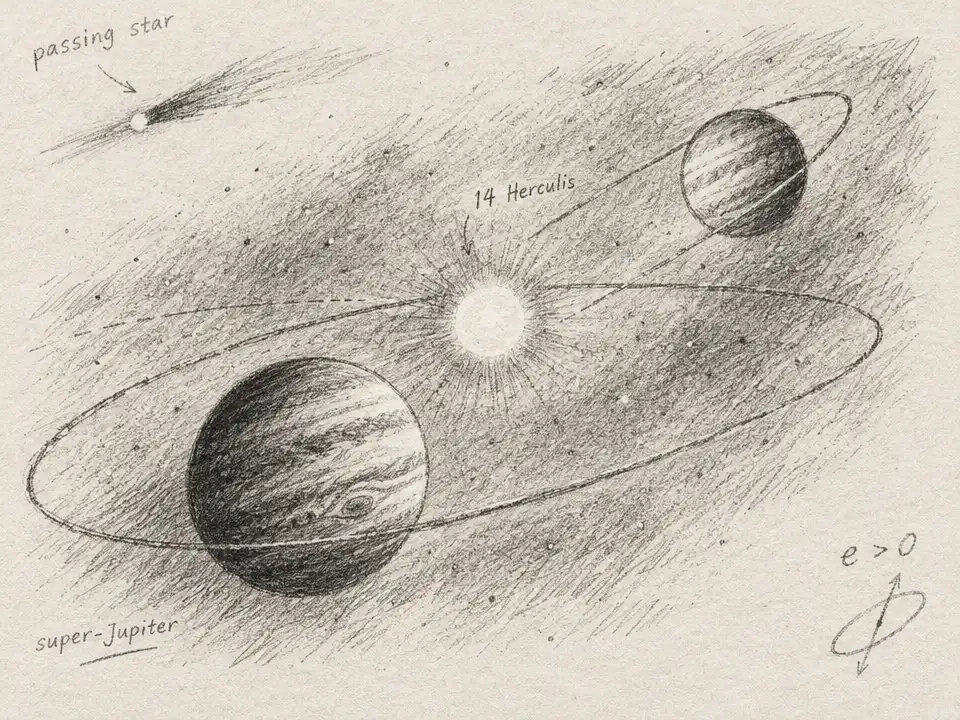
Imagine finding two enormous planets orbiting the same star—and discovering that their paths refuse to lie neatly in the same plane. That mismatch is the clue to a puzzle in the 14 Herculis system: how did its two surviving giants end up on such eccentric, tilted orbits? A new set of computer simulations suggests a startling answer. The system may once have had a third giant planet, which was flung away during a gravitational upheaval.
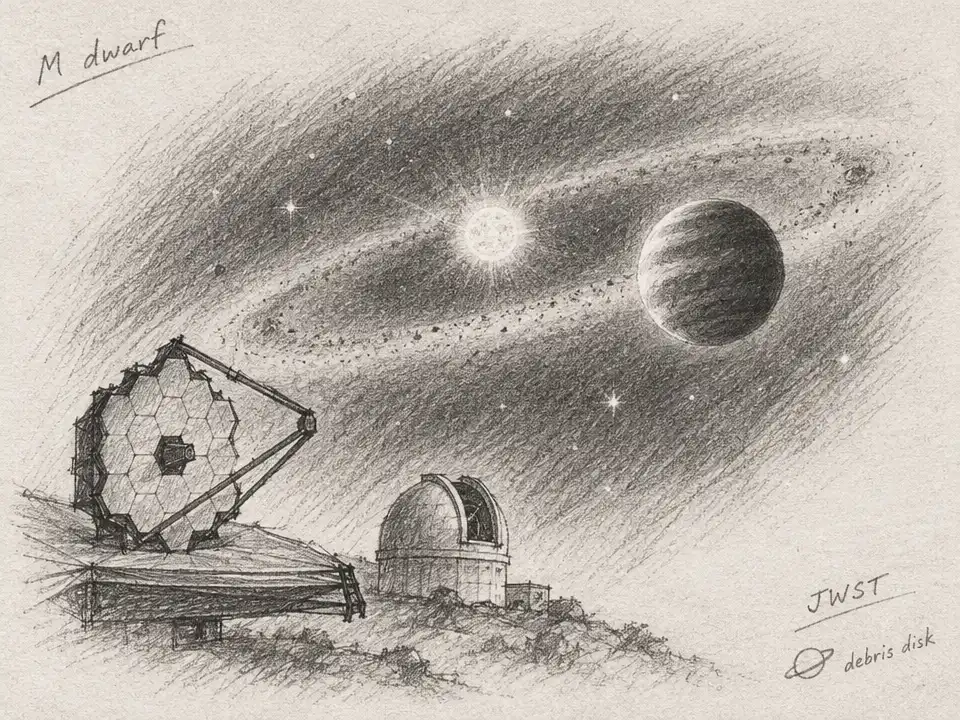
Fourteen Herculis is a near-solar-mass star about 17.9 parsecs away. Its inner planet, 14 Her b, was identified from the star’s recurring wobble; a much wider companion, 14 Her c, was later imaged with the James Webb Space Telescope. The current orbital estimates put their masses at 8.9 MJ and 7.9 MJ. Their paths are far from tidy: the inner planet’s semimajor axis is 2.839 au and its eccentricity is 0.3683; the outer planet’s semimajor axis is 20.0 au and its eccentricity is 0.52.
Those numbers describe planets that swing noticeably away from circular orbits. Their orbital planes also appear substantially misaligned. But the measurements leave two possible orientations: a prograde arrangement, in which the planets orbit in broadly the same direction, and a retrograde one, in which their motions are opposed. The uncertainty matters. Each version is a different clue about what might have disturbed the system.
The researchers began by asking whether the system can remain intact at all. They drew 10,000 possible orbital configurations from the published measurements and followed each one for 1 billion years. About 80% remained stable over that span. The close-to-perpendicular arrangements were trouble: none of the tested configurations with mutual inclinations between 75 and 105 degrees survived. That trimmed the puzzle, but it did not reveal how the planets got into their present positions.
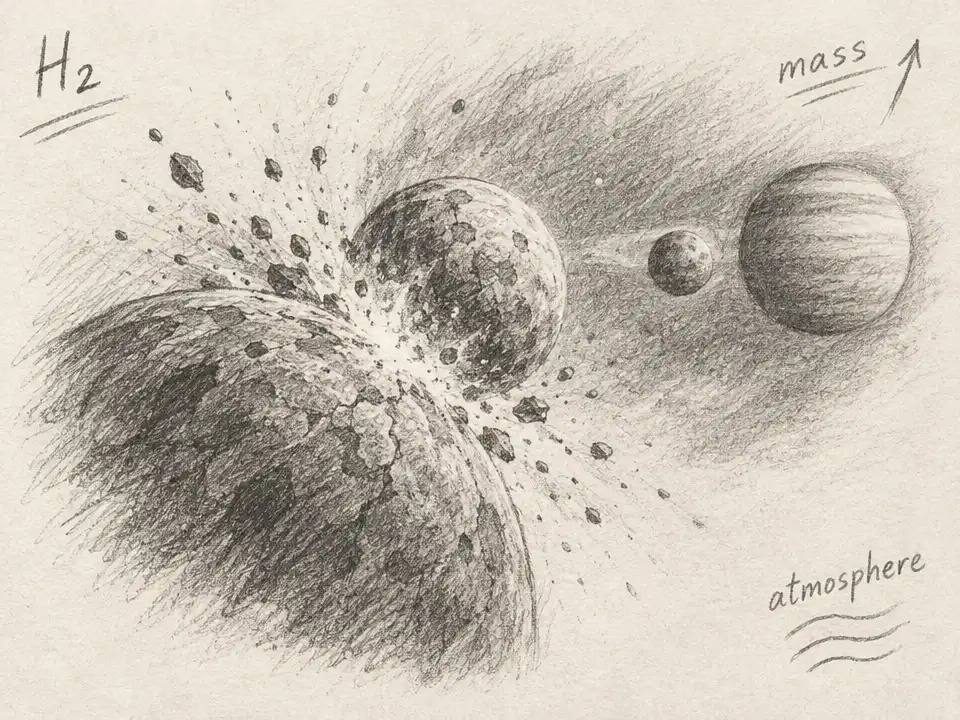
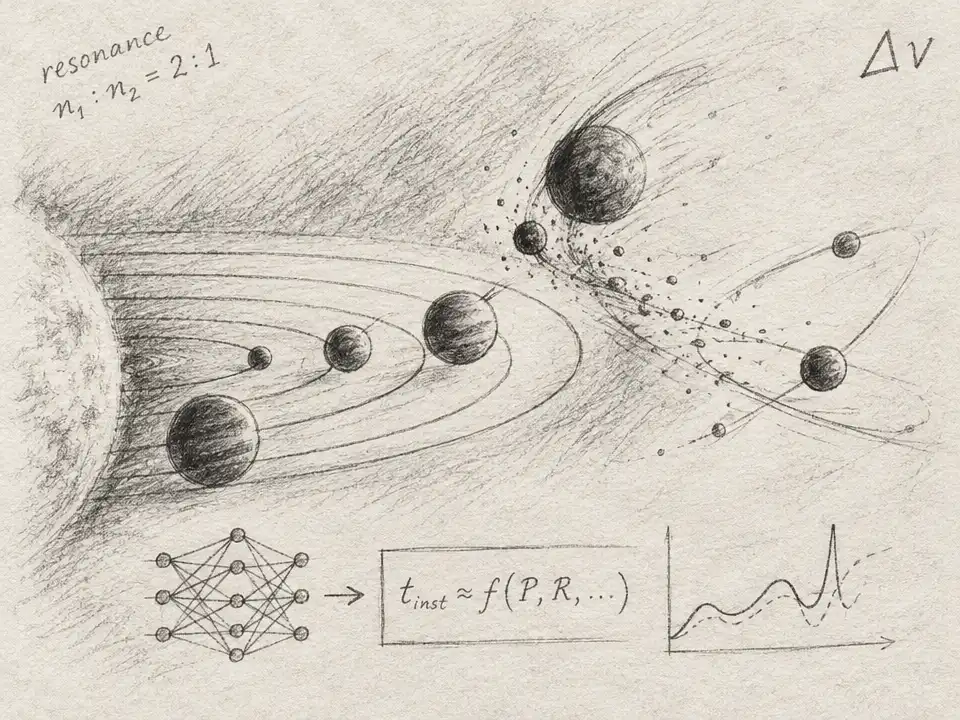
One plausible culprit is planet-planet scattering. In this process, giant planets repeatedly tug on one another until a close encounter changes their orbits dramatically. One planet can be thrown inward, collide with another, or escape the star altogether. The first test was spare: could the two planets alone have started on calmer paths and scattered into the system seen today?
That explanation hit a dead end. In the two-planet simulations, 81.4% ended with an ejection and 18.2% with a collision. Just 0.4% kept both planets. Of those survivors, none matched the observed system within the researchers’ 1-sigma comparison; only one matched at the 2-sigma level. Two planets could, in principle, scatter and survive, but the tested histories almost never produced the particular pair of orbits astronomers now see.
So the team added a third planet to the starting lineup. The best-fitting histories now had another substantial body among the original planets. After gravitational encounters, one world escaped, leaving two survivors on eccentric and misaligned paths. The simulations favored an ejected planet less massive than either present-day giant, but not a lightweight: the extra planet had to be a significant fraction of their mass. The authors estimate that the system’s original planets together carried about 10–30 Jupiter masses.
There is a complication. The simulations could reproduce the prograde version of the system, but none matched the retrograde family at the 2-sigma level. If the planets really follow the retrograde arrangement, the proposed scattering history may not be the right answer. The researchers also tested whether a passing star could have stirred up the system instead. Under their assumptions—a local stellar density of about 0.1 stars per cubic parsec and encounter speeds of 50 kilometers per second—the chance of a close pass within about 50 au over the system’s lifetime is below 0.1%. They therefore disfavor a flyby as the explanation, while noting that a more detailed study of the star’s motion is still needed.
The proposed escape is not a sighting. No one has found a runaway planet connected to 14 Herculis; its existence is inferred from which simulated histories can reproduce the survivors. And the calculation tests a particular story, not every imaginable one. The authors did not model every possible starting arrangement, and they acknowledge that two-planet scattering might happen rarely rather than never.
The next key clue may come from Gaia. Future time-series measurements are expected to distinguish the two possible orbital orientations. If they favor the prograde solution, the case for a lost giant will strengthen. If they reveal a retrograde system, astronomers will need another explanation. Either way, 14 Herculis offers a rare chance to read a planetary system as a crime scene: the orbiting giants are still there, while the strongest suspect may have long since left the neighborhood.