CZ Tucanae looks like an ordinary red giant: a cool, swollen star about 1.26 kiloparsecs away, in the direction of the Small Magellanic Cloud. But its light carries a stubborn riddle. The star brightens and fades on a cycle lasting more than a year, then shows a second, faster pulse. Why should those two rhythms fit together so neatly?
The long cycle belongs to a class of changes called long secondary periods, or LSPs. About 30 percent of pulsating red giants show them, yet decades of study have not settled what causes them. The leading ideas point in very different directions: unusual motions in a star’s turbulent outer layers, giant convective cells shifting across its surface, dust forming unevenly as the star sheds material, or a companion dragging a cloud of dust around with it. Each offers part of the story. None explains the full population.
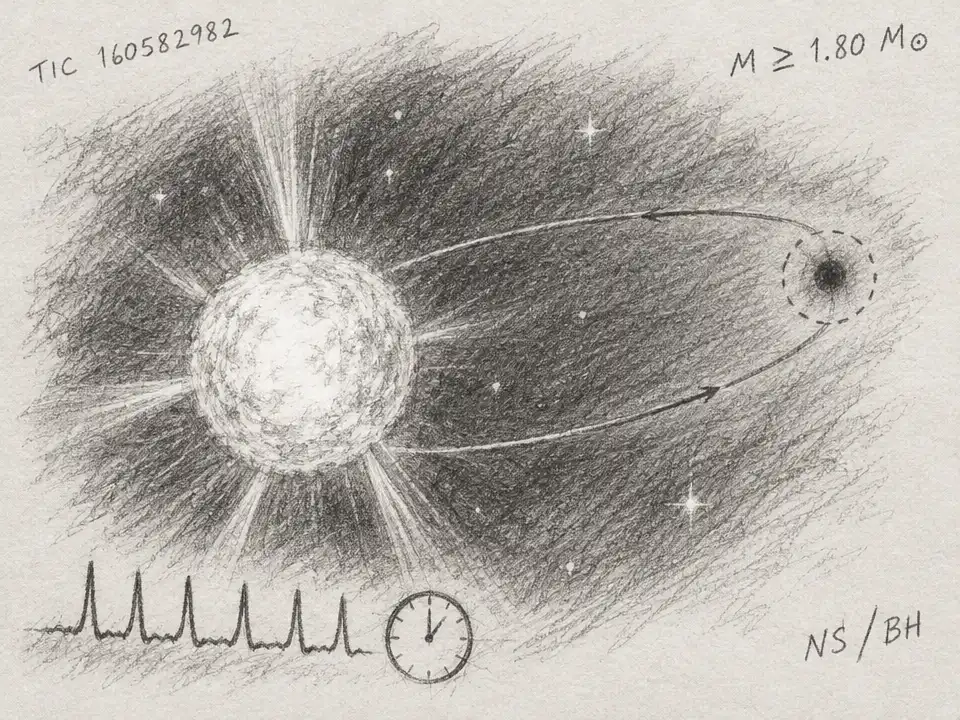
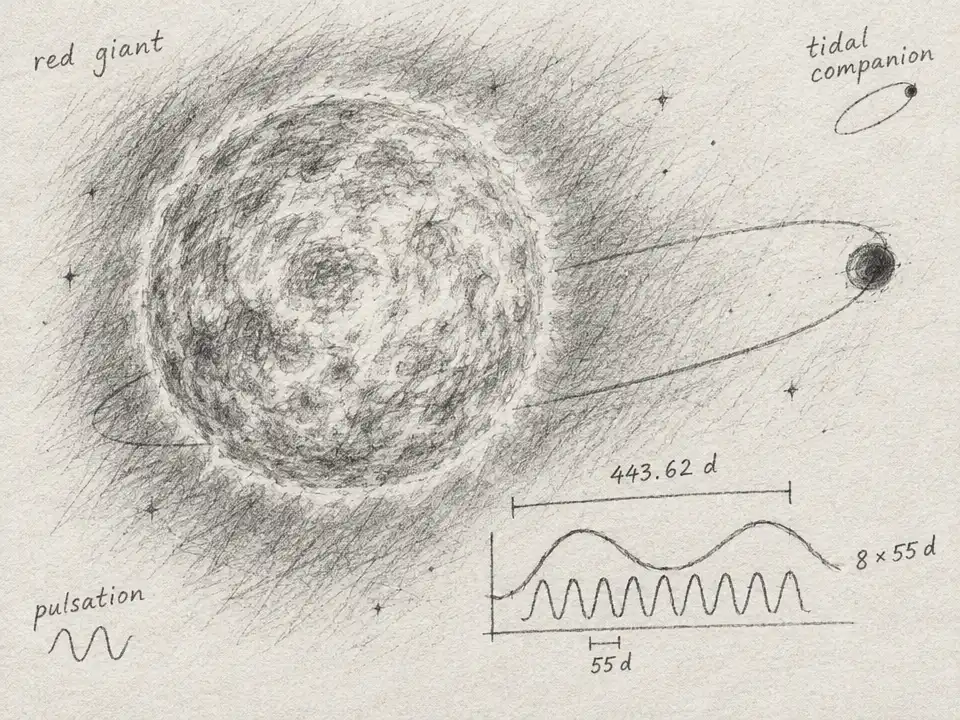
The companion idea makes a testable prediction. If an unseen object travels around a red giant on an eccentric orbit, its changing gravitational pull could periodically stir the star itself. The result would be a tidally excited oscillation: a genuine pulse in the star, driven by the orbiting partner. Unlike an ordinary, self-generated stellar pulse, its frequency should fall at an exact whole-number multiple of the orbital frequency. Find that precise musical relationship, and a supposedly solitary giant may have given away its companion.
To look for this clue, astronomers Piotr A. Kołaczek-Szymański and colleagues assembled a light record spanning about 80 years. They combined measurements from Harvard’s digitized photographic plates, the Hipparcos satellite, and the All Sky Automated Survey. It is not one seamless movie: the historical plates are noisy, and the long cycle is clearly visible in only a stretch from 1944 to 1950. But, together, the usable records cover roughly 66 repeats of the long cycle, giving the researchers the long baseline needed to measure its timing closely.
The first clock runs for 443.62 days, with an uncertainty of 0.12 days. After accounting for that slow variation, the researchers found another pulse: 55.4734 days, with an uncertainty of 0.0074 days. The long period is 7.9970 times the shorter one, with an uncertainty of 0.0024. In other words, the giant’s faster pulse repeats almost exactly eight times per long cycle. That is the pattern a tidal beat would leave if the long cycle is also the companion’s orbital period.
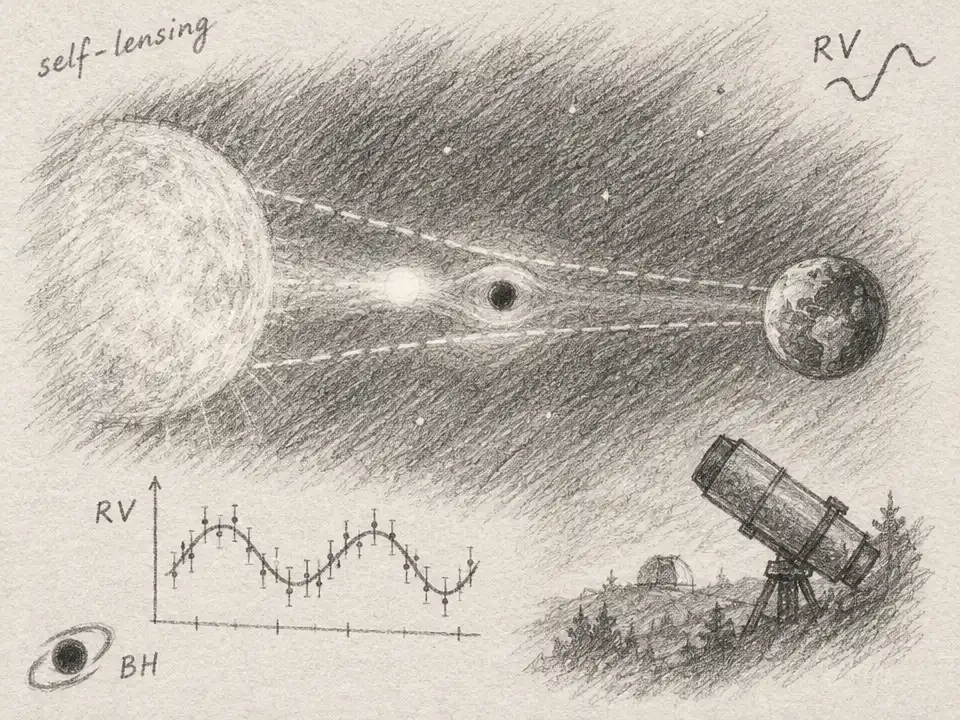
The fit is striking, but it is not a verdict. Under the assumptions used for their estimate, the authors judge a chance match to be only a few chances in a thousand. That makes coincidence less attractive, not impossible. And there is another clue: the Gaia mission measured changes in the star’s speed toward and away from Earth. A model that fixes the orbit to the 443.62-day period fits those measurements with an eccentric orbit, meaning the separation between the star and its possible companion would vary over time.
That speed data does not reveal the companion directly. The orbit was fitted using the period already identified in the brightness record, so it supports the binary interpretation without independently proving it. Under an assumed red-giant mass of one Sun, the fit gives a minimum companion mass of about 0.08 solar masses and an estimated orbital eccentricity of 0.31, with an uncertainty of about 0.11 to 0.12. The authors also modeled how a companion’s tides could excite a pulse of the observed size. A one-solar-mass red-giant model can produce the candidate eight-beat oscillation; a more massive model does not fit it in the same way.
Then comes the dead end that keeps the puzzle alive. Red giants can pulse on their own. In the models, an ordinary self-excited oscillation can occur at a similar frequency to the proposed tidal pulse. The researchers cannot rule out that explanation, and the predicted tidal response depends on details of the star that are not yet well pinned down. The 55-day signal is therefore a candidate tidally excited oscillation, not a confirmed one.
CZ Tuc may not be alone in the pattern. In a preliminary scan of 8,904 long-secondary-period stars in the Magellanic Clouds, the team found 283 with a pulse-to-cycle ratio close to a whole number under their selection criteria. That is a reason to look harder, not evidence that all 283 have companions: the authors estimate that chance alignments could account for as much as 2 percent of the sample, and the catalog search is not a confirmation of individual systems.
The next step is to test more stars and improve the physical models, while gathering observations that can distinguish a companion-driven pulse from one the giant generates itself. If similar locked rhythms turn up across a larger sample, astronomers could gain an independent way to test whether companions explain long secondary periods in at least some red giants. For now, CZ Tuc’s paired clocks leave investigators with a precise clue and an open question: is the star ringing on its own, or is an unseen partner keeping time?