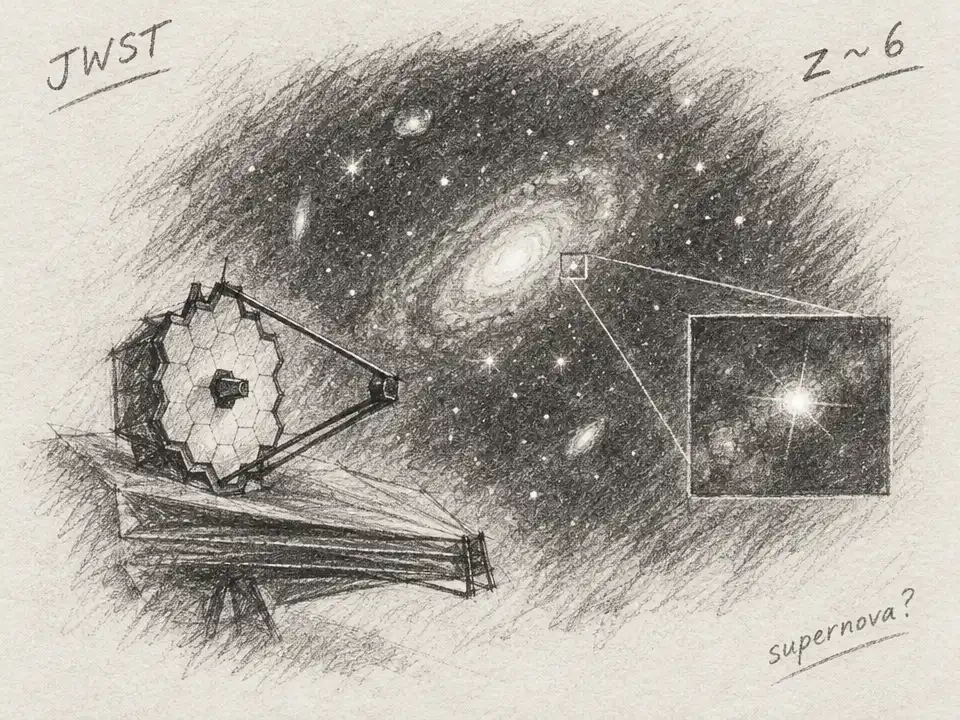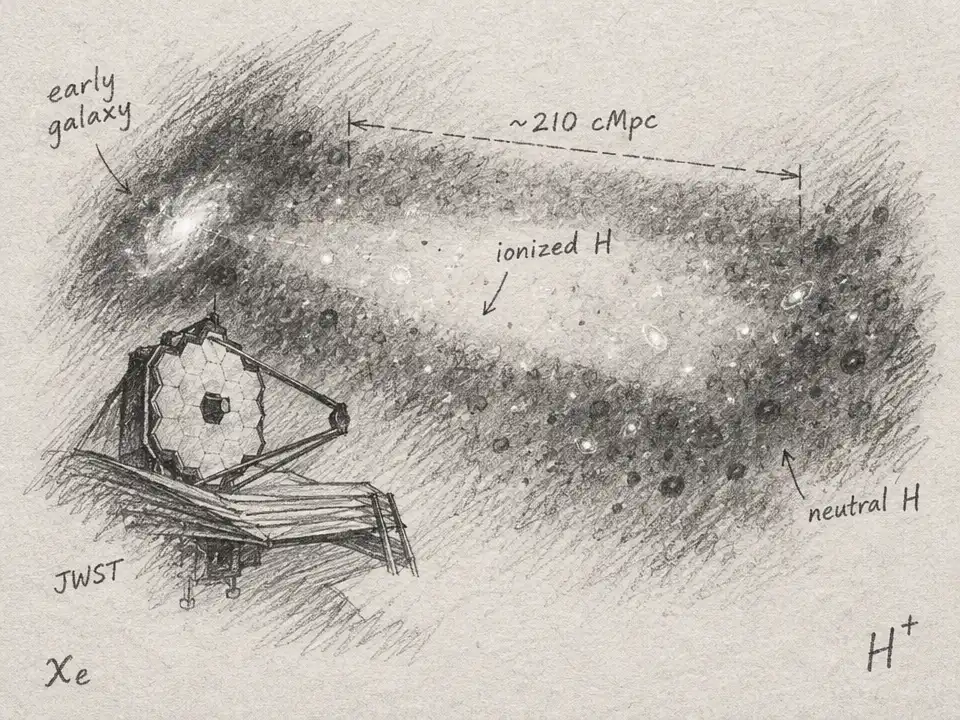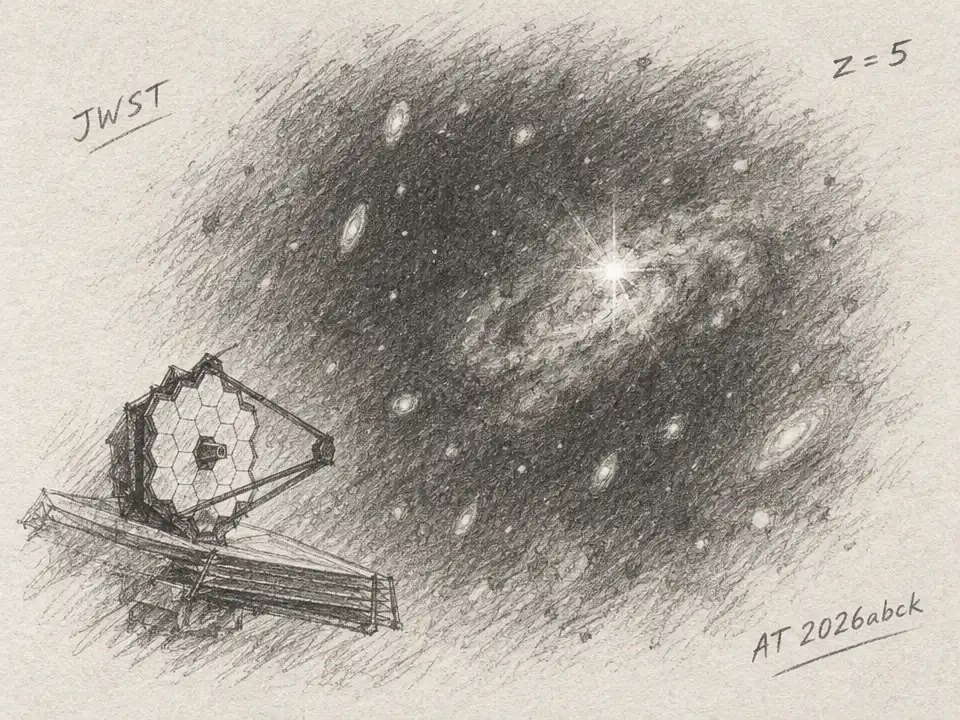
On 2026 May 28, a patch of sky in a distant galaxy looked quiet. By August 7, a new point of light had appeared there—so far away that the galaxy’s redshift was measured as 5.017 ± 0.001. The James Webb Space Telescope had caught a stellar explosion in an unlensed field, without the natural magnification of a foreground galaxy cluster. Then the light itself raised a puzzle: this possible supernova was hotter and more luminous than astronomers expected for an ordinary young explosion.
The object, named AT 2026abck, was first found in images from NEXUS, a JWST survey that revisits part of the sky on a regular schedule. That timing mattered. The new source was absent in a May image, then bright in August. In the galaxy’s own frame, the observations were about 11.8 days apart. By the later image, AT 2026abck had brightened by more than 1.4 magnitudes in one infrared filter—more than a 3.6-fold increase in brightness.
At redshift 5, the expanding universe stretches a source’s light on its long journey to us. The JWST filters therefore sampled ultraviolet and visible light as it would have been emitted near the object, not the infrared wavelengths we observed. Across three filters, the transient’s brightness was nearly level. A fourth filter failed to detect it, setting a useful limit on how much longer-wavelength light it could be emitting. Together, those measurements gave researchers a rough color and temperature, even though they had only one epoch of detections.
The team fitted the measured light with a simple model: a hot, glowing sphere. It yielded a temperature of about 1.7 × 10⁴ K and a radius of 7.0 × 1014 cm, or 46 ± 9 au. The inferred luminosity was 3.1 × 1043 erg s−1. These are estimates, not a direct photograph of a spherical surface; the model is a practical way to interpret a few points of light. Still, the result put AT 2026abck at the extreme bright and hot end of known young Type II supernovae.
Why call it a supernova candidate rather than a confirmed supernova? Its position offers an important clue. The light appeared between two components of its host galaxy, about 1.1 kiloparsecs from the brighter component’s center. That makes activity from the galaxy’s central black hole a poorer fit than an explosion away from the center. The host’s spectrum also established the galaxy’s redshift through its hydrogen-alpha and doubly ionized oxygen emission. But the transient itself has not yet been classified by a spectrum, and one set of colors cannot settle its identity.
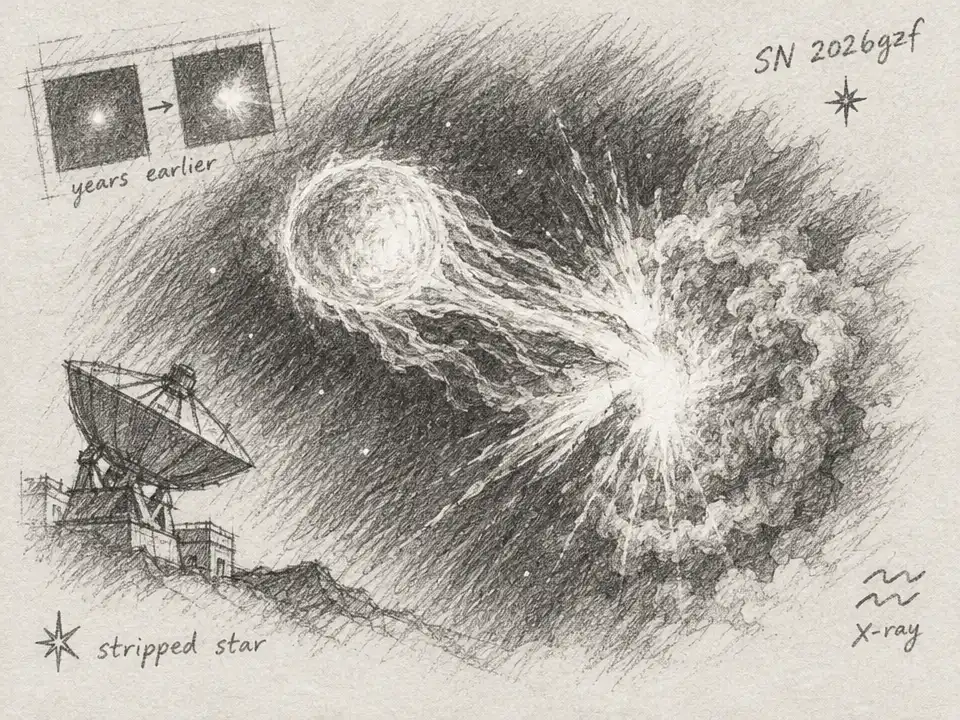
A core-collapse supernova is the leading explanation: the death of a massive star, whose core collapses while its outer layers are blasted outward. Yet this event does not look quite like the standard early script. In a sample of 34 Type II supernovae with early ultraviolet observations, none reached a luminosity as high as AT 2026abck’s at four or more days after explosion. Its temperature is also unusually high for a source that may already be several days old. The closest comparison was itself near the top of the ordinary Type II range.
That mismatch hints that the explosion may have had an extra source of early light. One possibility is shock cooling: the blast heats an extended envelope around the star, and that material glows as it expands and cools. Another is interaction with circumstellar material—the gas a star shed before it died. When fast-moving debris slams into that gas, the collision can add heat and light. The observations do not distinguish between these ideas. A superluminous supernova caught while still brightening also remains possible, as do some less common interaction-powered explosions.
The dates help narrow the possibilities. The source’s non-detection on May 28 means that it brightened substantially within about 11.8 days in its own frame. Meanwhile, the size inferred from its light suggests that its photosphere—the layer from which the light escapes—had already expanded considerably. Combining the timing, size, and temperature, the researchers estimate that JWST saw it about 4–10 rest-frame days after the explosion. The younger end fits an interpretation dominated by shock cooling; a collision with surrounding gas could keep the source bright nearer its peak.
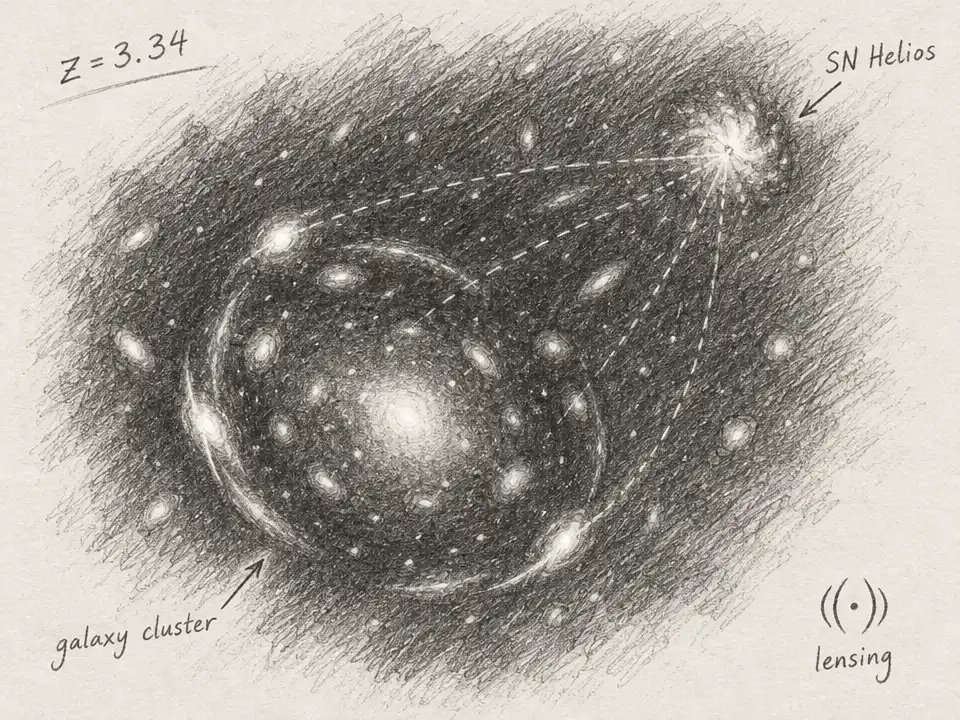
There is a larger surprise in how the event was found. Before AT 2026abck, the confirmed supernova known at roughly this redshift had been discovered with help from strong gravitational lensing, which magnified its light. This candidate was found without that boost. Its host is also a very different kind of home: a vigorously star-forming galaxy with an estimated stellar mass of about 109.8 solar masses. Compared with the much smaller host of the earlier lensed event, the two discoveries suggest that stellar explosions at these distances can occur across a wide range of galactic environments.
For now, the most useful instrument may be patience. If AT 2026abck is an ordinary Type II supernova, its ultraviolet light should fade quickly as the expanding surface cools, while longer-wavelength light settles into a plateau. A superluminous event could keep brightening across several filters; sustained interaction with surrounding gas could keep it hot for longer. Follow-up observations can test those competing predictions and may reveal whether a star’s extended outer layers—or the material it lost before death—powered the unexpected glow. The first clue was a point of light that should have been difficult to catch. The next is how it changes.