Imagine trying to read the fine print on a distant sign through a lens that smears every letter. That is the predicament of far-infrared astronomy: the light carries clues about star formation and planet-building, but its long wavelengths make details hard to separate. At 100 micrometers, achieving a sharpness of 0.1 arcsecond with a conventional telescope would require a mirror about 250 meters across. No one is proposing a mirror that size. Instead, researchers are testing a way to make two separated openings work together as one instrument—and to keep the far-infrared’s spectral information while sharpening its view.
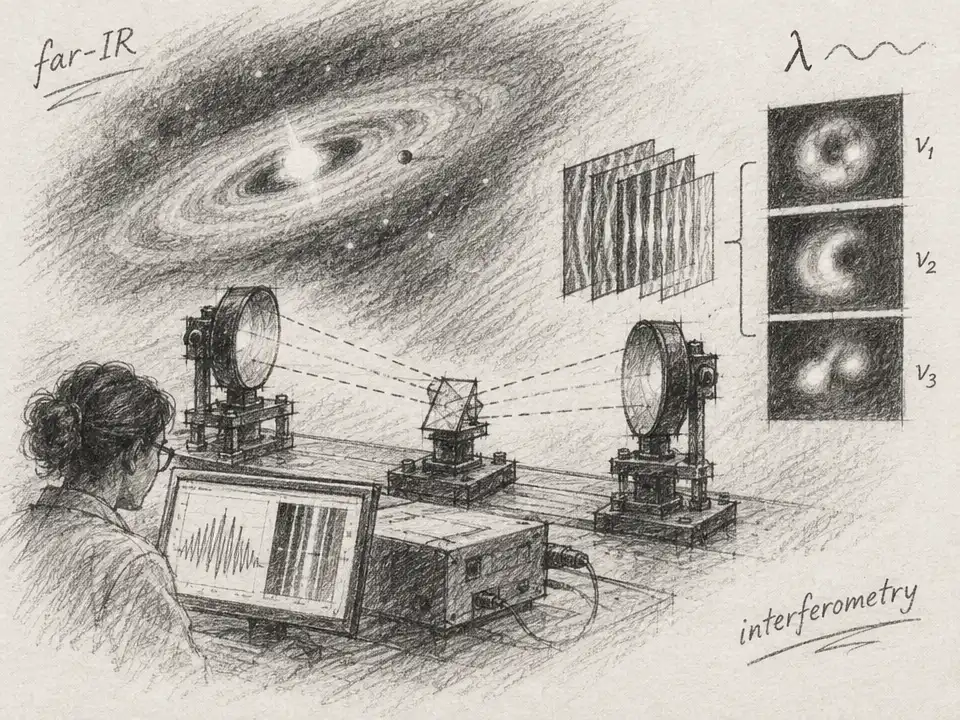
The idea is a double-Fourier interferometer, or DFI. It joins two familiar strategies. First, an interferometer combines light collected at two apertures; the distance between them, called the baseline, helps set the scale of detail the system can resolve. Second, a Fourier-transform spectrometer scans the difference in the light’s travel paths. The resulting pattern of brightening and dimming can be decoded into the source’s spectrum. Put together, those measurements can reveal not just where light comes from, but how its spectrum varies across the scene.
That combination has been proposed for future far-infrared observatories, but key capabilities had not all been demonstrated together. In a new laboratory study, researchers tested them on a bench-top instrument using a broadband range from 0.3 to 2.1 THz. Its two apertures were small, movable mirrors, with their separation adjustable from 135 to 310 millimeters. Another moving assembly changed the difference in the beams’ optical paths. The target was not a star or disk, but a lighted mask with carefully chosen slits: a controllable stand-in for a distant scene.
The first challenge was to see whether the instrument could distinguish shapes too close together for a single detector to resolve. The team observed a pair of slits of different widths, separated by 5 millimeters. Direct imaging would blend their light together on one detector. By combining measurements taken at different baselines, the DFI reconstructed the pair’s widths and relative positions. The reconstructed geometry was not a perfect copy of the mask: perspective made the slits appear narrower to the instrument. But accounting for that effect brought the model and measurements into substantial agreement.
Then came a test of the feature that makes the design more than a sharper camera. The researchers placed a low-pass filter over one slit. Below the filter’s cutoff, at about 1.0 THz, both slits contributed light. Above it, the filtered slit faded, and the scene appeared to contain only one. The DFI’s separate reconstructions reflected that change. In other words, the apparent shape of the target depended on which frequencies the instrument examined—a small laboratory demonstration of how a future telescope could map structure and spectral differences together.
The team also tested how to widen the view. A single detector sees only part of the source plane, so the researchers combined measurements from two detector pixels aimed at different regions. Together, the pixels captured a pair of slits too widely separated to fit in one detector’s view. The resulting image recovered their arrangement, though it also showed a practical complication: the off-axis scene was distorted. The authors trace that distortion to optical aberrations in the testbed, rather than to a fundamental limit of the technique.
To build a two-dimensional picture, the instrument had to sample the target from more than one direction. The researchers rotated the mask and changed the baseline orientation, much as changing the angle of a flashlight reveals the shape of an object from another side. The reconstruction captured the slits’ widths, orientations, and relative positions, but not their lengths. More complete sampling could help; in this experiment, limited signal and the precision needed to track the rotating mask made that harder.
Those limitations matter. The experiment was performed in a laboratory, not on the sky, and its reconstructed images were preliminary rather than finished astronomical pictures. The team also found that agreement with predictions weakened at high spatial frequencies, where maintaining alignment and coherence becomes more demanding. They developed calibration steps to correct phase errors and other instrumental effects, but wide-field distortions and imperfect optics remain issues to address. The test establishes capabilities, not a ready-to-launch observatory.
Still, the demonstration tackles a genuine trade-off. Far-infrared light contains spectral features useful for investigating star-forming regions and protoplanetary systems, yet ordinary mirrors struggle to resolve fine structure at those wavelengths. A DFI aims to preserve the spectrum while recovering detail from the combined light of separated apertures. If the approach can be developed for space, astronomers could get a more finely resolved view of cosmic environments where stars and planets take shape. For now, the important result is on the laboratory bench: two small openings, carefully synchronized, can reveal structure a single detector would blur away.