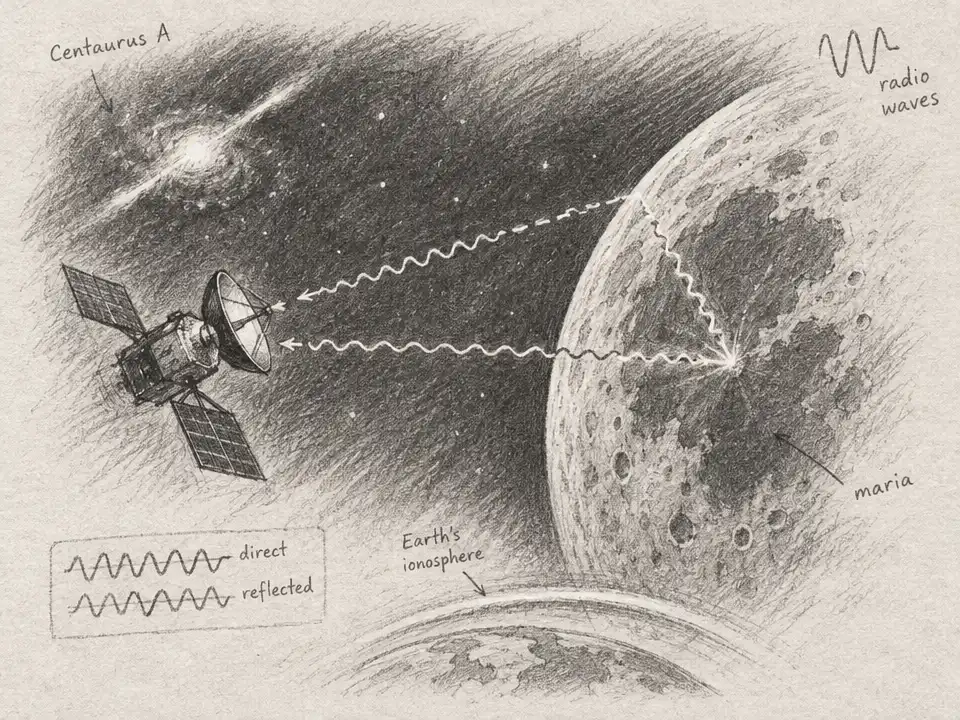
Below about 5–10 MHz, Earth’s ionosphere acts like a door that won’t open. Radio waves in this range struggle to reach the ground, leaving astronomers unable to observe much of a poorly explored slice of the sky from Earth. Moving a telescope into space seems like the obvious fix. But there is a catch: Earth’s own radio transmissions can leak through that same atmospheric shield and follow the telescope upward.
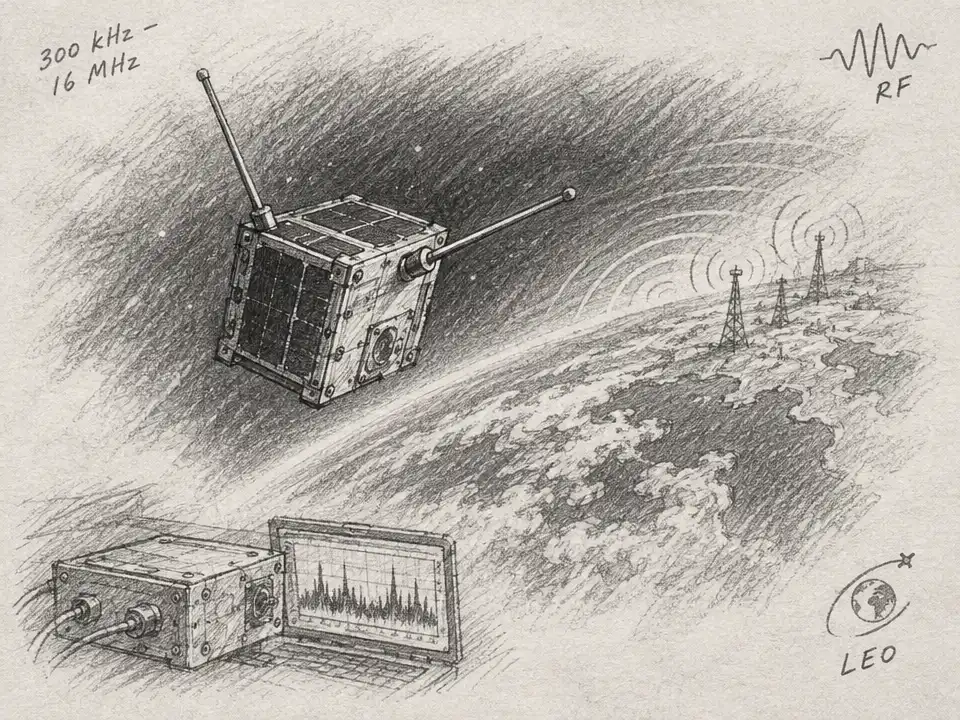
A proposed mission called SEAMS takes that problem as its starting point. Instead of leaping straight to a lunar observatory, its first phase would place a compact radio receiver in low Earth orbit and map the interference rising from Earth. The aim is practical: learn where, when, and at what frequencies the planet’s radio noise gets in the way, so future instruments can be designed with the real conditions in mind.
The need is not merely hypothetical. Earlier space missions detected human-made radio signals far above the atmosphere, including at lunar distances. In the frequency range SEAMS is designed to study, estimates based on earlier measurements suggest short-wave interference in low Earth orbit could reach 50–65 decibels above the Milky Way’s radio background. That background is itself a persistent wash of radio emission from our galaxy. A signal that much stronger can overwhelm the faint celestial patterns a radio astronomer hopes to measure.
SEAMS would ride on the fourth stage of India’s Polar Satellite Launch Vehicle, which is expected to remain in orbit for several weeks. At an altitude of about 475 kilometers, the stage would carry the receiver around Earth. As its orbit shifts over time, the instrument could sample interference from different parts of the globe and build a broad map. The first phase is not designed to deliver a detailed picture of the distant universe. It is a reconnaissance mission for the radio environment that future space telescopes will have to work through.
The hardware reflects that modest but demanding assignment. Two two-meter-long antennas, set at right angles, would measure the electric field in two orientations. At these long radio wavelengths, a conventional resonant antenna could stretch hundreds of meters or even kilometers—an unwieldy structure to fold into a launch vehicle. SEAMS instead uses short, electrically small antennas paired with electronics that help connect their weak signals to the receiver. The antennas are designed to fold into a compact package and spring open after reaching orbit.
That deployment has its own small drama of engineering. The antennas use a flexible stainless-steel profile that can be stowed and then stiffen when released. A nichrome-wire cutter is designed to free the folded antenna on command. Ground measurements found that about 23 newtons of force are needed to keep the antenna stowed. The team also tested the mechanism on a vibration shaker, checking how it responds to the shaking a payload can encounter during launch. In space, a two-meter antenna must unfold reliably without shaking the much larger launch-stage structure enough to cause trouble.
Once a signal reaches the antennas, it has to be separated into frequencies and recorded without the receiver adding too much noise of its own. SEAMS’s digital receiver samples the incoming signals and uses a fast Fourier transform to break them into frequency channels. Its planned resolution is about 16 kilohertz, across an operating range of 300 kilohertz to 16 megahertz. In its average-power mode, the receiver combines measurements over about 250 milliseconds, producing a manageable data packet for onboard storage.
Keeping the data manageable matters. The system has a one-gigabyte onboard flash memory, and at the described data rate it can operate continuously for about 45 minutes before filling that storage. The receiver also has modes that save raw samples or more detailed frequency information, which can support later analysis. This is a deliberate tradeoff: recording every detail all the time would quickly consume the available memory, while averaging helps reveal persistent signals and reduces the volume of data to send back.
Testing the instrument on Earth exposed a problem that could have masqueraded as a signal from space. Switching electronics in the digital receiver were coupling into the sampling system, creating unwanted features across several frequencies. The team changed the circuit-board layout and shielded the switching components, which substantially improved the receiver’s noise floor. The episode illustrates a central difficulty in radio astronomy: the instrument can generate the very interference it is meant to measure. A careful map from orbit is only useful if the spacecraft’s own electronics do not dominate it.
The team also carried the receiver into different radio environments. Near the university campus in Pune, it picked up a strong 792-kilohertz broadcast from a transmitter about 14 kilometers away. At a rural test site near Dapoli, roughly 110 kilometers from the campus, that medium-wave signal was no longer detected, though short-wave transmissions remained visible. In Svalbard, the receiver recorded a frequency sweep from an ionosonde, a device used to study the ionosphere. These were ground tests, not measurements from orbit, and the gain was reduced during some tests to avoid saturation. They nevertheless showed that the system could recognize radio signals across a range of settings.
For the first phase, the goal is not to eliminate interference or claim a view of the earliest universe. It is to measure the obstacle. The team’s estimates indicate that Earth’s radio leakage can be far stronger than the galactic background, while daytime absorption in parts of the ionosphere may sometimes create a quieter window for stronger natural signals, such as solar bursts. Those possibilities remain to be tested by the payload in orbit.
SEAMS’s longer-term plan points toward a more capable second phase in lunar orbit and, eventually, on the Moon. The far side is shielded from many Earth-based transmissions by the Moon itself, making it an attractive place for low-frequency astronomy. But getting there with a useful instrument requires knowing what the receiver will face, how sensitive it must be, and how to keep its own electronics quiet. At the time described in the paper, the Phase I qualification model was still under development. The first step toward hearing the radio sky, then, is not simply to escape Earth’s atmosphere. It is to listen carefully to what Earth is already broadcasting into space.