Some cosmic explosions announce themselves in the hardest light we can see. Others flare in X-rays, then leave gamma-ray telescopes with nothing to report. That silence sounds like a contradiction: gamma rays carry more energy, so shouldn’t a powerful burst show up there too? A new survey suggests the answer may depend less on how bright an explosion looks overall than on where its light falls on the energy scale.
The clues come from fast X-ray transients, brief, brilliant flashes that can last from seconds to thousands of seconds. The Einstein Probe is built to find them. Its Wide-field X-ray Telescope watches a broad patch of sky in soft X-rays, between 0.5 and 4 keV, using optics designed to gather light across a large field. Instruments such as Fermi’s Gamma-ray Burst Monitor look at a different part of the spectrum: 10–1000 keV. The same distant event can appear in both bands, but each telescope sees only the part of the story its detectors can catch.
Researchers examined 72 extragalactic transients found by Einstein Probe during its first year of operations, from February 2024 to February 2025. They searched for matching gamma-ray signals in data from Fermi and several other missions, and calculated limits on how much gamma-ray light could have gone undetected. The result: 23 events, or 32%, had a gamma-ray counterpart. The other 49, or 68%, did not. Importantly, 43 of those 49 had been covered by gamma-ray instruments during the event. For most, the silence was not simply a matter of the observatories looking away.
Yet the gamma-ray-quiet events were not obviously dimmer in X-rays. Their average X-ray brightness distribution was statistically similar to that of events with gamma-ray detections. That makes a simple explanation—“they were too faint”—harder to rely on. Instead, the spectrum may be doing the hiding. If an explosion’s output peaks at lower energies, it can shine conspicuously in soft X-rays while sending much less light into a detector tuned to harder gamma rays.
The timing offers another clue. For events seen in both X-rays and gamma rays, the X-ray glow lasted at least five times longer than the gamma-ray episode; the median ratio was about 12. The researchers also found that X-ray brightness rose when measured over the shorter interval of the gamma-ray burst, compared with an average taken over the whole, longer X-ray event. In other words, the hardest flash tends to coincide with a particularly active stretch of the X-ray signal. The softer afterglow keeps going after the brief, intense phase has passed.
For events without a gamma-ray detection, the team compared the X-ray measurements with upper limits from gamma-ray instruments. In the cases with the tightest limits, the missing gamma rays point to a spectral peak energy of no more than 30–100 keV, depending on assumptions about the spectrum’s shape. That is a ceiling inferred from the non-detection, not a direct measurement of every event. Still, it fits a picture in which at least some transients are softer, lower-energy relatives of familiar gamma-ray bursts.
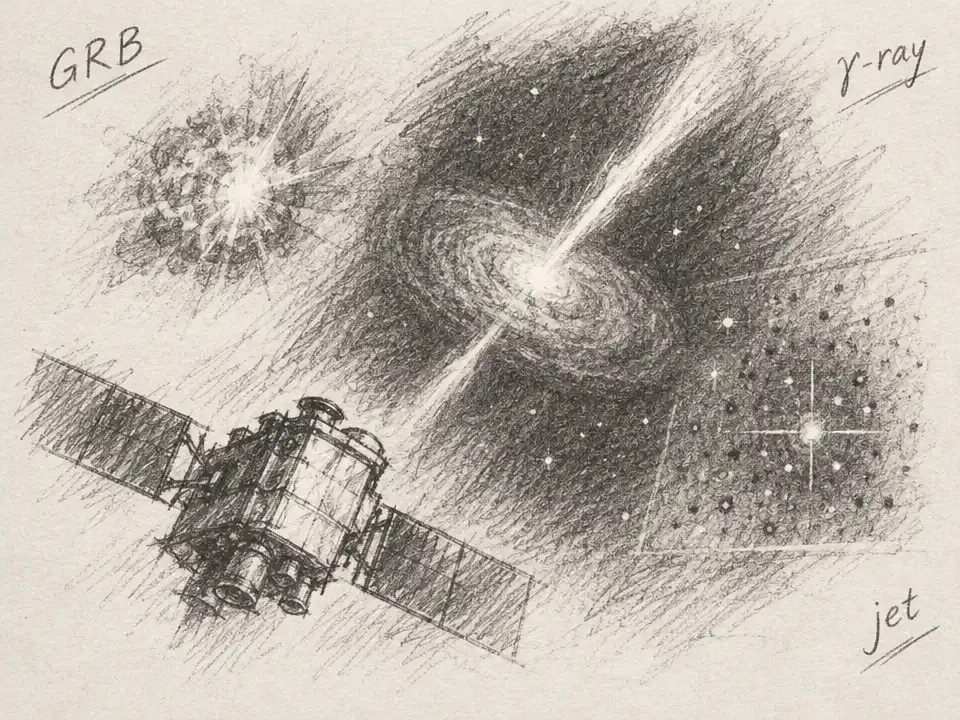
That possibility matters because classic gamma-ray bursts are thought to involve jets: narrow outflows launched by extreme cosmic events. Their material races outward at a substantial fraction of the speed of light. If the quieter Einstein Probe transients belong to the same broad family, they may extend the known population toward less luminous, less energetic explosions with slower jets. Based on a relationship observed for classical bursts, the paper estimates that some could have bulk Lorentz factors below 100. A few individual events have separate afterglow analyses suggesting values around 20–60. Those estimates do not establish that every gamma-ray-quiet transient has a slow jet; they show that this previously hard-to-study range may be opening up.
There is a second possibility: perhaps some jets are not intrinsically weak at all. A powerful, narrow jet aimed away from Earth can look faint in gamma rays because we are viewing it from the side. From our vantage point, the same explosion might look more like a soft X-ray transient than a classic gamma-ray burst. Distinguishing a slower jet aimed toward us from a faster jet seen off-axis is difficult, and the researchers stress that the current observations do not settle the question.
Nor must every event share one origin. A supernova’s shock breaking through its outer layers could produce a soft flash. Other candidates include tidal disruption events, in which a star is torn apart by a black hole, or emission from material surrounding an explosion. The authors find that many events could fit within an expanded gamma-ray-burst population, but they emphasize that individual sources remain uncertain. “No gamma-ray counterpart” is a description of what the instruments recorded—not proof that no gamma rays were produced.
The survey also shows how the way we search changes what we find. A burst that is too soft or too drawn out to trigger a gamma-ray detector may still stand out in a wide-field X-ray survey. A targeted search through data already collected by Fermi recovered faint gamma-ray signals that would have fallen below its usual automatic triggers. Five of the counterparts were found this way. The X-ray instrument did not merely add another view of known bursts; it helped uncover events that the usual alarm system could miss.
Even so, this is an early map, built from one year of discoveries and a limited number of transients with measured distances. The study’s estimates depend on assumptions about spectral shape, and the sample does not yet reveal what fraction of the quiet events are genuinely low-luminosity bursts, off-axis jets, or something else. More detections, redshifts, and observations across multiple wavelengths will help separate those possibilities. For now, the most revealing feature may be the apparent absence itself: a cosmic explosion can be visible in one kind of light and nearly vanish in another.
Zoom in on the X-ray flash, and the event looks like a fleeting point of light. Zoom out across the energy spectrum, and it becomes a test of what our instruments are built to notice. Einstein Probe is bringing a hidden population into view—not necessarily a new kind of explosion, but a part of the cosmic landscape that harder-eyed observatories could easily overlook.