For decades, VX Sagittarii has resisted a simple label. It is an enormous, cool, restless star—often classified as a red supergiant, but also proposed as a different kind of aging star, or even something far stranger. Now a faint arc of glowing gas, almost two light-years from the star, has added a new clue. The arc does not settle the argument. It offers something more useful: a place to look for evidence the star may have carried outward.
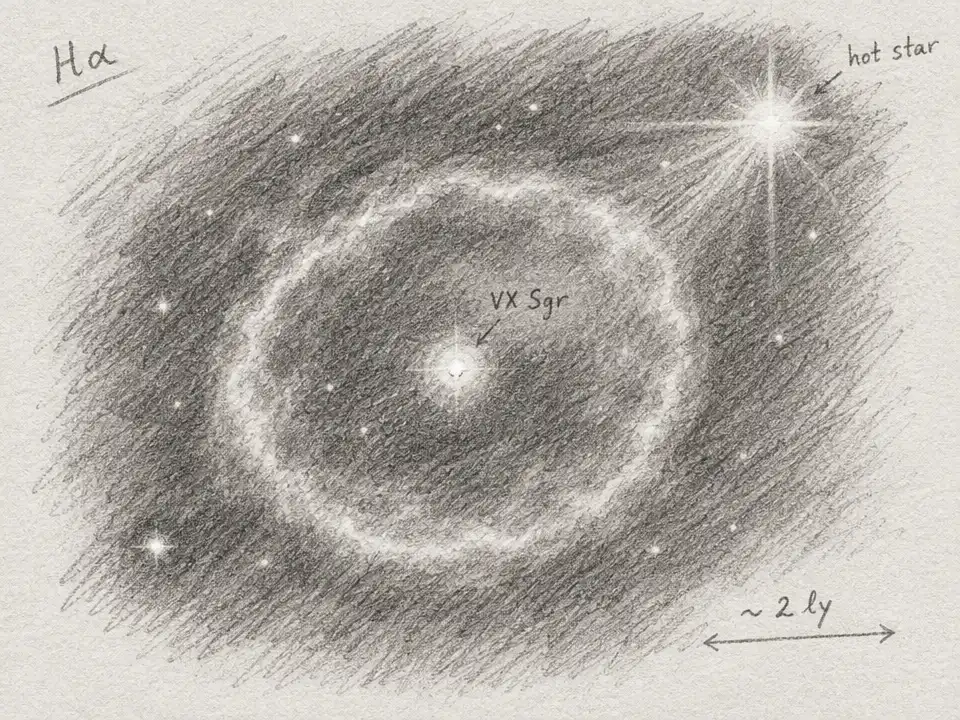
The discovery began in archival images, not a new view through a telescope. In surveys of the southern sky, astronomer Julian Shapiro identified a thin arc shining in hydrogen’s red light, called H-alpha. The structure curves around VX Sgr at a radius of about 0.59 pc. It is the most extensive circumstellar shell reported around a red supergiant. The glow is faint, but its shape and position raise a basic question: what made it?
The first tempting answer is a bow shock. A star plowing through surrounding gas can pile material up ahead of itself, much as a boat pushes a wave. That explanation fits some famous stellar arcs, including the one around Betelgeuse. But VX Sgr’s motion is a poor match. Its speed relative to nearby stars is only about 12 km/s, and its direction does not line up with the arc’s axis. The researchers also found no corresponding far-infrared glow, which heated dust in a typical bow shock would help produce.
Instead, the arc appears to be material VX Sgr shed, later lit from the outside. A nearby hot star, HD 313822, could supply the energetic ultraviolet light that makes hydrogen in the shell glow. Its estimated temperature is about 36,000 K, and its position is aligned with the arc. The distance between the two stars is uncertain, but the paper estimates at least 12.4 pc across the sky. In this picture, the shell is less a wake left by a moving star than a castoff envelope caught in another star’s spotlight.
That distinction matters. The shell preserves a record of mass leaving VX Sgr, but the image alone cannot reveal whether the material drifted away in a long-running wind or escaped in a more concentrated outburst. Using the arc’s brightness and geometry, the study estimates a mass-loss rate of approximately 4 × 10⁻⁵ solar masses per year—substantial for a star like this. But the estimate assumes a steady wind, and an alternative fit to the arc’s shape gives a higher rate. The authors stress that a spectrum measuring the gas’s motion could help distinguish a wind from a discrete ejection.
Then comes the larger identity puzzle. A red supergiant is a massive star nearing the end of its life. A super-AGB star is also elderly, but belongs to a lower-mass range and follows a different evolutionary path. VX Sgr’s distance has been disputed, making its true brightness—and therefore its mass—hard to pin down. Some unusual features in its atmosphere have helped keep the super-AGB interpretation alive.
The new paper uses a different clue: the star’s apparent membership in the Sgr OB1 stellar association. The association’s age estimates are uncertain, but the study compares them with models of how long stars take to evolve. The super-AGB models require at least about 25 million years, and often considerably longer. That is much older than the association’s estimated age range. If VX Sgr belongs to the group, the timing makes the super-AGB explanation difficult to sustain. The authors therefore favor a red supergiant or red hypergiant.
But one rival refuses to leave the stage. VX Sgr has also been discussed as a possible Thorne–Żytkow object: a theorized star with a neutron star embedded inside a bloated stellar envelope. Such an object could look much like an ordinary red supergiant from the outside. The idea is exotic, but the point of the paper is not that the shell proves it. Rather, if the shell came from VX Sgr, it may contain material processed deep inside the star and carried to its surface before being lost.
That opens a way to test what ordinary images cannot. Future high-resolution spectroscopy could measure the shell’s chemical fingerprints. Some models of Thorne–Żytkow objects predict unusual amounts of elements such as krypton, sulfur, chlorine, and argon; helium could also provide a clue in certain models. None is a guaranteed signature, and the predictions vary. The star’s existing chemical oddities have other possible explanations, too. A detection would need careful interpretation, not a quick verdict.
For now, the arc leaves two puzzles in view: what kind of star is VX Sgr, and how did it lose the gas now glowing around it? The study narrows one option, points to an external source for the arc’s light, and identifies observations that could sharpen both answers. The shell is not a label written across the sky. It is an old message from the star, illuminated just enough for astronomers to begin reading it.