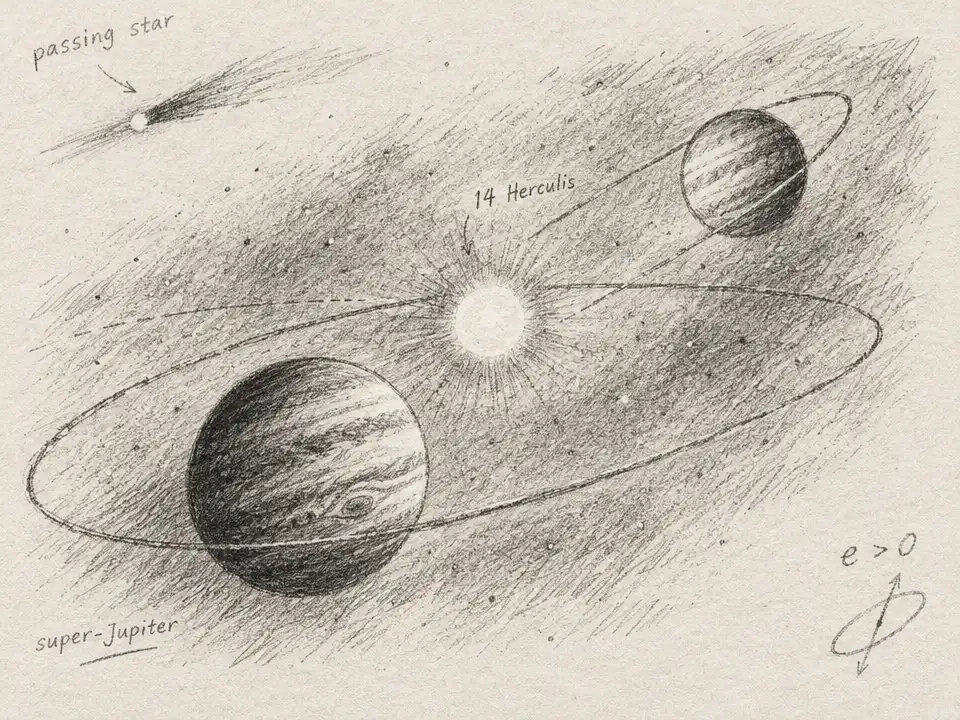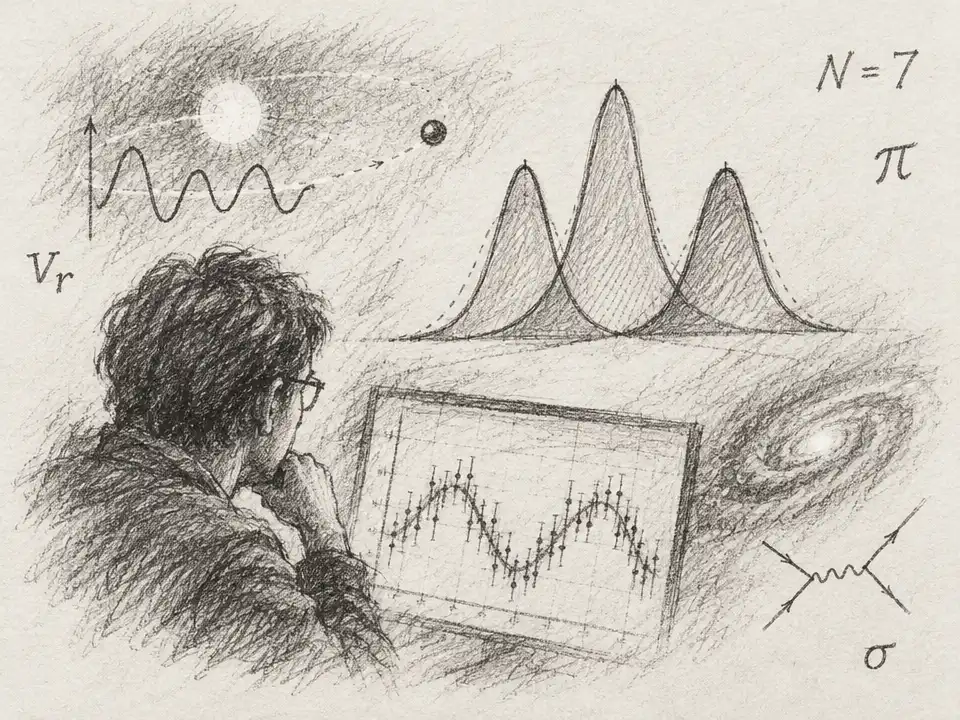
A star can betray an unseen planet without ever showing it to us. As the planet tugs on its star, the star shifts slightly toward and away from Earth, leaving a repeating pattern in its light. Astronomers try to work backward from that faint wobble to the planet’s orbit and other properties. But there may be more than one plausible explanation for the signal—and the mathematical terrain between the data and an answer can be surprisingly rugged.
A recent study by Johannes Buchner brings an idea associated with statistical physics to this problem: phase transitions. The phrase usually evokes matter abruptly changing state, as when water vapor condenses. Here it describes a different kind of sudden change: while an analysis gradually tightens the match between a model and observations, the range of possible explanations can abruptly collapse. That shift can be hard for statistical algorithms to navigate, even though the observations themselves have not suddenly changed.
The paper’s central project is a map—not of the sky, but of the varied landscapes scientists face when they infer physical properties from data. It assembles examples from astronomy, cosmology, and particle physics, alongside simulated and simplified problems. The cases include gravitational-wave signals, neutrinos detected by IceCube, gamma rays from the Crab Nebula, exoplanet measurements, and other analyses. The point is not that these fields study the same objects. It is that their calculations can pose different versions of the same challenge: finding the explanations that remain plausible after data are taken into account.
In Bayesian inference, researchers begin with a range of possible parameter values, called a prior. A model predicts what each possibility would look like in the data. The observations then favor some possibilities over others, producing a posterior: the updated range of explanations. Imagine searching a landscape where the data gradually reveal which valleys are promising. Some problems have one broad, smooth valley. Others have narrow ridges, long tails, or several separate valleys. A sampler—an algorithm that explores this landscape—can mistake a difficult route for an empty one, or fail to visit one of the viable regions.
Buchner organizes these problems using seven characteristics. They include how many parameters a model has, whether the posterior resembles a familiar bell curve, how informative the data are, whether some parameters are tightly constrained while others remain loose, and whether the plausible answers split into multiple modes. The final characteristic is whether the problem contains a phase transition: a sharp change in the landscape as the analysis moves from the broad prior toward the data-supported posterior.
The planet-hunting example makes the map tangible. In a radial-velocity model with one planet, the study identifies a seven-parameter problem with three distinct modes and a phase-transition signal. Those modes are separate plausible regions in the model’s parameter space; they are not three newly discovered planets. The result illustrates how a seemingly straightforward fit can contain multiple routes to a good explanation, along with a point where the space of possibilities changes quickly. Add more planets to the example and the landscape grows more complicated still: the three-planet case has nine modes.
That is where the physics crossover earns its place. A phase transition is a useful image for an algorithm’s sudden change of surroundings. Before the transition, a sampler may be exploring a broad expanse of possibilities. After it, the relevant answers may occupy a much smaller region, or split into separated pockets. A method that works well in the open terrain may struggle once the landscape narrows or fragments. The metaphor does not mean a planet system is undergoing a physical phase change; it describes a change in the structure of the inference problem.
The map also warns against assuming that a clean, bell-shaped uncertainty curve is typical. Across the collected examples, the study finds a wide range of posterior shapes and difficulties. Some parameters are barely constrained by the observations while others are pinned down much more tightly. Some problems have one main mode; others have several. A simplified toy problem can help researchers test a sampler, but Buchner notes that real analyses can contain stronger parameter degeneracies than those tidy practice cases. A benchmark that resembles the messiness of actual research may therefore be more revealing than one built only from textbook puzzles.
This is a methodological study, not a new detection of a planet, neutrino, or cosmic event. It does not establish that one sampling algorithm is best for every scientific question. Instead, it proposes a shared test bed for comparing algorithms on a range of realistic problems, with the underlying analyses and examples made available for reproducibility. The practical lesson is to test whether a method can recover the right answers under the conditions a particular problem presents—not simply whether it performs well on an easy, smooth example.
That lesson matters as astronomy asks increasingly subtle questions of its measurements. A tiny stellar wobble may encode an orbit, but it can also leave several mathematical explanations in play. Statistical physics offers a way to recognize one danger in the search: the terrain can change sharply while the investigator is still moving through it. By charting those changes alongside other kinds of uncertainty, the study gives researchers a way to ask not just what an algorithm concludes, but whether it has explored the full landscape well enough to earn that conclusion.