A star’s spectrum can suggest that it has weak gravity even when the star itself hasn’t changed. That mismatch matters: astronomers use the fingerprints in starlight to estimate a star’s properties, and a wrong reading of the star can complicate what they learn about the planets around it. A new study of small, cool stars points to a surprising source of the confusion: magnetic activity—the same restless process behind flares and X-rays—may reshape the star’s atmosphere enough to make its spectrum imitate a lower-gravity star.
The puzzle is easiest to see in late-M dwarfs, stars near the cool, faint end of the stellar population. Their near-infrared spectra are crowded with molecular features. Some of those features respond to pressure, which changes with gravity in a star’s atmosphere. That makes them useful clues—but not necessarily exclusive ones. A spectral pattern associated with low gravity can also be produced by other changes in the atmosphere. In other words, the stellar spectrum may be telling the truth about what it looks like while misleading us about why.
TRAPPIST-1 offered a vivid example. It is a small star whose planets have drawn intense interest, but previous efforts to model its light kept favoring atmospheres with much lower surface gravity than expected for a field late-M dwarf. In this new analysis, a one-component model of TRAPPIST-1 returned a logarithmic gravity estimate of 3.995, with an uncertainty of +0.222 and −0.217; the expected value is about 5.24. The researchers could make the fit use the expected high gravity, but then the model had to raise its estimate of the star’s photospheric temperature. The spectrum seemed to be forcing the model to trade one property for another.
To see whether this was peculiar to one famous star, the team compared near-infrared observations of 23 late-M dwarfs. They analyzed TRAPPIST-1 with JWST’s NIRISS instrument and 22 other stars observed with the SpeX spectrograph on NASA’s Infrared Telescope Facility. The team fitted the spectra with PHOENIX/NewEra stellar-atmosphere models, then compared results from fits that allowed gravity to vary with fits that restricted it to the expected high-gravity range. For every star in the sample, the freely varying fit preferred a lower gravity.
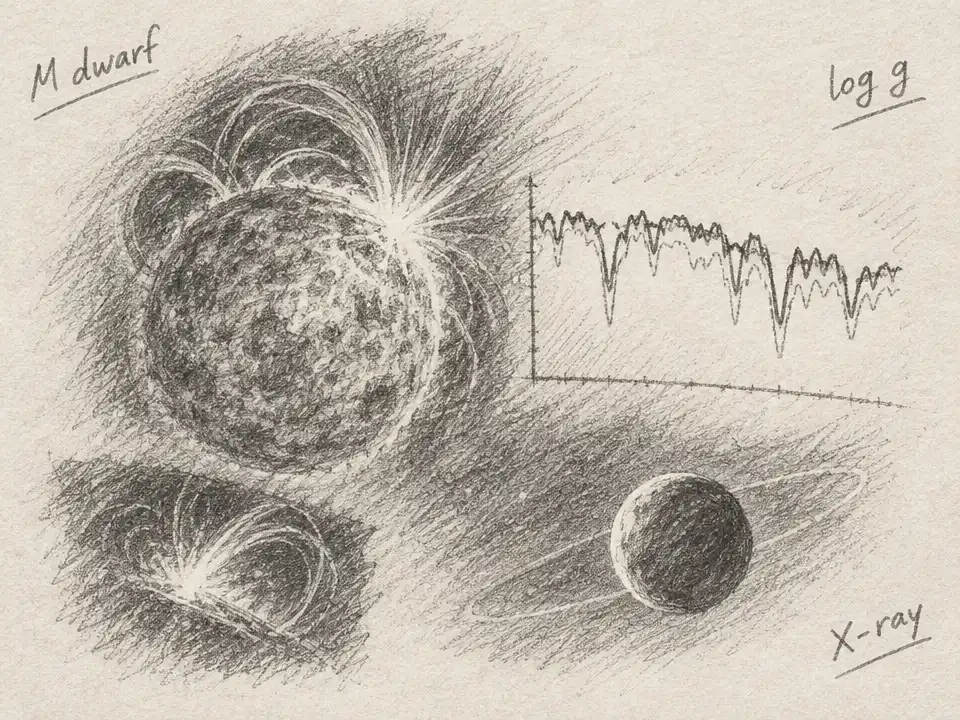
Next came a bridge between two kinds of evidence. The researchers compared the fitted gravities with indicators of magnetic activity: flare luminosities measured from TESS and K2 observations, and X-ray luminosities gathered from previous studies. The pattern was striking. More active stars tended to have spectra that the models matched with lower gravity. The reported correlations were strong: −0.931 for flare luminosity and −0.948 for X-ray luminosity. These numbers describe how tightly the quantities varied together; they do not establish that magnetic activity caused the spectral changes. Still, the agreement between two different activity measures made the connection difficult to ignore.
The obvious next move was to watch a flare as it happened. TRAPPIST-1 was observed by JWST across nine visits, during which the team identified six flares. They looked for short-term changes in magnetically sensitive spectral features during the events, including the iron-hydride feature near 0.998 µm. The flare signals were clear in the star’s brightness and hydrogen-alpha light, but the selected spectral features showed no clear immediate change. That was a twist: the activity link appeared across the stars, yet the most visible outbursts did not produce the expected quick spectral response.
The researchers suggest that the culprit may be less like a single lightning bolt and more like a persistent drizzle of small-scale heating. Frequent, unresolved magnetic events could warm broad regions of a stellar atmosphere over time, leaving a lasting imprint even when no large flare is underway. To test whether heating could plausibly produce the right kind of imprint, the team built a simplified radiative-transfer experiment. They began with a model atmosphere at a fixed gravity, then altered its temperature structure. As the imposed heating grew stronger, several features commonly used as gravity clues changed in the direction associated with low gravity. The true gravity in the experiment never changed.
That demonstration is important, but it is not a full physical model of a flaring star. The heating profiles were deliberately simplified, and the authors describe the exercise as a sensitivity test, not a self-consistent simulation of magnetic activity. Other explanations remain in play, including uncertainties in how stellar models represent the pressure broadening of molecular features. The study also relies on a modest sample, and the stellar spectra and activity measurements were not always taken at the same time. The correlations point toward a mechanism worth testing; they do not settle the case.
Why should anyone beyond stellar spectroscopy care? Because the star is part of the measurement when astronomers study a planet. During a transit, a planet filters a small fraction of its star’s light, and researchers analyze the change to infer what the planet’s atmosphere contains. If the star’s own spectrum is being reshaped by ongoing magnetic activity, an inaccurate model of the star could complicate interpretation of that planetary signal. The same warning reaches stellar age estimates: low-gravity-like features are often treated as clues that a star is young, but activity may produce similar features in some late-M dwarfs.
The deeper lesson is methodological: a spectral clue can be real without having the cause we first assigned to it. By connecting magnetic-activity measurements with the physics of near-infrared spectra, the researchers have offered one possible explanation for a stubborn mismatch between stellar models and observations. The next test will require larger samples and observations that track each star’s spectrum and magnetic activity at the same time. Until then, a star that looks light in its spectral fingerprints may not be light at all—it may simply be magnetic.