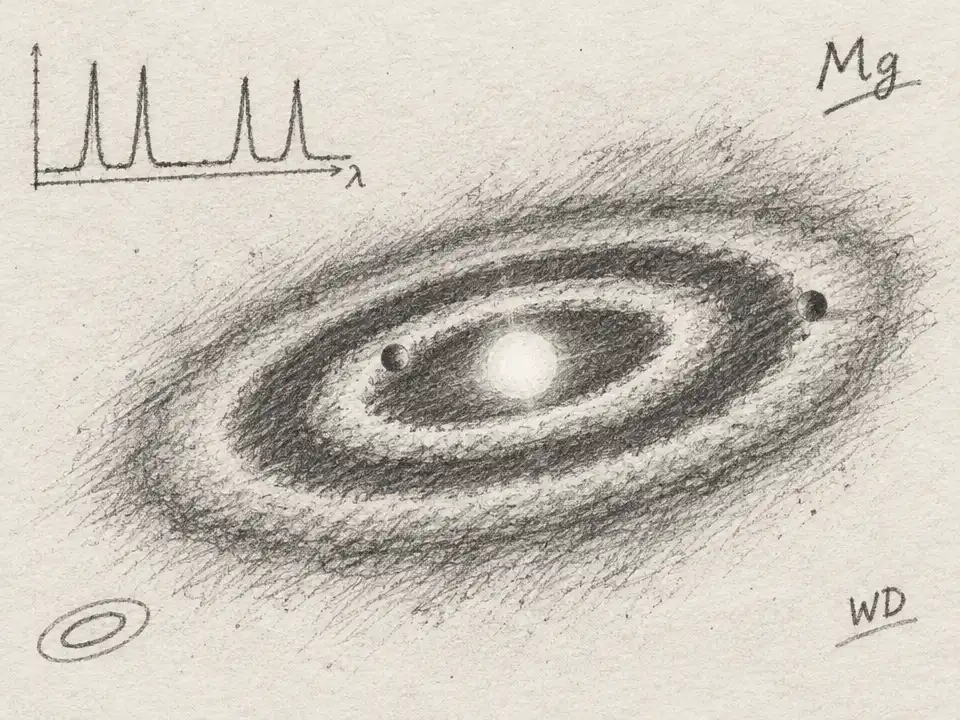
Picture a ring of dust around a young star: a place where tiny grains warm, release trapped molecules, and begin a long journey toward planets. If methanol is escaping from those grains, water should be a reasonable companion. The two substances leave ice at similar temperatures. Yet in one disk, astronomers found methanol and no detectable water vapor. The missing signal may point to a surprising chemical difference in the material that could someday become worlds.
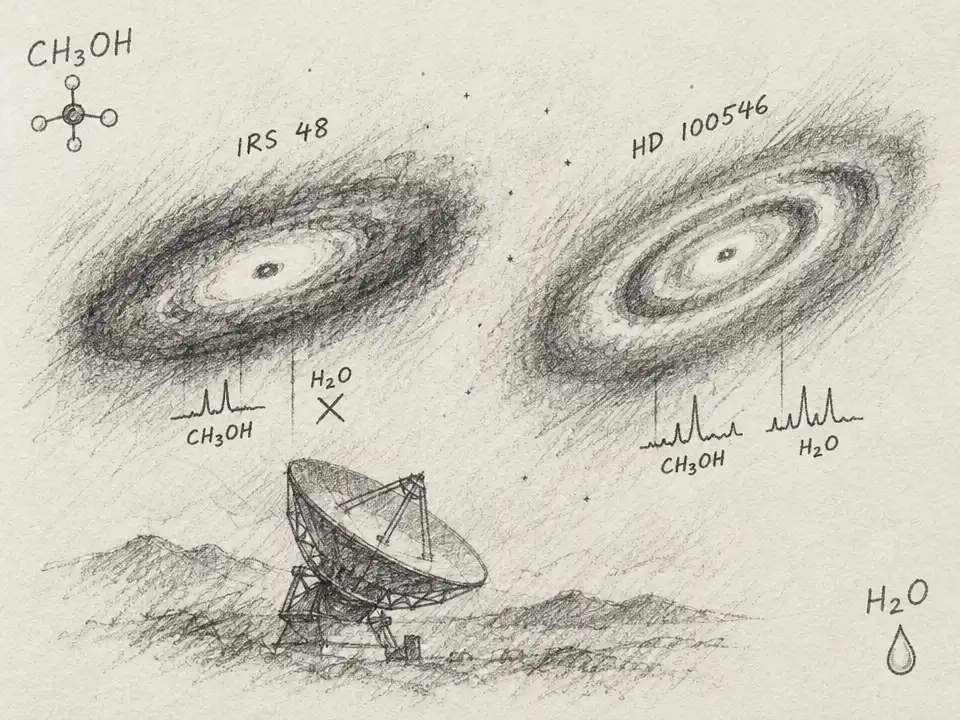
The clue came from two planet-forming disks observed with the Atacama Large Millimeter/submillimeter Array, or ALMA. Astronomers tuned the telescope to particular radio frequencies, where molecules reveal themselves through narrow spectral lines. One target, HD 100546, showed water and methanol. The other, IRS 48, showed three methanol lines—but no water line at 183.31 gigahertz.
That silence was not for lack of trying. The team tested different ways of processing the ALMA data, including methods designed to make faint signals easier to see. They also checked whether the expected water signal appeared in the disk’s motion pattern. It did not. Earlier far-infrared observations had also failed to detect water in IRS 48.
But an undetected line does not prove that a molecule is absent. Water could be too faint, hidden, or emitting under conditions that make this particular line hard to see. The researchers therefore treated the result as a limit: water must be below the level their observations could detect. Even with that caution, the contrast with methanol was striking.
In IRS 48, the measured amount of methanol relative to water must be at least about 0.2. In HD 100546, the corresponding ratio is about 0.02—roughly ten times lower. The value for IRS 48 is a lower limit, not an exact measurement, but it is still the highest such lower limit among the objects compared in the study.
Why expect water in the first place? Methanol and water are both common ingredients of cosmic ice. In a warm part of a disk, heat can free them from dust grains, letting them enter the gas where ALMA can detect them. Methanol is especially useful as a chemical time capsule: it forms primarily in ice, so gas-phase methanol can reveal something about the frozen material that preceded it.
The disk of HD 100546 offers a useful counterpoint. Its measured methanol-to-water ratio, about 0.02, sits within the range seen in comets and near the low end of measurements from young stellar objects. That resemblance is consistent with an idea that some of the disk’s ice was inherited from earlier stages of star formation and later released as the disk warmed. It does not settle the matter: more water lines would help determine how much water is present and how its emission is produced.
IRS 48, by contrast, seems unusually rich in complex organic molecules relative to water. The team suggests that the ice in its conspicuous dust crescent may have a distinct chemical composition. Another possibility is that vertical mixing—material circulating between different heights in the disk—has changed local chemistry. The available evidence does not identify a single cause. The researchers also note that water’s emission may be affected by conditions that differ from those governing methanol, complicating a direct comparison.
A second molecular clue adds another wrinkle. In HD 100546, the team found methyl formate, a more complex molecule, at a level that gives a methyl-formate-to-methanol ratio of about 2. That is unusually high compared with younger and older sources. One possible explanation is that chemistry in the disk has reworked simpler ice ingredients into more complex molecules. But the interpretation is still tentative: the researchers say more molecular lines and better knowledge of how those molecules are excited are needed.
These two disks are not a survey large enough to define a rule for all planet-forming systems. They are more like two samples from a vast and varied pantry. One has a comet-like methanol-and-water balance; the other appears to serve up methanol without a detectable water signal. Their contrast suggests that the chemistry planets inherit may depend on a disk’s local history, not just on the ingredients available at the start.
The unexpected result is not that water has vanished from a planet nursery. It is that a disk can show a clear molecular signal for methanol while water remains out of reach—and that the difference may carry information about the icy grains beneath the gas. With more disks and more lines to compare, astronomers may be able to trace how those hidden ice recipes change before planets take shape.