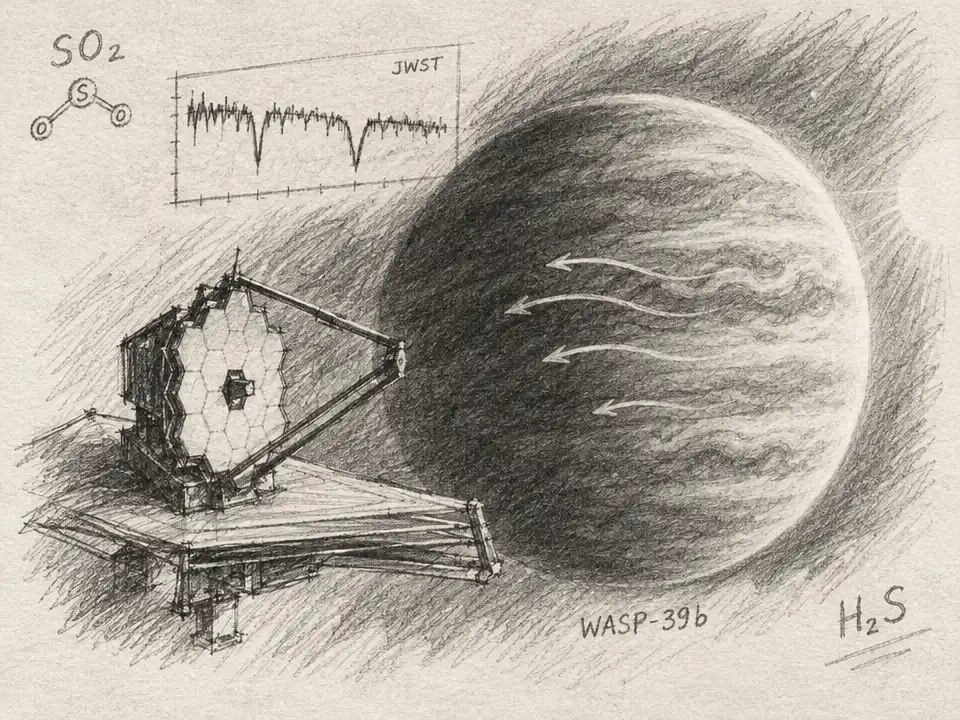
At first, WASP-39b seemed like the kind of planet whose atmosphere could be read from a tidy chemical recipe: measure its heat and pressure, then predict which gases should be there. But when the James Webb Space Telescope studied the planet’s filtered starlight, a faint notch appeared where that recipe had no good answer. The clue was sulfur dioxide. On this scorching gas giant, the molecule may be less a remnant of the planet’s original ingredients than a product of what its star is doing to the atmosphere right now.
WASP-39b is roughly Saturn’s mass but about Jupiter-sized, swollen by the energy it receives from its star. It completes an orbit in just over four days, with an estimated equilibrium temperature around 1,100 to 1,200 K. When the planet passes in front of its star, a thin rim of atmosphere lets some starlight through. Different gases absorb different colors, leaving patterns in the light that reach the telescope. It is an indirect portrait: no one sees a cloud of sulfur dioxide directly. Researchers infer the gas from the wavelength-shaped shadows it leaves.
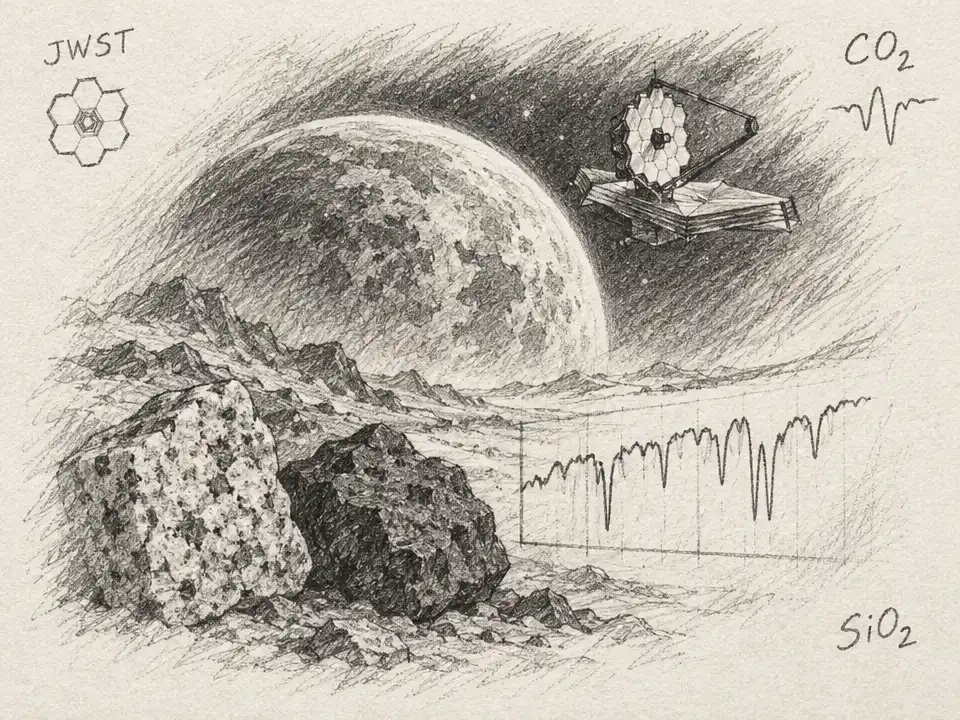
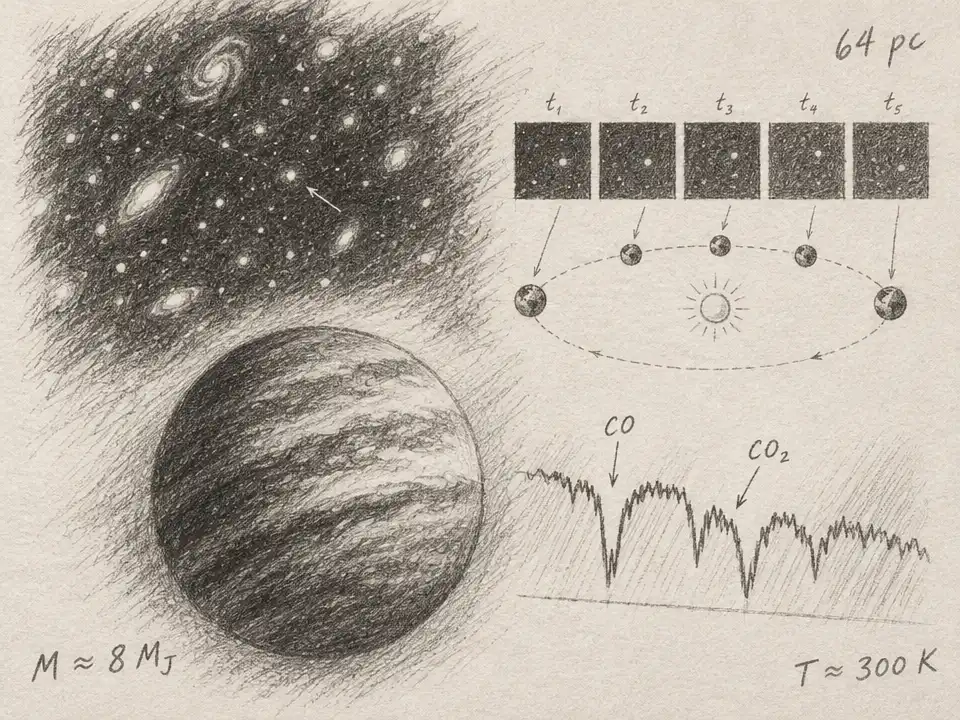
JWST’s early spectrum offered plenty to interpret. Researchers identified water, carbon dioxide, carbon monoxide and sodium, while methane was not detected. A strong carbon-dioxide feature at 4.3 μm fit models in which the atmosphere was chemically close to equilibrium—the condition in which chemical reactions have settled into a balance set by temperature and pressure. In that picture, the spectrum looked like a useful inventory of the planet’s atmosphere and, potentially, clues about its composition.
Then there was the small feature near 4 μm. The first broad spectrum showed an absorption feature that the expected equilibrium chemistry did not reproduce. It was a tentative clue, not a triumphant identification: the initial sulfur-dioxide interpretation had a significance of 2.7σ. That means the data pointed toward the molecule, but the feature was modest enough that the explanation needed more support. A mismatch in a spectrum can have several causes, and a single small bump is a precarious foundation for a claim about chemistry on another world.
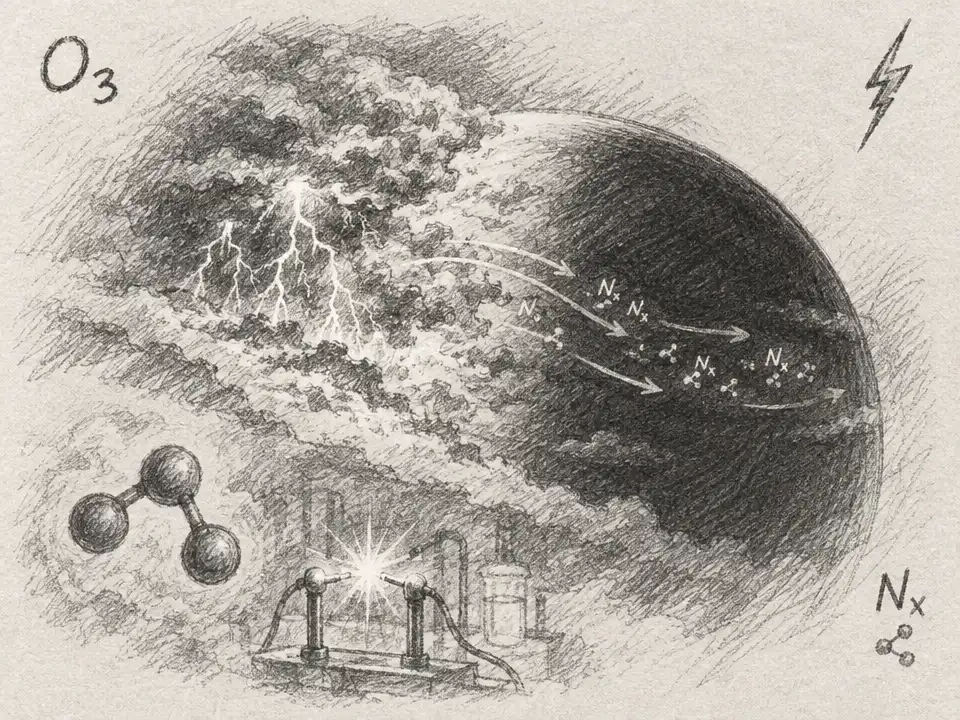
The surprise was not simply that sulfur dioxide might be present. It was that the molecule seemed to be far more abundant than equilibrium chemistry would allow. In those conditions, models put sulfur dioxide below one part per billion. Photochemical models, which track reactions triggered by starlight, could instead produce concentrations in the parts-per-million range. The atmosphere, in other words, might not be sitting still chemically. Energy from the star could be changing which molecules survive and which are assembled.
The proposed route begins with hydrogen sulfide, a sulfur-bearing gas expected in the hydrogen-rich atmosphere. High-energy light can break molecules apart, freeing sulfur-containing fragments. Those fragments then take part in a chain of reactions, including oxidation, that can build sulfur dioxide. The details depend on the atmosphere’s chemistry and how gases move through it, but the key distinction is clear: the sulfur dioxide may be a chemical product of irradiation, not a straightforward leftover from the planet’s formation. The star is helping write the atmosphere’s recipe.
A second instrument gave the clue a stronger test. JWST’s mid-infrared observations found sulfur-dioxide features at 7.7 and 8.5 μm, wavelengths separate from the original near-infrared feature. Detecting the molecule in more than one spectral region matters because a proposed gas should leave a recognizable pattern, not merely explain one isolated notch. The mid-infrared analysis estimated an abundance range of roughly 0.5 to 25 parts per million, consistent with the earlier interpretation, though still broad. The extra bands strengthened the case without making every atmospheric detail certain.
Those observations also preserve an important note of caution. The mid-infrared spectrum included a decrease in transit depth beyond 10 μm that the study did not explain. And even a real molecular signature does not provide a perfect census: clouds, the atmosphere’s temperature structure and the way a spectrum is modeled can affect what abundance researchers infer. The measurements support sulfur dioxide as a key ingredient, but they do not turn a distant, dynamic atmosphere into a completely transparent laboratory.
There is another complication: a planet’s atmosphere is not a single, motionless column of gas. WASP-39b’s dayside faces the star, while its nightside turns away. Models that combine simulated global circulation with atmospheric chemistry suggest that sulfur dioxide made on the dayside can be carried toward the nightside by fast winds. The same transport can blur differences between the planet’s morning and evening edges—the atmospheric limbs that starlight passes through during a transit. These are model results, not a direct map of the winds, but they show why a one-dimensional chemical picture can miss the action.
That changes what astronomers can ask of a spectrum. A chemical signature can say more than “this gas is present.” In principle, sulfur dioxide may help reveal how strongly a star’s light drives reactions, how quickly the planet’s atmosphere mixes, and whether winds move chemical products before they are destroyed or transformed. Researchers have proposed that observations at different points in the planet’s orbit could test how the gas is distributed. The spectrum is not yet a weather map, but it may contain clues about circulation hidden inside its molecular patterns.
The first interpretation of the 4 μm feature also illustrates how evidence accumulates. A broad spectrum raised a possibility; chemical models supplied a physical route; later observations found additional absorption bands where the molecule should leave its mark. None of these steps alone settles every question. Together, they make a stronger case that the atmosphere contains the product of active photochemistry. The plot twist is that the spectrum’s unexpected detail did not merely add another gas to the inventory. It challenged the assumption that the inventory could be understood without accounting for sunlight-driven reactions.
For exoplanet science, that distinction matters. If researchers treat every atmosphere as though its gases simply reflect a balance set by temperature and pressure, they can misread the chemistry—and perhaps the composition—of a planet. Photochemical products can complicate estimates of atmospheric properties, while also becoming useful tracers of processes that are otherwise difficult to observe. JWST’s sulfur-dioxide measurements do not mean that every strange feature will turn out to be a photochemical signal. They show why unexplained features deserve careful tests across wavelengths and against models that include more than equilibrium chemistry.
WASP-39b is not a place where sulfur dioxide signals familiar weather or a habitable surface. It is a hot gas giant, and the evidence concerns molecules in its atmosphere. But the discovery offers a vivid change in perspective: starlight can do more than illuminate a distant planet for our telescopes. It can alter the very gases those telescopes measure. A small spectral clue, followed across several wavelengths and tested against chemical and circulation models, has begun to reveal an atmosphere in motion—one whose chemistry is being rewritten as it travels around its star.