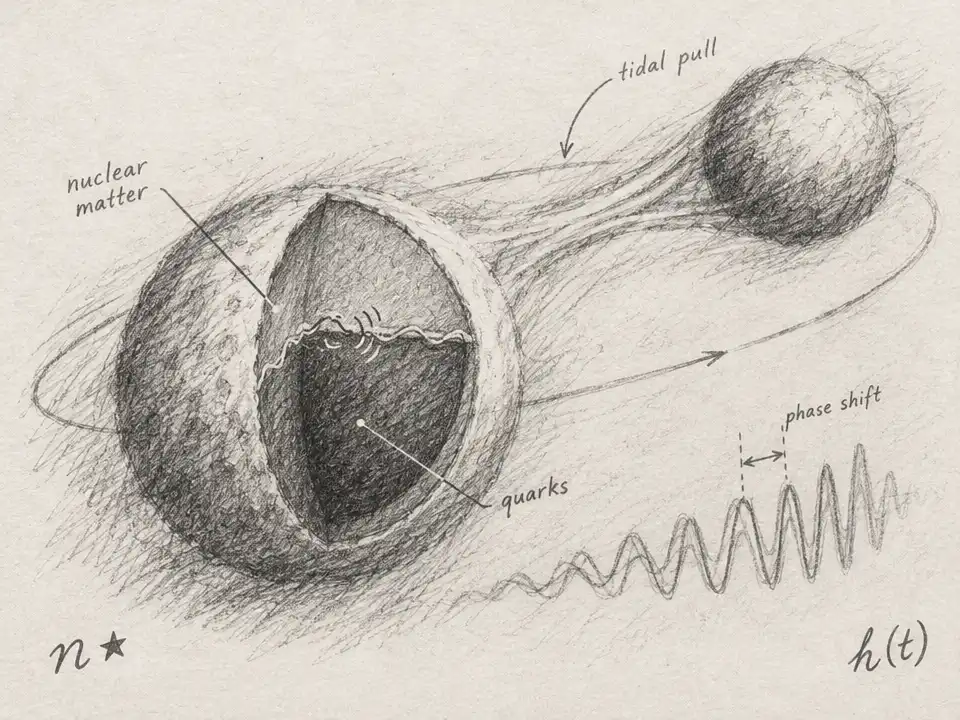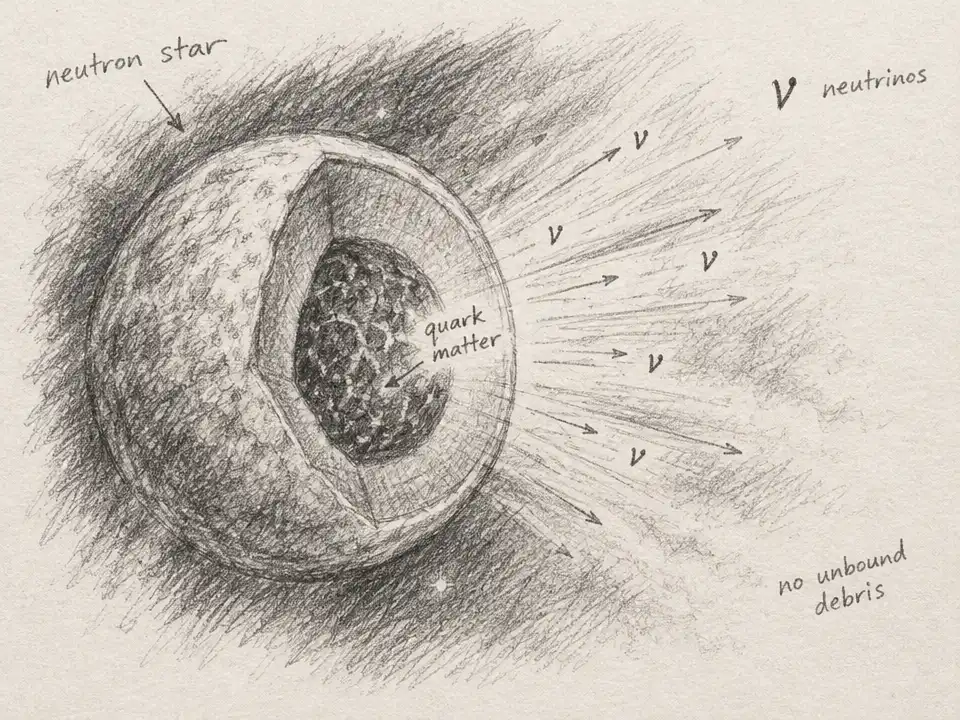
A neutron star can weigh more than the Sun while squeezing its mass into a sphere roughly the size of a city. Add a little more matter, and the pressure at its heart may push familiar nuclear matter into a new state: quarks, no longer bound inside protons and neutrons, move freely through a quark core. Scientists have wondered whether that sudden change could shake the star so violently that material escapes into space.
A new set of computer simulations delivers an unexpected answer. In all three cases the researchers modeled, the star produced virtually no unbound debris. The strongest transition did, however, bring a powerful burst of neutrinos—the elusive particles that can stream out of dense matter. The finding challenges an earlier simulation that predicted an eruption of material, and points to a basic question: when a neutron star changes its inner structure, must its outer layers fly apart?
The possibility matters because a neutron star’s composition is almost impossible to inspect directly. Observations can measure a star’s mass and estimate its size, but different theories of matter can produce similar-looking stars. A change from ordinary nuclear matter to deconfined quarks might leave a more distinctive mark. If that change also launched glowing debris, astronomers might search for a brief flash of light. Neutrinos could provide another kind of signal, carrying information from regions light struggles to escape.
The study’s authors built five theoretical descriptions of matter that allow such a transition, each with a different jump in density between the hadronic and quark phases. They then used three of those descriptions in detailed simulations that track the star’s matter, gravity and neutrinos. Rather than modeling a star slowly gaining mass from a companion over its real-world lifetime, they started with a simulated neutron star and gave it a small, sudden increase in mass to push it toward the transition. The added mass was about 6 × 10⁻³ solar masses.
The stars did not all respond alike. With the strongest transition, the core rang through large density oscillations before a substantial quark core appeared, about 1.3 milliseconds after the simulation began. In a second model, a smaller quark core formed more gradually. In the weakest case, the star kept oscillating between phases without settling into a lasting quark core. This variation was part of the point: the researchers wanted to see how the strength of the transition changed the star’s response.
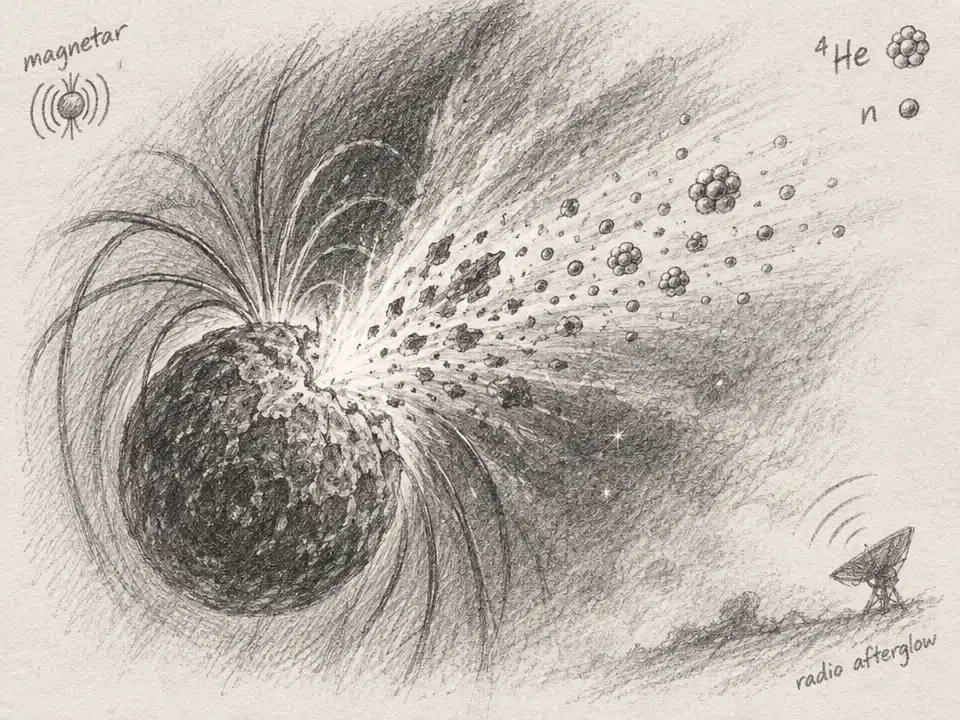
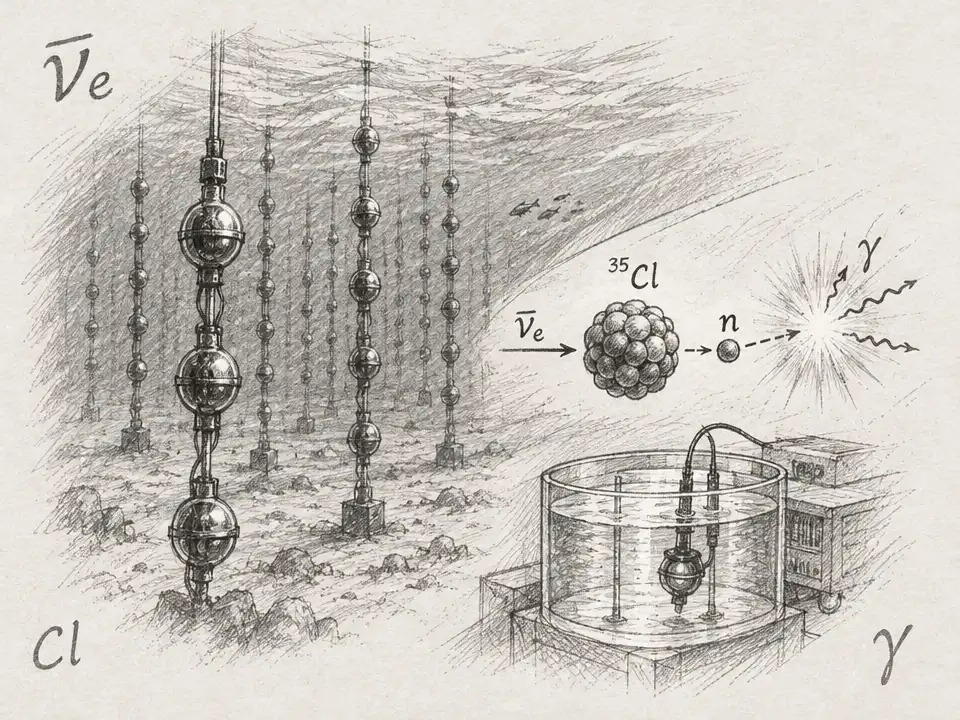
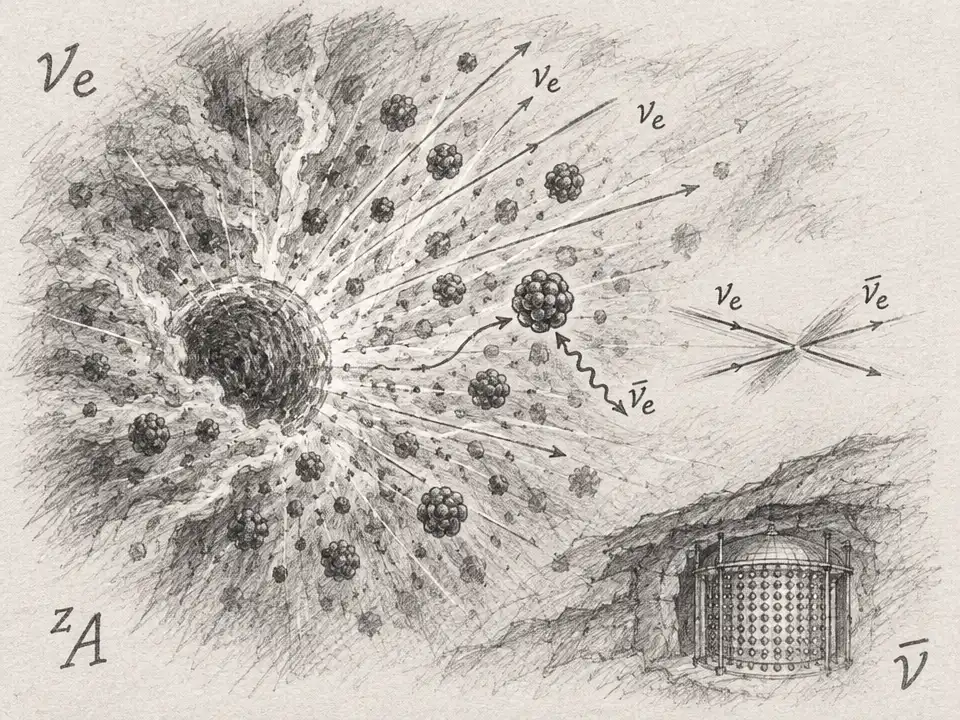
For the strongest transition, the researchers calculated neutrino luminosities reaching about 1052 erg/s. That is an extraordinary flow of energy in neutrinos, even though the signal comes from a numerical model, not a telescope watching an actual star. Yet the outer material did not follow the dramatic path one might expect. The star’s surface and surrounding matter moved and heated, but the simulations found no significant material that had enough energy to escape. Instead, a cloud of matter remained gravitationally bound around the star.
That quiet ending contrasts with a previous study, which reported about 10-3 solar masses of ejected matter during a similar kind of phase transition. The disagreement is not simply a contest between two answers. The simulations used different starting setups and different treatments of neutrino transport. The earlier calculation added an envelope of 0.018 solar masses—roughly three times the mass increment in the new study—and used different neutrino opacities and radiation-transport methods. The new authors suggest these differences could help explain why the calculations diverged, while acknowledging that the cause is not yet clear.
There is another important boundary around the result: the simulations do not reproduce the slow, physically realistic process of accretion. The researchers explain that modeling a neutron star gaining a small amount of mass over a realistic timescale is beyond what their numerical setup can follow. They tested different ways of adding matter, but some produced artificial heating or outflows. Their chosen method was designed to trigger the transition without creating those unwanted effects. That makes the clean result useful—but it also means it cannot settle what every real accreting neutron star would do.
In the strongest-transition model, the quark core’s formation changed the star’s internal composition, and the new calculations included neutrino absorption by quarks to track how that material and a trapped neutrino gas moved toward equilibrium. The paper’s broader contribution is a family of matter models that other researchers can use to test different transition strengths in future simulations. More realistic accretion histories, alternate neutrino treatments and independent calculations will help show whether the missing debris is a robust feature or a consequence of modeling choices.
For now, the surprise is not that the star stayed perfectly still. It shuddered, heated and sent out neutrinos. What it did not do, in these simulations, was shed a significant amount of matter into space. The result suggests that a star’s interior can undergo a dramatic change without automatically turning that change into a visible explosion—a distinction future observations and better models will need to test.