A black hole seems to offer a simple photographic promise: point a telescope at the edge of darkness and capture the place where light disappears. But the famous image of the supermassive black hole in galaxy M87 is not a snapshot of its event horizon. It is a glowing ring shaped by hot gas, powerful gravity, and the difficult work of turning radio signals into an image. Inside that bright outline, researchers suspect a subtler prize: light that has looped around the black hole before escaping. Finding it could turn a striking portrait into a sharper test of gravity.
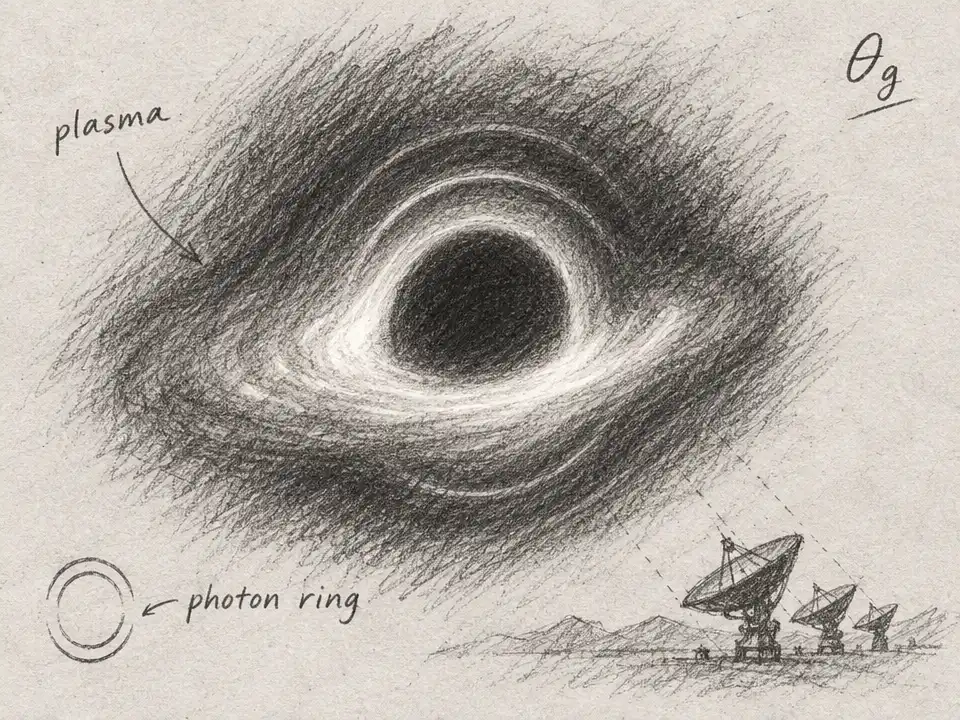
The Event Horizon Telescope’s first M87 image, released in 2019, showed a lopsided ring around a dim center. The ring measured about 42 μas across—so tiny that resolving it required radio observatories spread across Earth to work together as one virtual telescope. The collaboration found the feature persisted across four observing nights and that its size agreed with expectations for emission near a black hole. The brighter southern side also made sense: glowing plasma moving toward us appears brighter than plasma moving away. It was remarkable evidence, but the picture did not show a clean, black outline etched around an otherwise empty horizon.
Here is the first turn in the story: a black hole’s “shadow” and its observed dark center are related ideas, not interchangeable objects. In a textbook setup, a black hole is illuminated from behind, and the missing light makes a silhouette. Around a real black hole, however, the light comes from turbulent matter nearby. Where that matter glows, how it moves, and how gravity stretches and redshifts its light all help determine the image. A dark patch can be evidence of the black hole’s influence without tracing the event horizon itself like a drawn boundary.
That distinction matters because the word “ring” can hide several different journeys taken by light. Some rays travel comparatively direct paths from the glowing gas to Earth. Others bend around the black hole and create additional, distorted images of the emitting material. A much narrower set of rays skims near unstable photon orbits: paths where light can circle the black hole before eventually escaping or falling in. Small changes to those paths decide their fate, which is why the light can be bent into delicate structures near the black hole’s apparent edge.
Researchers do not always use “photon ring” in exactly the same way, so the label can cause confusion. One influential analysis separated the narrow feature associated with near-orbiting light from a broader “lensing ring” made by light bent around the hole. In its models, the broader ring could be brighter and wider than the narrow feature. The glow from nearby matter, meanwhile, strongly influences what the telescope actually sees. The crucial point is not that the M87 ring is unrelated to photon paths; it is that a bright circular feature does not, by itself, prove that astronomers have isolated light that circled the hole many times.
Think of the image as a crowded shoreline. The gas is the surf, continuously changing shape and brightness. Gravity is the terrain redirecting it. The special, highly bent rays are not necessarily the brightest waves; they are more like thin marks left by repeated paths through the landscape. In an ordinary reconstructed image, these layers can overlap. A black hole may imprint a theoretically precise pattern while the surrounding plasma supplies most of the visible light—and obscures the pattern researchers hope to measure.
There is a clever way to search for that hidden structure without demanding a perfect close-up. A radio interferometer does not simply take a picture with every detail already present. Each pair of telescopes samples information about the sky at a particular scale and direction. Combine enough samples and researchers can reconstruct an image. But the raw measurements also contain clues about fine structure that may be hard to pick out in the finished picture.
A 2019 study of black-hole photon rings predicted a distinctive clue in those measurements. As light makes more of its way around the black hole, its image forms a sequence of increasingly narrow rings, or subrings. In the study’s framework, each additional subring can leave a new pattern in the interferometer’s measurements on longer baselines—the connections between more widely separated telescopes. The predicted pattern is a cascade of damped oscillations. Its changing rhythm could encode a ring’s size and thickness, and, in principle, information about the black hole’s mass and spin.
This is the plot twist: the most informative signal may be easier to recognize in the data’s rhythm than in a dramatic image. The narrowest subrings grow fainter and thinner, making them difficult to separate from the surrounding glow in a conventional picture. Yet their predicted signatures in long-baseline measurements may persist. The proposal does not mean astronomers have already detected the full sequence. It offers a way to look, and the observations would still have to contend with changing plasma, limited sensitivity, and other fine-scale structures that can complicate the signal.
Models of the gas make the hunt more challenging—and more interesting. A study of thick accretion disks found that simulated images can have a layered, “wedding cake” structure: narrow photon rings stacked over broader emission surrounding a central dim region. But the layers do not always show up equally well. At the observing frequency of 230 GHz, the model’s first ring was visible, while absorption by the gas could suppress the second. At 345 GHz, where the modeled flow is more transparent, the second ring produced clearer signatures. That makes the higher frequency a promising target for future measurements, not a guarantee of success.
Another proposed clue may sit just inside the more familiar dark center. Researchers modeling M87* have argued that, under some conditions, a high-dynamic-range image could reveal both the photon ring and a smaller “inner shadow,” whose edge is tied more closely to the lensed appearance of the event horizon. Comparing the two features might help estimate a black hole’s mass and spin in ways that a ring measurement alone cannot. But this prediction depends on how the gas is arranged. It is a possible opportunity, not a detail already established in the 2019 image.
That dependence on the gas is not a nuisance to wave away. It is part of the experiment. A black hole’s gravity sets the rules for light, but the environment decides which rays are available to observe and whether they can escape without being absorbed. A convincing test must therefore match the gravitational predictions against realistic models of the glowing plasma, while checking whether the measurement survives different ways of reconstructing the image and interpreting the telescope data.
The original M87 portrait remains a landmark: its ring-like emission and central depression matched expectations for a black hole, and different imaging approaches recovered a stable ring size. The next step is more demanding than taking a sharper version of the same picture. Researchers want to separate the ordinary glow from the fine structure gravity adds, then see whether that structure follows the predicted pattern. If the pattern appears, it could offer a new way to measure black-hole properties and test general relativity in extreme conditions. If it does not, astronomers will need to work out whether the signal was hidden by the plasma, lost in the measurement, or predicted incorrectly.
For now, the black hole’s famous ring is both a portrait and a puzzle. Its brightness tells a story about matter racing through intense gravity. Its shape carries clues about the dark object in the center. But the most precise marks of gravity may be thinner than the picture can readily show. The adventure ahead is to find them not by staring only at the glowing outline, but by listening for the faint, repeating signature that its light may leave in the telescope array’s measurements.