A disk around a star should not care where you put the observer. Move the coordinates, and the equations of motion should still describe the same reality. Yet a new analysis of a simplified celestial disk found an unsettling twist: in one common frame, the disk develops a growing disturbance; in another, that same kind of disturbance is stable. The culprit was not a new force or a hidden planet. It was the edge of the computer model.
The work, posted to arXiv on October 6, 2026, investigates what happens when an unevenly distributed disk tugs on the object at its center. A lopsided disk pulls harder from one side than the other, nudging the central star or compact object. That motion changes the gravitational pull felt across the disk, which can rearrange its material and alter the tug in return. The researchers set out to understand whether this feedback loop settles down or runs away.
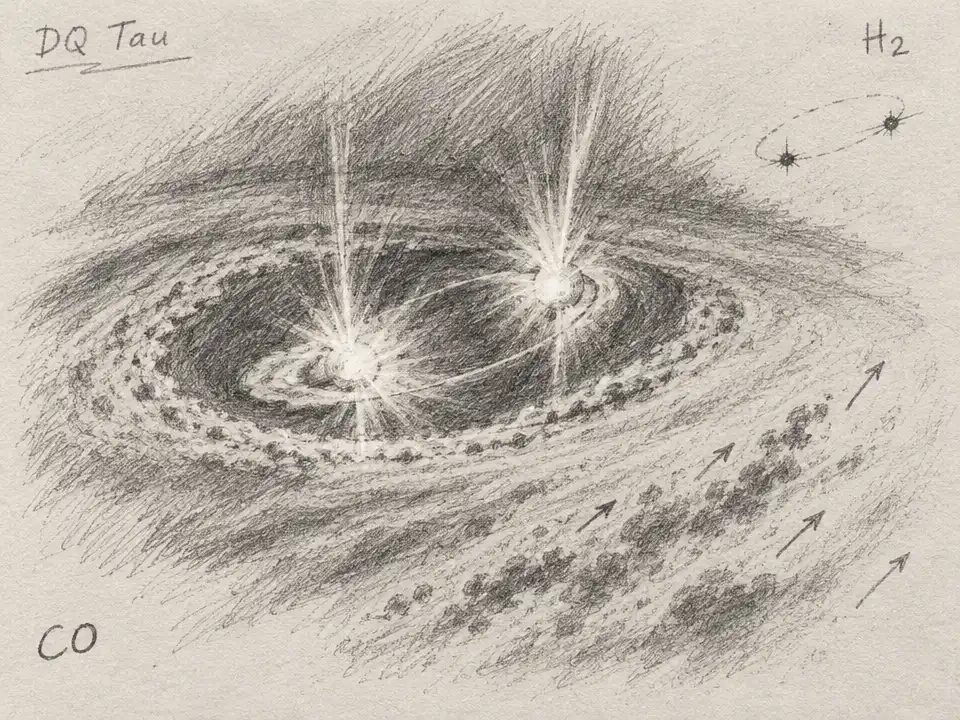
To isolate the effect, the team examined a stripped-down, two-dimensional disk. They left out gas pressure and kept gravity from the central object and the disk itself. The model is deliberately simple—not a photograph of a particular system, but a mathematical test bed. The question is whether a small, one-sided disturbance grows as the disk responds and the central object shifts.
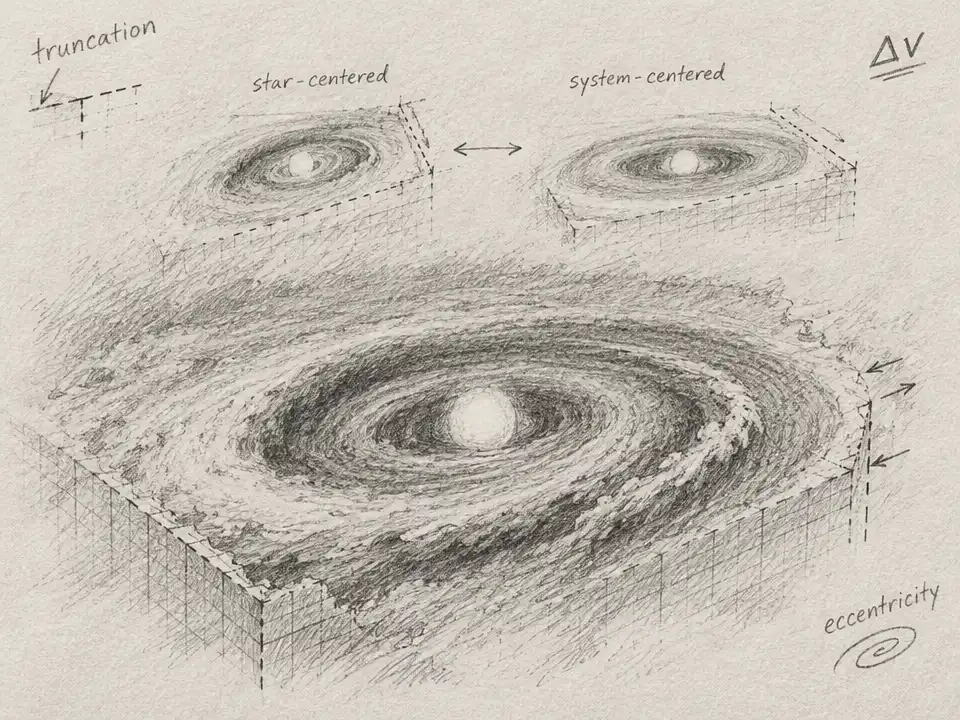
There are two natural ways to describe the system. In a system-centered, or barycentric, frame, the combined center of mass stays put while the central object can move. In a star-centered frame, the object at the middle remains fixed on the page, but the coordinates accelerate along with it. That second choice requires an extra bookkeeping force, an apparent push that accounts for the frame’s motion. If the whole disk is included and the equations are handled consistently, these are simply two descriptions of the same physics.
The catch is that simulations rarely include every last bit of a disk. Researchers often calculate only a convenient radial slice, even when the modeled disk continues beyond both edges. In this paper, the authors found that the slice’s boundaries can become part of the story. They derived equations for the disturbances and identified what they call “bracket modes”: patterns whose behavior depends on terms at the edges of the modeled region.
In their example, the truncated disk has a growing mode in the barycentric frame. It takes the form of a loosely wound, one-armed spiral: a broad, lopsided pattern rather than a tightly wrapped coil. In the star-centered frame, the corresponding edge-related mode is marginally stable—it neither grows nor fades. The disk has not undergone a physical transformation between the two calculations. Rather, the boundaries of the computational slice relate differently to the moving central object in each frame.
Why should a cut-off line matter so much? Imagine tracking a drifting crowd while drawing a rectangle around only part of it. If the rectangle stays fixed as the crowd shifts, it includes and excludes different people than a rectangle that travels with the crowd. In the disk model, matter still exists beyond the selected slice. Leaving it out removes part of the gravitational balance. In the authors’ idealized full-disk limit, the contributions that drive the barycentric instability cancel; truncating the model removes some of that stabilizing influence.
This is not the familiar kind of computer glitch where rounding errors accumulate or a grid is too coarse. The authors show that the edge-dependent modes are already present in the analytical equations, before any computer grid approximates them. A numerical calculation can reproduce the mathematics and still describe an artifact of the model’s boundaries. Even the stable version may matter: the authors find that it can act as a false reservoir of energy, taking energy from real disk patterns and returning it to others. That could distort the apparent strength of physical features.
The possible consequences are worth taking seriously, but not overreading. The authors say bracket modes could generate apparent large-scale spirals or eccentricity, redistribute disk material, and bias simulations of planet migration. Those are warnings about what a model could misrepresent, not proof that every simulated spiral is fake or that any specific observed disk has been misread. The analysis is linear and pressureless; the paper notes that pressure and more complicated conditions need further study.
The calculation method matters, too. In an appendix, the researchers find that a different, more conservative way of calculating the central object’s motion—using the system’s center of mass—does not produce these bracket modes in their analysis. That result underlines the paper’s central point: the apparent instability is not an unavoidable property of real disks. It depends on how the model is framed and constructed.
One robust remedy would be to model the disk from its inner cavity all the way to its outer edge, so that the omitted material no longer leaves a boundary hanging in the middle of the system. The authors note that this can be prohibitively expensive, and some young disks may not have a clear inner cavity to begin with. They recommend caution when simulations make claims about disk spirals, eccentricity, or planet migration—and suggest checking whether the result survives a change of reference frame.
There is a larger lesson hiding at the edge of this small model. A coordinate system is supposed to be a neutral way to tell a story about the universe. But combine a moving center with a truncated domain, and the bookkeeping can start to imitate a physical cause. Before asking what a simulated disk is doing, it may be worth asking a quieter question: what, exactly, did the model leave out?