Imagine handing a computer a precise list of equations and asking a simple-sounding question: if the system starts anywhere, will it keep running and eventually settle at the origin? For many familiar systems, mathematics gives a reliable test. For nonlinear equations, researchers have built powerful tools—but a new result shows that, in one carefully defined family, no procedure can always give the right yes-or-no answer.
In a paper submitted to arXiv on October 8, 2026, Ivan O. Shevchenko, Jun Liu, and Xinzhi Liu prove that global asymptotic stability becomes undecidable even for homogeneous cubic systems with rational coefficients, once the dimension is a sufficiently large fixed number. The threshold is fixed by their construction, but they do not calculate it. The surprise is not that some cases are difficult. It is that no algorithm can correctly classify every case in that family, no matter how long it is allowed to run.
Here, global asymptotic stability is a demanding promise. Every solution must exist for all future time; solutions that start near the origin must stay near it; and every solution, even one starting far away, must eventually approach the origin. “Homogeneous” means every term in each equation has the same total degree. In the cubic systems at the heart of the result, that degree is three.
Undecidable does not mean that mathematicians cannot analyze any particular system, or that computers are merely too slow. Many individual examples can be settled. It means there can be no universal algorithm that always halts and correctly says stable or not stable for every allowed input. The authors show an even sharper limitation: stable cases can be recognized in principle, but there is no matching procedure that recognizes every unstable case and always finishes.
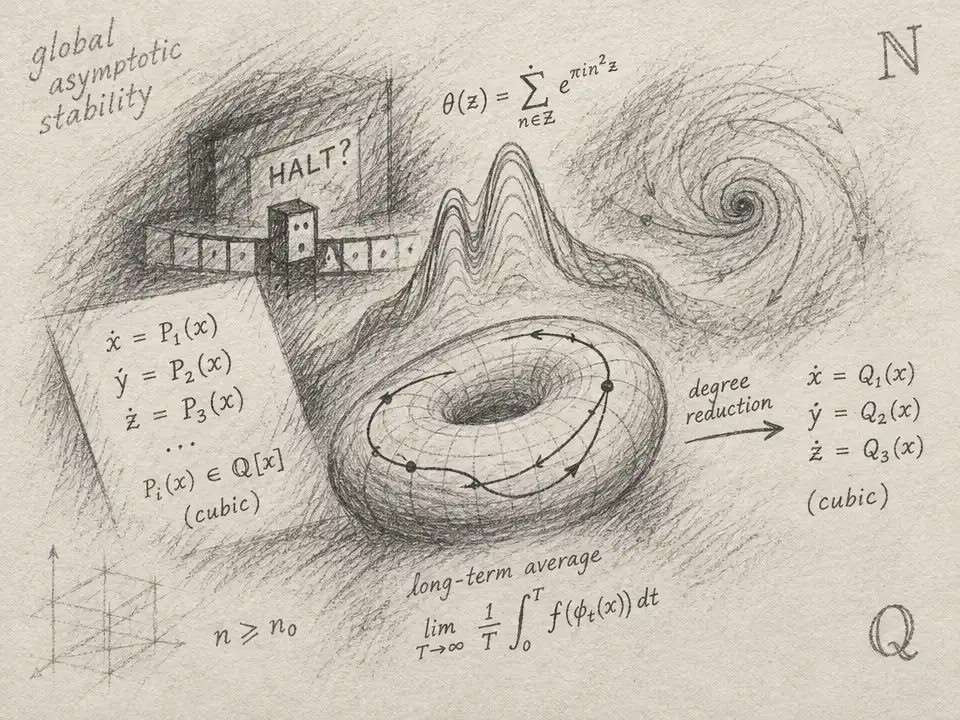
The proof’s first change of viewpoint turns a sprawling question about motion through all of space into a question about motion on a compact surface. Follow a solution and separate its direction from its distance to the origin. After adjusting the clock, the direction travels on a sphere, while the logarithm of the distance accumulates a rate determined by that direction. If the worst long-run average of this rate is negative, the system pulls trajectories inward and the origin is globally asymptotically stable.
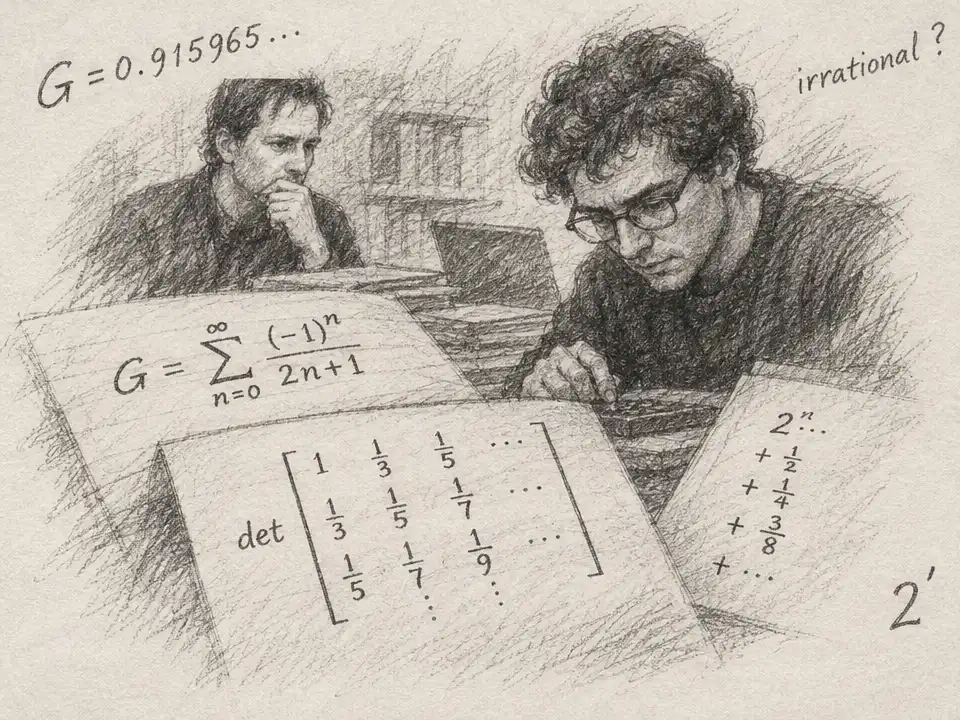
That average becomes a hiding place for computation. The researchers begin with the halting problem: no algorithm can decide, for every program, whether it eventually stops. A classical result in mathematical logic lets them translate the question into a fixed template of integer polynomial equations. The right-hand side of the template depends on the program, and the equations have an integer solution exactly when that program halts.
Next, the authors build a mathematical detector for those integer solutions. Products of Jacobi theta functions—a special family of functions with carefully structured expansions—are arranged so that a particular average, called a constant term, adds positive contributions from solutions. If at least one integer solution exists, the signal is positive; if none exists, there is nothing to contribute. Positive contributions matter because they cannot cancel one another out.
A formula alone would not be enough. The detector has to live inside a polynomial differential system whose coefficients are rational numbers, and the final stability claim concerns every possible starting point. The paper constructs polynomial dynamics that reproduce the needed theta-function behavior, then uses constraints and long-run averages to single out the intended motion. Its technical work is largely about ruling out misleading trajectories: unrelated recurrent motion must not imitate the signal or create a false stability result.
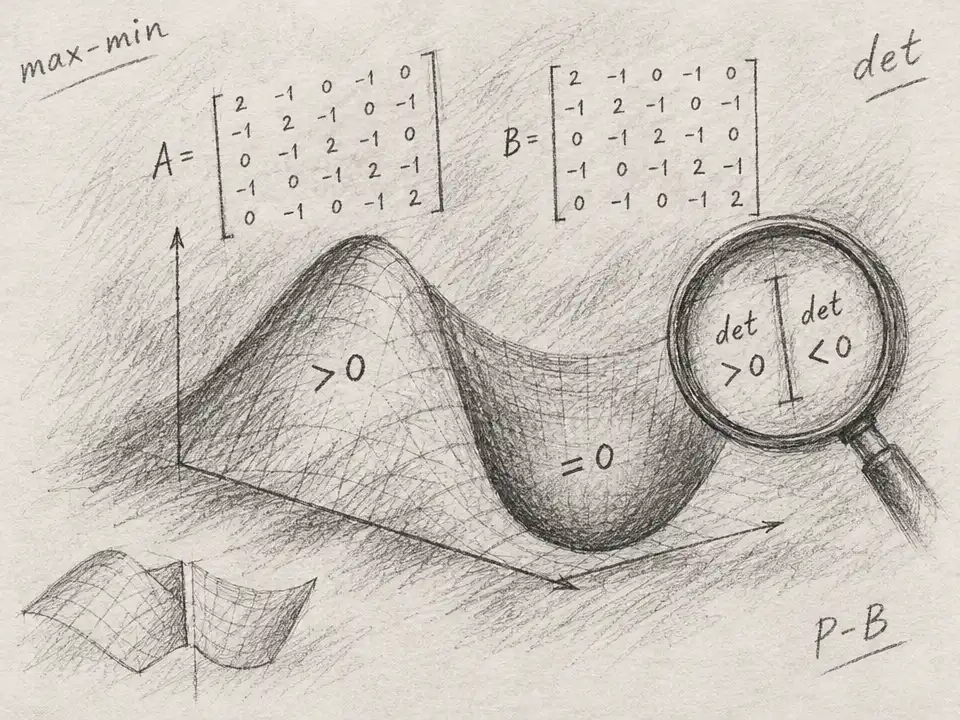
Finally, the encoded signal is converted into an inward-or-not-inward average for a homogeneous polynomial system. The constructed system is globally asymptotically stable exactly when the original program halts. Feed an algorithm the system’s rational coefficients, and a correct stability decision would answer the halting question too. Since no algorithm can solve that question for every program, no such universal stability test can exist.
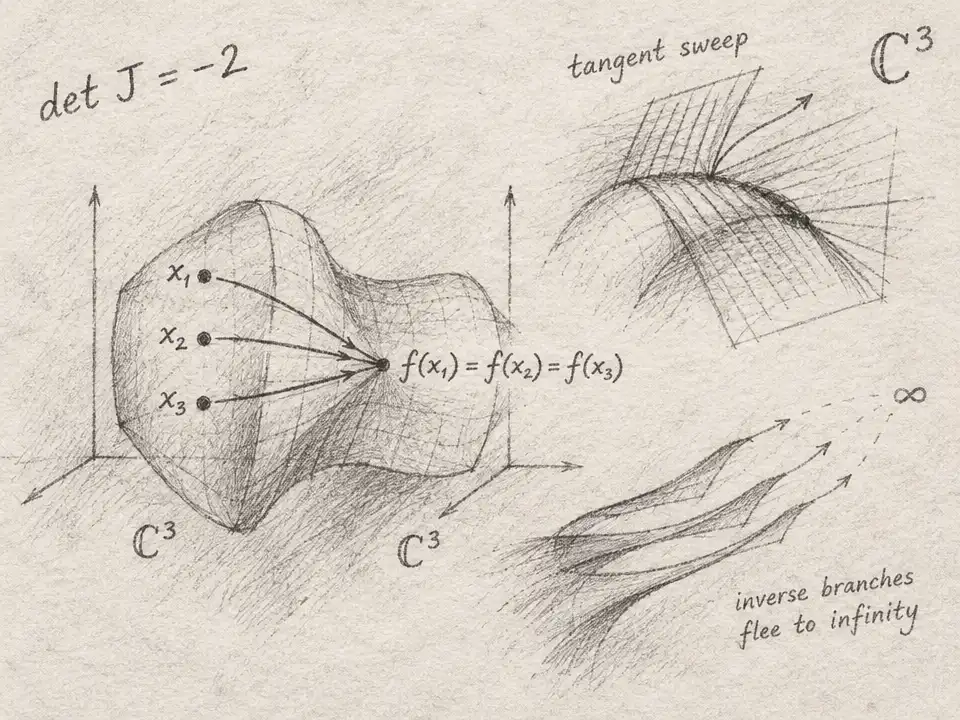
There is another twist. The initial encoding can involve equations of a higher odd degree, but the authors show how to reduce the stability question to cubic equations. They give every monomial of a chosen degree its own coordinate, embedding the original motion in a higher-dimensional space. A carefully designed cubic penalty pushes trajectories back toward the embedded surface. This is more than a bookkeeping trick: it controls starting points that do not lie on the surface, which a global stability theorem must account for.
The limits are important. The result concerns dimensions above an unspecified threshold, not every cubic system or every dimension. The paper notes that homogeneous stability questions in the plane are decidable; whether the same undecidability already occurs for three-dimensional cubic systems remains open. So this is not a verdict on ordinary simulations or a claim that all nonlinear models are unknowable. It is a precise boundary: beyond a certain fixed dimension, the equations can conceal a computational question no algorithm can always extract.
That is the unexpected turn. A stability test seems to ask whether motion ultimately points inward. But the authors show how a system’s long-run patterns can carry the answer to a question about computation itself. The equations are still finite and exact; what defeats the algorithm is the meaning packed into their dynamics.