A tiny silicon nitride beam is set vibrating, then watched as it settles down. In the simplest version of the experiment, its motion fades in the familiar way: each swing is smaller than the last, tracing a steadily shrinking spiral toward rest. But add a second tone to the drive, and the beam can linger in motion long after the ordinary explanation says it should be on its way down.
The lingering is not a sign that the beam has stopped losing energy. Instead, a mathematical “ghost” in the resonator’s phase space slows its approach to a quieter state. The surprising part is that this ghost can remain influential even after the fixed point it came from has disappeared. The result offers a striking reminder that how a device relaxes can depend not just on friction, but on the shape of the routes available to it.
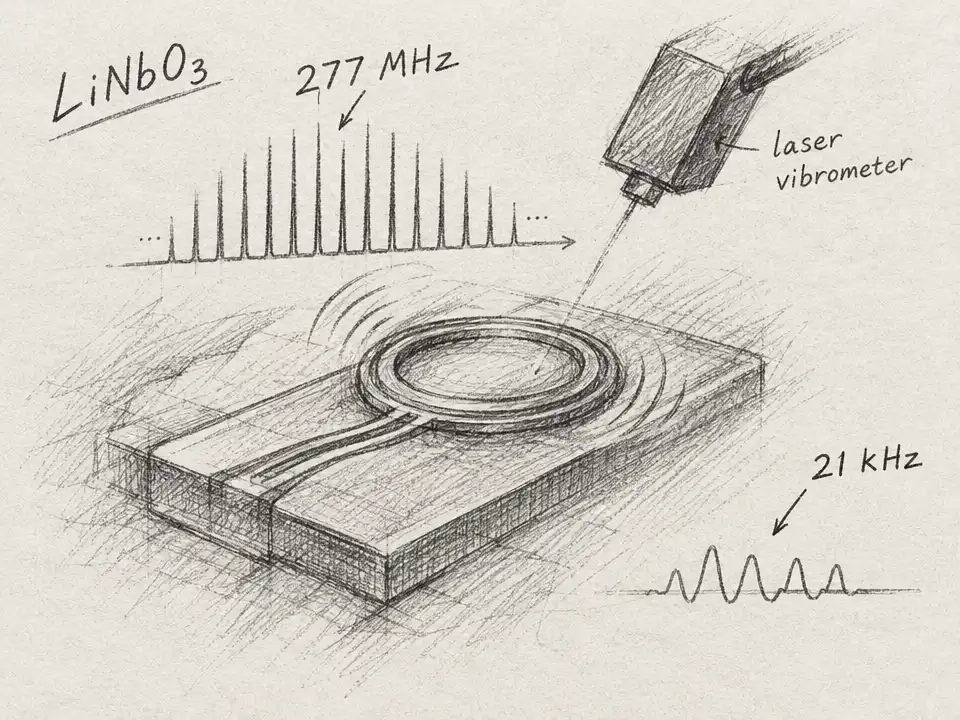
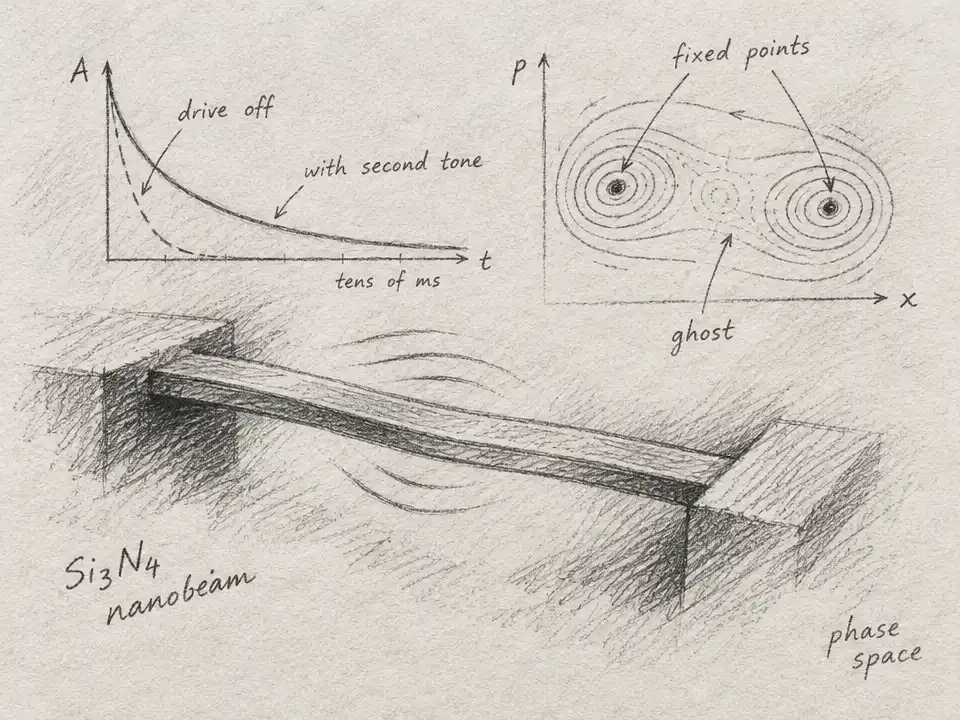
Samer Houri, Agnes Zinth, and Menno Poot studied the motion of a suspended silicon nitride beam about 110 micrometers long. A nearby optical cavity served as a sensitive motion detector: the beam’s movement shifted the cavity’s resonances, changing the light transmitted through the device. The beam’s ordinary resonance frequency was 2.4471 MHz, and its measured quality factor was about 46,600. In plain terms, it was a very lightly damped mechanical string, capable of oscillating for a long time.
First came the baseline. Drive the beam at one frequency, then switch that drive off. Its amplitude decays exponentially, with a reported decay time of about 3.0 milliseconds. Even when the beam is driven hard enough to behave nonlinearly, switching off the only tone produces a straightforward inward spiral in the researchers’ measurements and simulations. It is the sort of result that makes “ringdown” sound simple: remove the push, and the motion ebbs.
Then the researchers changed what “remove the push” meant. They used two tones at the same frequency. One tone stayed on; the other, called the switching tone, was turned off. Before the switch, both tones helped set the beam’s motion. After it, the remaining tone continued to shape the forces acting on the beam. The researchers tracked the resulting motion not just as a changing amplitude, but as a path through phase space—a map of the oscillation’s two measured components.
That map revealed the key difference. With the continuing tone in place, the beam’s motion could settle into more than one stable state: a lower-amplitude state or a higher-amplitude one. Between them lay an unstable fixed point, a saddle in the phase-space landscape. Picture two valleys separated by a narrow pass. A trajectory that comes close to the pass can slow dramatically before moving on, even though nothing has physically blocked its way.
The team saw paths that approached this unstable point and then “scattered” away from it. In one case, the beam’s motion remained at high energy for more than 70 milliseconds before its amplitude began to decay toward the final state. That is far longer than the roughly 3.0-millisecond decay time measured for the ordinary ringdown. The tone that remained on mattered: it supplied energy that could offset the beam’s ongoing losses while the motion lingered.
The more unexpected test came when the researchers adjusted the drive beyond the bistable region. There, the high-amplitude fixed point and the unstable point had vanished. A simple picture might predict that, with no extra resting point to approach, the beam would now relax promptly to the remaining low-amplitude state. Instead, some trajectories still slowed and gathered along a shared path before continuing downward.
The authors explain this delay through a “ghost”: a lingering influence of the vanished pair of fixed points. It is not a hidden object or a second vibration. It is a feature of the system’s dynamics, visible in how motion through phase space slows in a region where the old fixed points used to shape the flow. In measurements near this ghost, the delay could last tens of milliseconds; one analyzed trajectory showed a delay of about 20 milliseconds. The paper reports that such delays can span several decay times.
Crucially, this was not simply an apparent pause created by subtracting the beam’s final motion from the measurements. The researchers’ simulations showed a delay in both amplitude and mechanical energy, with and without subtracting the final state. Nor did the model need an extra form of nonlinear damping to reproduce it. The beam still experienced damping throughout. During the long-lived episode, the remaining drive did work on the resonator, compensating for energy lost along the way.
That energy exchange makes the motion less like a ball rolling downhill with the motor switched off. In the two-tone setup, the motor is not entirely off: the continuing tone keeps acting on the beam. The researchers also found that mechanical energy could temporarily rise above its starting value or fall below its eventual value before settling. Those changes reflect energy exchanged between the resonator and the drive, not a suspension of the usual rules of energy conservation.
So the overturned expectation is not that a damped beam can ring forever. It is that the route to rest need not be a smooth, predictable fade. By shaping the phase-space landscape with two tones, the researchers could steer the beam through regions where motion slowed sharply—even past the disappearance of the fixed points that helped create those regions. The experiment turns a familiar fading vibration into a probe of hidden structure in nonlinear dynamics, and suggests that controlling those slow passages could be useful in the design of sensitive nanomechanical devices.