Turn up an oscillating force on a bound quantum system, and you expect it to come apart faster. Push harder, and more particles should escape. But in a recent experiment, researchers found a counterintuitive reversal: beyond a certain strength, a stronger drive could leave more atoms trapped. The cloud did not merely shrink less. It split into two distinct lobes, as if the force had redrawn the landscape holding it together.
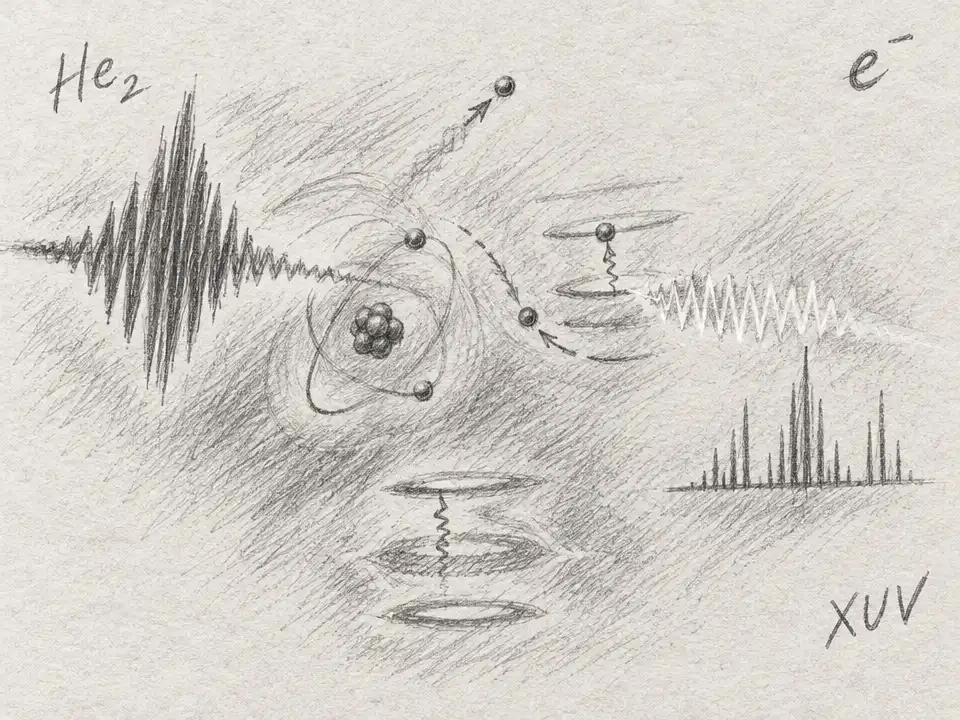
The result is an experimental glimpse of strong-field stabilization, a long-discussed prediction about atoms in intense laser fields. The researchers did not blast ordinary atoms with a super-powerful laser. Instead, they used a carefully controlled cloud of ultracold strontium atoms to emulate how an electron behaves when a powerful oscillating field drives it. That distinction matters: the experiment tests the physics in an analog system, where the motion can be watched and tuned in detail.
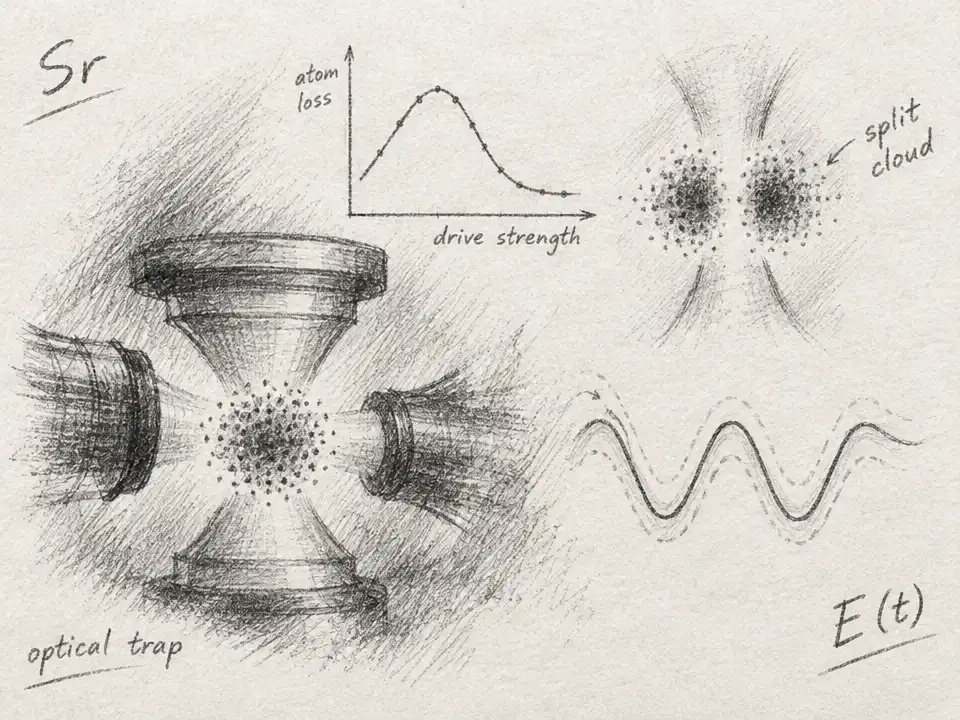
The team began with roughly 250,000 atoms of strontium-84 in an optical trap—a bowl of light that holds the atoms in place. By moving the trap back and forth, they made the atoms experience an inertial force. In a suitable moving frame, that force plays the role of the electric force that a laser exerts on a bound electron. The trap supplies the binding; its shaking supplies the drive. The mapping lets researchers explore extreme field behavior without needing a laser that can produce those conditions directly.
At modest shaking strengths, the intuition works: atoms get knocked out of the trap. The team measured this escape, or “unbinding,” by counting how many atoms remained after different drive durations. At a drive frequency of 40 hertz—about 1.43 times the trap’s natural frequency—the loss rate first rose as the shaking grew stronger. Then it reached a peak and fell. With a pulsed drive, the surviving population likewise stopped declining and began to recover at the largest amplitudes they tested.
That downturn is the surprise. The drive has not weakened; it has become strong enough to change the effective shape of the trap. Instead of one central basin, the time-averaged landscape develops two low regions on opposite sides. The trapped cloud follows suit, dividing into a pair of lobes. Researchers had predicted this kind of wavepacket bifurcation, but now the team could image the split directly. In a separate measurement, the two parts expanded and overlapped after the trap was switched off, producing interference fringes—a sign that the split retained quantum coherence.
The change of shape helps explain why stronger shaking can sometimes hold atoms more securely. Below the threshold, the cloud largely tracks the moving trap and loses atoms as it is driven. Above it, the two lobes gather near the trap’s turning points, where the motion changes direction. The researchers’ time-resolved images showed that the lobes moved with little drift and interacted with the trap as it slowed. Their interpretation is that repeated emission and recapture, together with the altered average potential, creates an unexpected kind of confinement.
This mechanism is easiest to picture when the drive is much faster than the trap’s natural motion: rapid oscillations can blur into a smoother, time-averaged landscape. But the experiment’s strongest surprise was that stabilization persisted even at much lower frequencies, including drives near and below the trap’s natural frequency. That is a regime where a simple “the system just averages over fast shaking” explanation is less comfortable. The researchers mapped stabilization across drive frequencies from 25 to 40 hertz and found that lower frequencies required stronger applied forces.
There is a catch on the way to stability. Between gentle shaking and the stabilizing regime lies a range where loss is especially severe—a “death valley” in the field’s terminology. The cloud can shed many atoms while the drive ramps through this unstable zone. Pulse shape therefore matters: the researchers found that, once a pulse is strong enough to reach stabilization, a faster ramp through the high-loss region can help more atoms survive. Simply increasing the peak strength is not the whole story; the route there counts too.
To compare their cold-atom system with laser-driven atoms, the team translated the experimental settings into equivalent strong-field parameters. Under that mapping, the explored photon energies span 0.04–8 eV, and the strongest drive corresponds to a synthetic intensity of about 1021 W/cm2. Those are comparison values, not laser intensities applied to the strontium cloud. The actual experiment used a moving optical trap, whose controllability let the team inspect the dynamics cycle by cycle.
The finding does not mean that atoms become indestructible when light grows intense, or that any strong field will protect a bound state. Stabilization appears only in particular drive regimes, and the passage through the high-loss zone can be destructive. Nor does an analog experiment settle every question about real atoms in laser pulses. What it does provide is direct evidence that a strong oscillating drive can reorganize a bound quantum state—and, under the right conditions, make escape less likely rather than more.
For decades, the idea seemed to demand extraordinary laser conditions and remained difficult to pin down experimentally. Here, the laboratory substitute was a cloud of atoms, a movable trap, and enough control to watch a quantum state change shape. Turn the drive up, and the single basin becomes two. The particles that should have been swept away instead find new places to linger. In this small, cold system, greater force does not simply mean greater destruction; it can build a different kind of shelter.