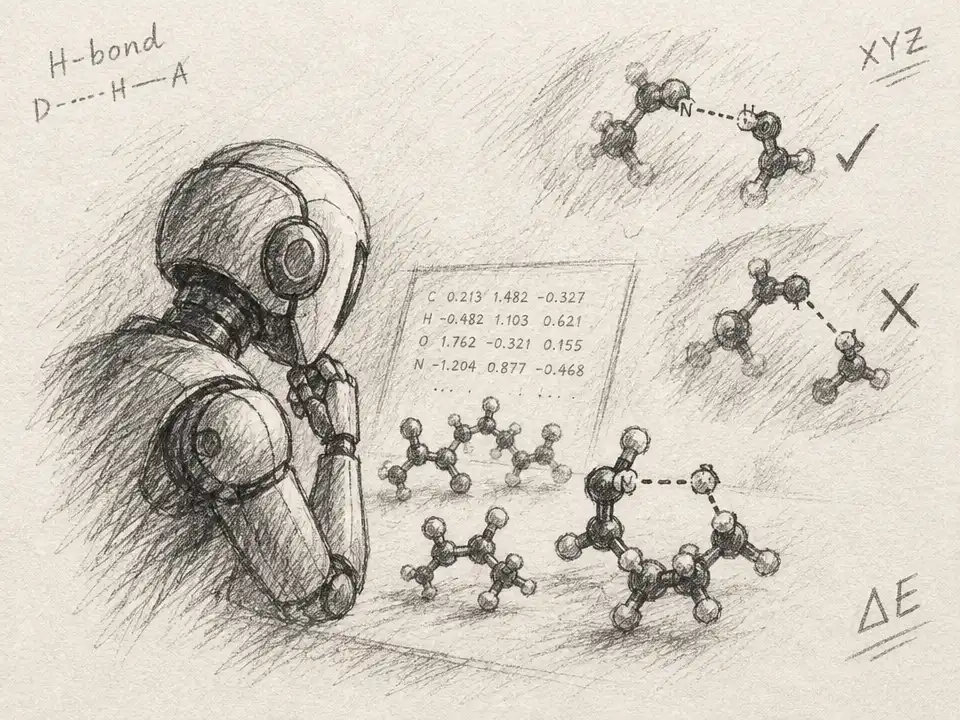
A molecule can arrive on a computer screen as a long column of letters and numbers: atom names followed by three coordinates for each atom. To a chemist, those coordinates describe a shape. To a language model, they are just text—unless the model has somehow learned to read the shape hiding inside them. In a recent test, researchers asked general-purpose language models to do just that: compare different shapes of the same small molecule and rank them by stability. The experiment brought two unlikely interpreters together: a model trained to predict language and the physics that helps determine a molecule’s preferred form.
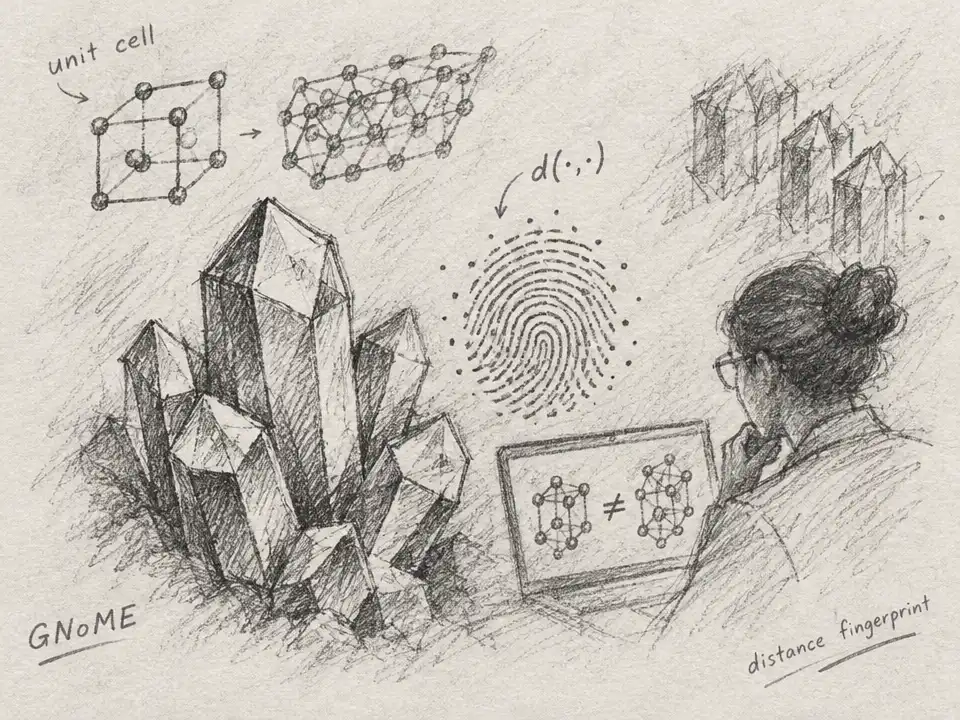
The puzzle is that one molecule can fold into several shapes, called conformers. Its atoms and bonds stay the same, but bonds rotate and atoms shift in space. Some arrangements are energetically more comfortable than others. A chemist can reason about close contacts, twisting bonds and attractions between parts of the molecule; a quantum-chemistry calculation can estimate the relative energies. But could a language model, given only coordinates, make a useful ranking without being shown the molecule’s name, its known energies or a tool for calculating them?
The researchers tested 28 language models on 810 conformers from 27 molecules. Each model received coordinates in text form and was asked to rank 30 shapes of one molecule from most stable to least stable. The researchers shuffled the input and labels to reduce the chance that position or numbering could give away the answer, and rotated the coordinate sets to make simple recall of familiar structures less likely. Reference rankings came from quantum-chemistry calculations, with a subset checked against a more demanding calculation. For scoring, the team focused on conformer pairs whose reference energies differed by at least 2.0 kcal mol⁻¹.
The result was not a clean triumph or a clean failure. Older models generally ranked shapes close to random, while several newer ones showed a meaningful ability to sort them. On the paper’s Conformer Ranking Accuracy measure, GPT-6 Astra scored 0.67 and Claude Opus 5 scored 0.61; the general-purpose force field GFN-FF scored 0.72. The more specialized MMFF94 force field scored 0.93, while the older Universal Force Field scored 0.23. These scores describe agreement in ordering—not the percentage of conformers each system got right. The models were learning something useful, but they were not replacing a well-matched chemistry tool.
To see what that “something” might be, the researchers examined the molecules where the models did best. A recurring clue was the hydrogen bond, an attraction that can form when appropriately positioned parts of a molecule interact. In most of the tested pairs with different numbers of hydrogen bonds, the more stable shape had more of them: that was true in 715 of 805 such pairs. A model that recognizes those attractions and counts them has a handy route to many correct comparisons. The researchers’ analysis found that models often did well on these conventional cases, sometimes approaching perfect ranking on that subset.
Then came the trap. In 90 pairs, the shape with more hydrogen bonds was actually less stable. Models that leaned heavily on “more hydrogen bonds means more stable” often leaned the wrong way, reversing their ranking. This is the kind of failure that makes the experiment more revealing than a single high score. The models had not simply acquired a dependable molecular energy calculator. They had picked up a useful chemical pattern—and, in many cases, treated it as a rule even when the surrounding geometry contradicted it. The more successful a model was on the conventional hydrogen-bond cases, the more it tended to stumble on these exceptions.
The researchers also compared pairs with equal numbers of hydrogen bonds, where merely counting them could not settle the ranking. On this harder set, some newer models still performed better than the Universal Force Field, and GPT-6 Astra reached the range of GFN-FF. The improvement suggests the models’ performance was not entirely a hydrogen-bond shortcut. Yet the pattern remained uneven: models tended to do better when their explanations discussed hydrogen bonds, while talk of ring strain and twisting strain did not show the same helpful connection. Those stresses can arise from constraints spread across a molecule, rather than from one clearly named attraction.
That difference hints at the crossover at the heart of the study. Chemistry describes matter through physical interactions, but it also builds a vocabulary for talking about them. Hydrogen bonding has a well-established name and a relatively clear account in scientific writing. More distributed distortions can be harder to sum up with one verbal label. The researchers suggest that language models may be better at physical reasoning when scientific language has already made the relevant concept legible. In this picture, words are not a substitute for physics. They are a map that may help a model connect coordinate patterns to physical meaning—and may leave blank areas where the map is less precise.
There are reasons to be cautious about what the experiment proves. The test covered only 27 small molecules, most drawn from one dataset, and the especially revealing “more hydrogen bonds, less stability” category contained 90 pairs. Written explanations also cannot show exactly how a model reached its answer. The researchers ran a recall check and found that models were poor at estimating stored conformer energies, which weighs against simple memorization as the explanation. But a small benchmark cannot establish that a model understands molecular geometry in the broad, reliable way a chemist or a specialized simulation method might.
Still, the test points to a useful question for future research: when a model seems to reason about the physical world, what clues is it actually using? Here, the answer was partly visible in the way performance changed across different kinds of molecular comparisons. A language-based system could infer something about three-dimensional arrangements from numbers on a page, but its strongest foothold came from a familiar chemical interaction—and that foothold sometimes became a blind spot. For molecular design, such a model might help generate ideas or sort candidates, but its rankings would need independent checks. The coordinates opened a door between language and chemistry. The misranked molecules showed where that doorway still narrows.