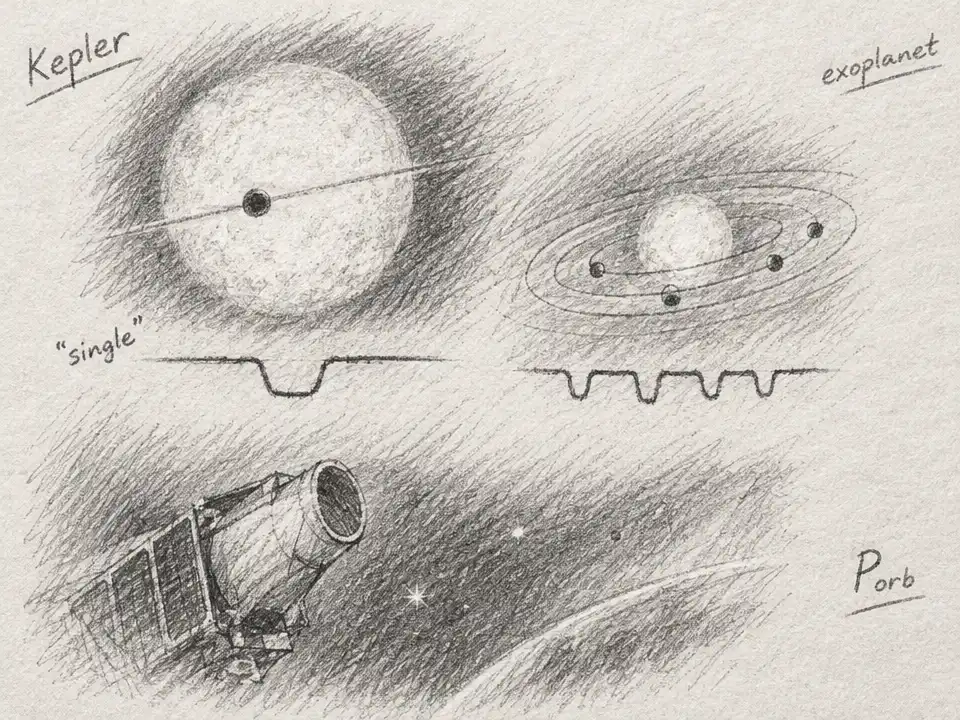
A planet crosses the face of its star, and the star’s light dips. Kepler catches the dip, records one planet, and files the system as a “single.” It sounds like a straightforward census: one world, one star. But a new analysis suggests the label may say as much about what Kepler could see as about what the system actually contains.
The puzzle has two layers. Kepler found more systems with one detected transiting planet than early models expected. And among those “singles,” the detected signals tend to be weaker than the signals in systems where Kepler saw several planets. Were some weak signals false alarms? Were singles a genuinely different kind of planetary system? Or were planets hiding in plain sight?
Daniel Yahalomi and colleagues set out to test those possibilities using Kepler’s catalog and a computer model of planetary systems. Their carefully selected catalog contained 2,557 planet candidates: 1,485 in systems with one detected transiting planet and 1,072 in systems with two or more. Those counts describe detected transits, not necessarily the full populations of planets around each star. A “single,” in this study, means one planet made it into the catalog.
The distinction matters because finding a transit is a game of geometry and patience. A planet must pass between its star and the telescope’s line of sight. Then it must do so often enough, and dim the star clearly enough, for the signal to rise above the noise. A faraway planet takes longer to complete an orbit, so it crosses less often. Its orbit is also less likely to line up just right for a transit. And with only a finite observing record, there is a point beyond which Kepler cannot collect enough repeat crossings to confirm a planet by its transits.
That creates a quiet bias in the catalog. A system earns the label “multi” only if Kepler catches at least two planets transiting. That is a tougher bar than catching one. Several planets must have favorable alignments, and their signals must each clear the detection limits. At longer orbital periods, both conditions become harder to satisfy. A system with several planets can therefore enter the catalog as a single when only one member happens to show itself.
The data offer clues to this effect. In the researchers’ sample, the detected planets in single-transit systems had a median orbital period of 13.8 days, compared with 12.1 days for planets in multi-transit systems. Their host stars were also noisier on average, which makes faint signals harder to pick out. The singles’ planets were slightly larger, however—a difference that should make their transits easier to detect, not harder. When the team compared systems with similar properties, orbital period stood out as the main contributor to the signal-strength gap.
Then came a useful test: the researchers asked what would happen if they gave the single-transit planets the orbital periods seen in multi-transit systems. The resulting simulated signal strengths looked much more like the signals of the multis. A separate comparison that matched systems on orbital period, planet size relative to the star, and stellar noise brought their signal-strength distributions close together. In other words, the weak-signal excess did not require a special breed of faint or suspicious planets. The different periods helped explain it.
To see whether hidden companions could account for the broader pattern, the researchers turned to ExoMOD, a model that builds planetary systems and simulates which planets Kepler would detect. Crucially, its simulated detections contain no false positives. Yet the model produced the same broad trend: systems cataloged with more transiting planets tended to have stronger signals. That means false alarms are not needed to create the trend, though the authors note the real data leave room for some additional false-positive contribution among singles.
The model’s most striking result is that 85% of its detected singles belonged to systems that actually contained multiple planets. Even among the modeled single-transit planets with orbital periods longer than 100 days, 73% came from multi-planet systems. The catalog’s “lonely” worlds, in this simulation, were usually members of a crowd with most of its members missing from view.
Where those hidden planets sit depends on the planet Kepler did detect. For shorter-period singles, the model often places undetected companions farther from the star. For detected planets beyond 100 days, it more often places missed companions on inner orbits. Some may be too small to register; others may not cross the star from our viewpoint. The model also finds that many systems already classified as multis are incomplete. The telescope’s catalog is not a complete inventory even when it has found more than one planet.
The important caveat is that a model showing how selection effects can produce the observed pattern does not prove that every single-transit system is secretly a multi. The study shows that the detection process is sufficient to explain the low-signal excess and the longer periods of cataloged singles; it cannot rule out real differences between planetary systems. The model also stops at 300-day orbits, which limits what it can say about the longest-period planets in the catalog.
Still, the result changes how to read a small label in a vast catalog. “Single” need not mean solitary, just as “not detected” need not mean absent. Kepler’s planets are not simply counted; they are filtered through alignment, timing, signal strength, and the length of the observing run. Sometimes the surprise is not a new planet, but how many different planetary families can look like one world passing in front of one star.