A black hole’s horizon seems to draw a hard line around its secrets. Cross it, and no message can come back out. Yet a new theoretical study asks whether the black hole’s own ringing could carry clues about what lies far deeper inside—without sending anything across that one-way boundary.
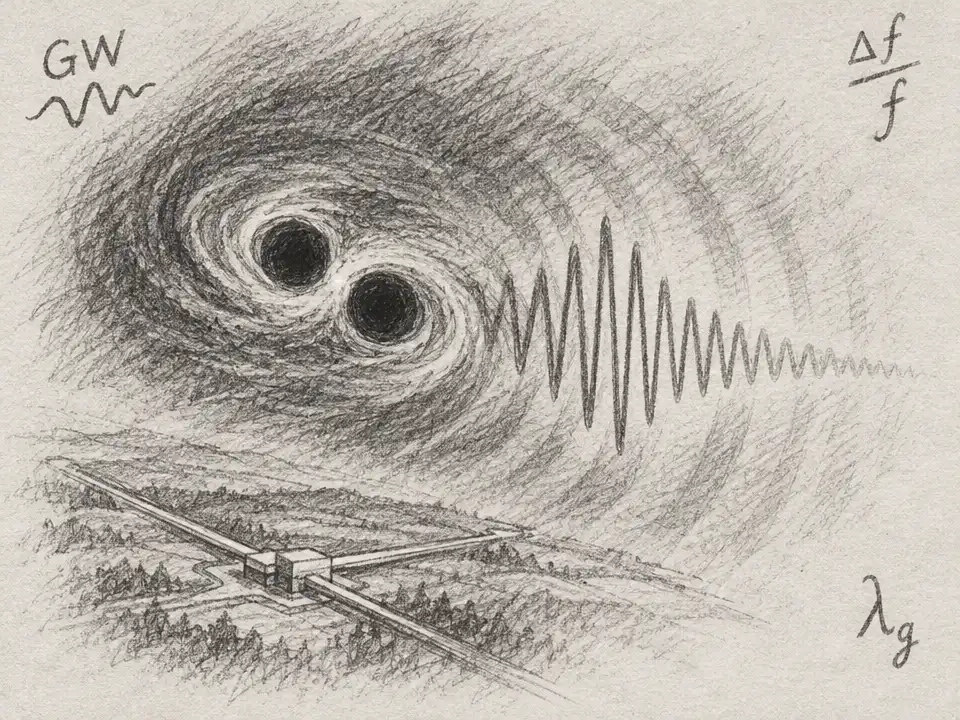
The ringing is not sound. It is a pattern of waves, called quasinormal modes, that describes how a black hole settles after a disturbance. Like a bell’s changing tones, the modes have characteristic frequencies and lifetimes. The study’s central idea is that the faintest, most rapidly fading modes may be unusually sensitive to the black hole’s inner geometry. Read their pattern carefully, and an invisible core might leave a trace in a signal available outside.
That possibility comes with a demanding condition: the researchers need the modes with very high overtone numbers. An overtone is a step in a sequence of modes; as the number rises, these modes become increasingly damped. The team worked out how the way their frequencies shift across the sequence can reveal the scaling of the geometry near a singularity. Comparing modes with different angular patterns helps isolate that clue from other features of the calculation.
The result is a kind of indirect interior map. It does not show a picture of a black hole’s center, or track a probe traveling inward. Instead, it turns the modes’ mathematical pattern into a measure of how sharply the interior geometry changes near the singularity. The method is designed to work even when the exact global pattern of wave paths—their Stokes topology—is not fully known, because the scaling of the frequency shifts carries information that is less dependent on those details.
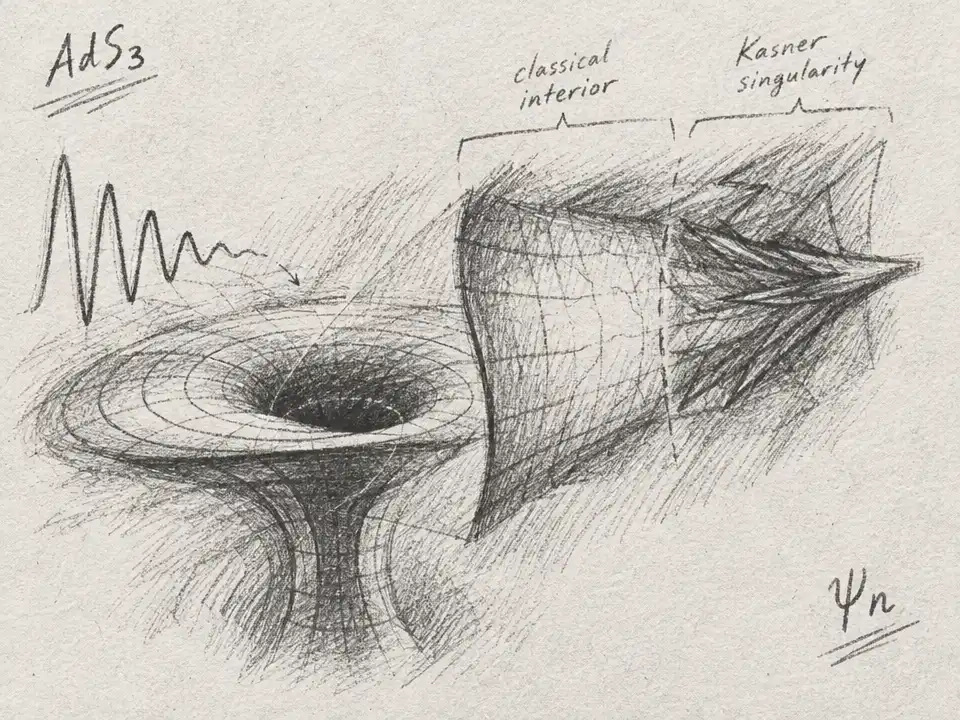
To test the idea, the authors chose a specific theoretical setting: a quantum-corrected version of the three-dimensional BTZ black hole, a solution in anti-de Sitter space. The original BTZ black hole has no curvature singularity at its center. In the quantum-corrected model, however, the interior changes character as one moves inward. The solution is exact within its theoretical framework, which matters: small corrections to an ordinary black-hole solution may fail to describe the deep interior, where those corrections can become as important as the original geometry.
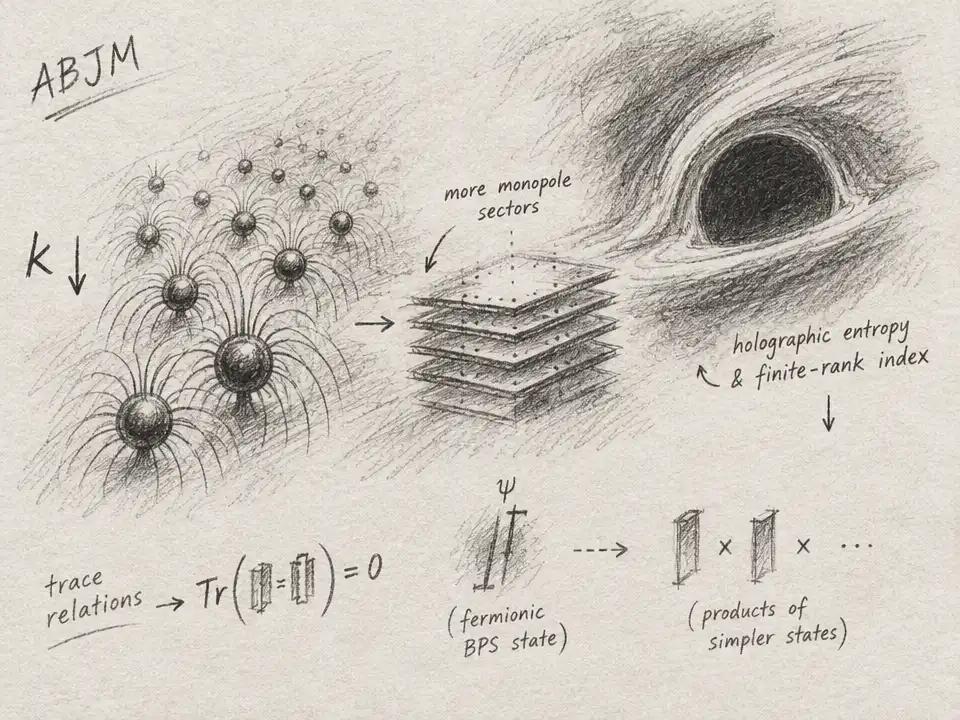
For a range of distances inside the modeled black hole, the geometry resembles the classical BTZ case. Deeper in, quantum corrections take over and the geometry approaches a Kasner singularity, a region where different directions change scale at different rates. In this model, the classical regime has Kasner exponents of zero and one; the quantum-dominated regime has exponents of minus one-third and two-thirds. These numbers are not measurements from a real black hole. They describe how the model’s geometry behaves near its interior boundary.
The wave calculation picks up the same handoff. The researchers track an effective scaling exponent built from differences in the mode frequencies. In the classical BTZ limit, it approaches zero; in the quantum-dominated regime, it approaches one-quarter. Their analysis and numerical calculations show a crossover between those patterns as the overtone number increases. In the paper’s language, the shift marks a transition between classical and quantum “Kasner eons”—not eras in a black hole’s lifetime, but stretches of its interior governed by different geometric behavior.
That distinction matters. A rising overtone number does not mean the black hole is aging, or that a wave is literally diving farther inward. Rather, the sequence of modes probes the modeled geometry in increasingly fine detail. The result is a mathematical signature of the hidden transition, recovered from the wave spectrum. The team also finds that the crossover depends on the strength of the quantum corrections: when they are large, the classical-like regime can disappear, leaving the quantum behavior dominant from the outset.
What could this unlock? If the method survives beyond this example, researchers might use waves measured outside a black hole to test competing ideas about its interior. It could offer a new way to ask whether quantum effects reshape the region where classical gravity predicts a singularity, and whether different theories leave distinguishable fingerprints in black-hole signals.
But the price of that reach is steep. This is a theoretical calculation, not an observation of a black hole or a demonstrated analysis of telescope data. The study uses a carefully chosen, exact model in three-dimensional anti-de Sitter space, rather than establishing that the same signal can be recovered from astrophysical black holes in our universe. The authors identify broader directions for the method, but those extensions still need to be worked out and tested.
There is also the overtone problem. For very small quantum corrections in the model, the spectrum would need to reach hundreds of thousands of modes before the quantum-dominated pattern becomes clear. Because the modes at issue are highly damped, extracting such a pattern from a real signal may be difficult. The paper does not show that current observations can reach it.
For now, the advance is a proof of possibility: under the right conditions, a black hole’s mathematical ringing can encode a transition hidden behind its horizon. The next frontier is finding out whether nature supplies a signal strong enough to read. The answer could turn black-hole waves into more than a record of how a collision settles. They might become a rare form of evidence about what gravity does where our best-known description begins to fail.