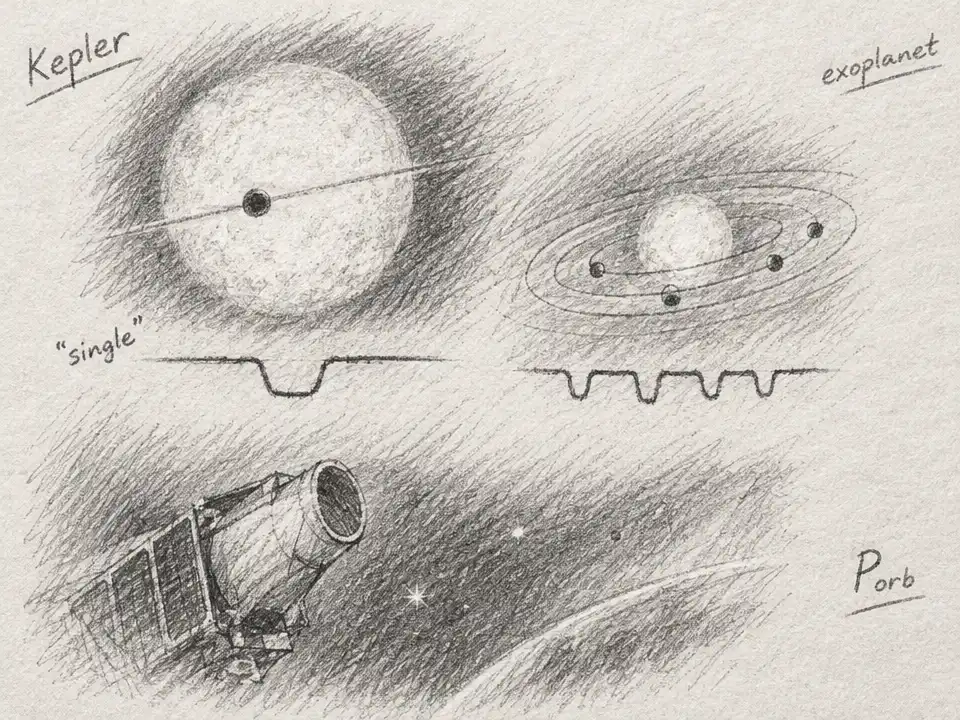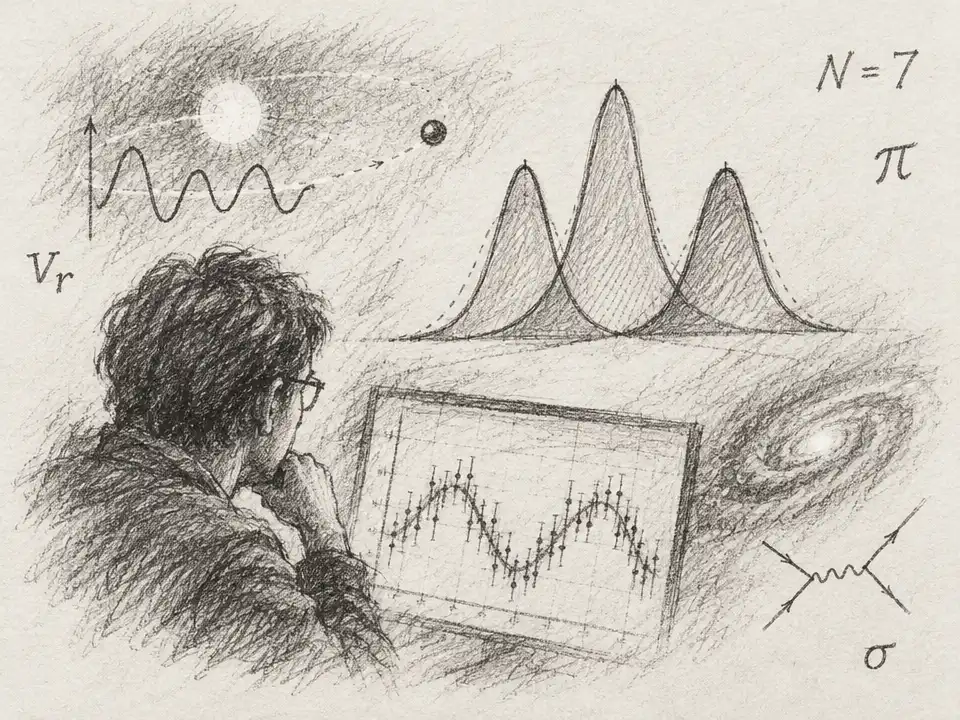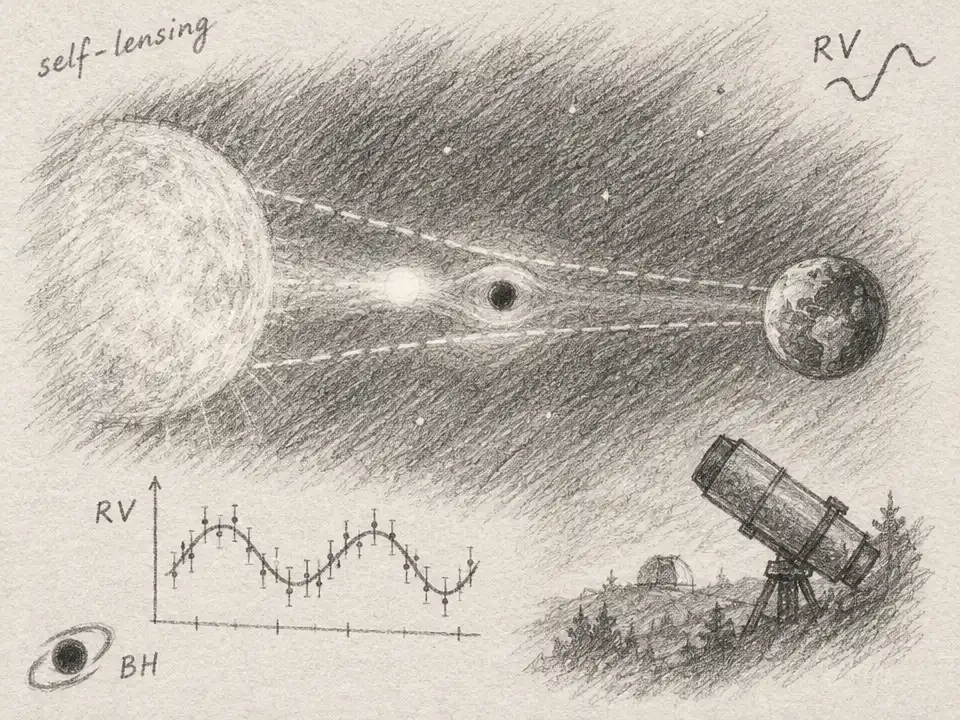
A star dims, then brightens again. If the dip repeats on schedule, a planet crossing the star’s face may be the cause. But a planet is only one possibility: a companion star or another signal can imitate the same pattern. Astronomers have thousands of such unresolved candidates to sort through, and each one may call for more observation. A new study asks whether machine learning can help decide which clues deserve a closer look—and whether planet hunters can make better use of two surveys by teaching their data together.
The surveys in question are Kepler and TESS. Both searched for planets by watching stars for the characteristic dips caused by transits, but they did not build identical catalogs. Their observing strategies and the stars and candidate signals they captured differ. That difference creates a familiar problem in machine learning: a system that learns from one collection of data may stumble when the next collection comes from a different source. A classifier can mistake the habits of a survey for the signatures of a planet.
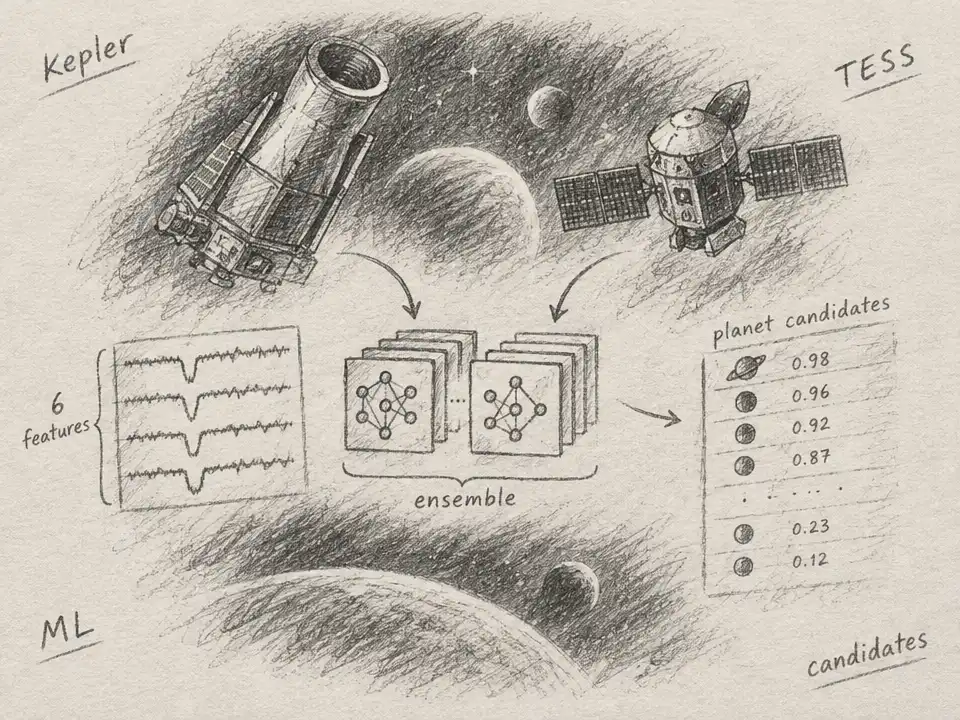
The researchers tested that problem directly. They used six cataloged measurements: the candidate planet’s orbital period and radius, its star’s temperature and radius, and the transit’s depth and duration. These are not six independent clues. For instance, transit depth depends on how the planet’s size compares with its star’s, while the duration reflects the orbit and the star. But taken together, the measurements describe a transit in ways that can help distinguish confirmed planets from false alarms.
Instead of betting on one algorithm, the team compared eleven standard machine-learning models. They trained and tested them in different combinations: Kepler data predicting Kepler outcomes, TESS predicting TESS, and one survey being asked to predict the other. They also tried training on both catalogs together. To make comparisons fair, they repeatedly drew balanced samples of confirmed planets and false positives from the surveys, using 80% for training and 20% for testing, and repeated the process 20 times.
The mismatch mattered. When a model learned from just one survey, its performance generally weakened on the other. The promising turn came when the researchers combined Kepler and TESS examples. The shared training set exposed the algorithms to a wider range of candidate properties, helping them work across both catalogs instead of overfitting to one survey’s particular mix. In this case, the bridge between two fields was practical: machine learning’s challenge of generalizing across different data sources met astronomy’s need to compare discoveries made by different instruments.
The best-performing approach combined three models: a random forest, a neural network called a multilayer perceptron, and XGBoost, a method built from decision trees. Each model was trained through repeated resampling, and the researchers averaged 60 scores for each candidate—20 predictions from each of the three models. The point was not to have a computer declare a planet discovered. It was to create a more stable ranking, so astronomers could spend follow-up time first on candidates that looked most promising.
That ranking was applied to 4,701 unresolved TESS candidates and 1,874 unresolved Kepler candidates. The researchers then checked how the TESS scores matched 203 candidates that had been resolved after the catalog snapshot used in the analysis. Among those, 153 had been confirmed as planets and 50 had been identified as false positives. All 47 objects with scores of at least 0.90 were confirmed planets; all 12 with scores of 0.05 or lower were false positives. These later outcomes offer a useful check on the ranking, though they do not turn its scores into independent confirmations.
That distinction matters. The model learned from catalog labels—human-vetted decisions about which signals were planets and which were not. The authors note that those catalogs carry biases, including toward stars or candidates that are easier to observe and classify. They did not set out to build an unbiased census of every kind of planet. Nor did the model examine every detail in the original light curves. It used six already-processed measurements to prioritize candidates, a narrower task than proving that any particular world exists.
The result is a modest but valuable kind of astronomical teamwork. Two surveys do not have to be interchangeable to help each other: one can supply examples that broaden what a model has learned from the other. The authors suggest the approach could be adapted to the Nancy Grace Roman Space Telescope, whose survey is expected to produce a much larger pool of planet candidates. Whether that transfer works will need to be tested on Roman data. For now, the study shows how a lesson from machine learning—train across varied sources, not just one—can help astronomers decide where to point their next telescope.