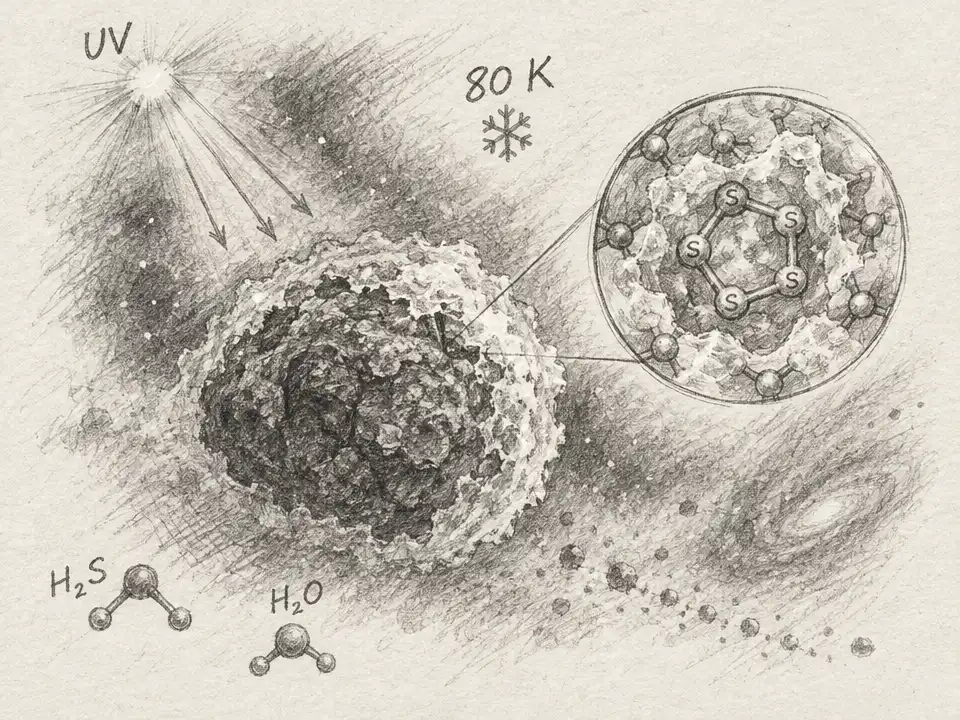
Imagine a patch of water ice so thin it is only a few molecules deep, spread across a grain smaller than a speck of smoke. In a cold interstellar cloud, that grain may be part of the place water is stored. Ultraviolet light can knock some of the frozen molecules back into the gas. But a new laboratory study suggests the result depends on more than the water and the light: the tiny landscape beneath the ice matters, too.
The finding brings surface chemistry into a problem in astrophysics. Astronomers use chemical models to track where water sits—in gas or on grains—in cold clouds and the outer parts of planet-forming disks. Those models need to estimate how readily ultraviolet photons release water from ice. The usual laboratory measurements are often made on flat surfaces. Real cosmic dust, however, is particulate and irregular. Philippe Parent and Carine Laffon set out to test whether that difference changes the chemistry.
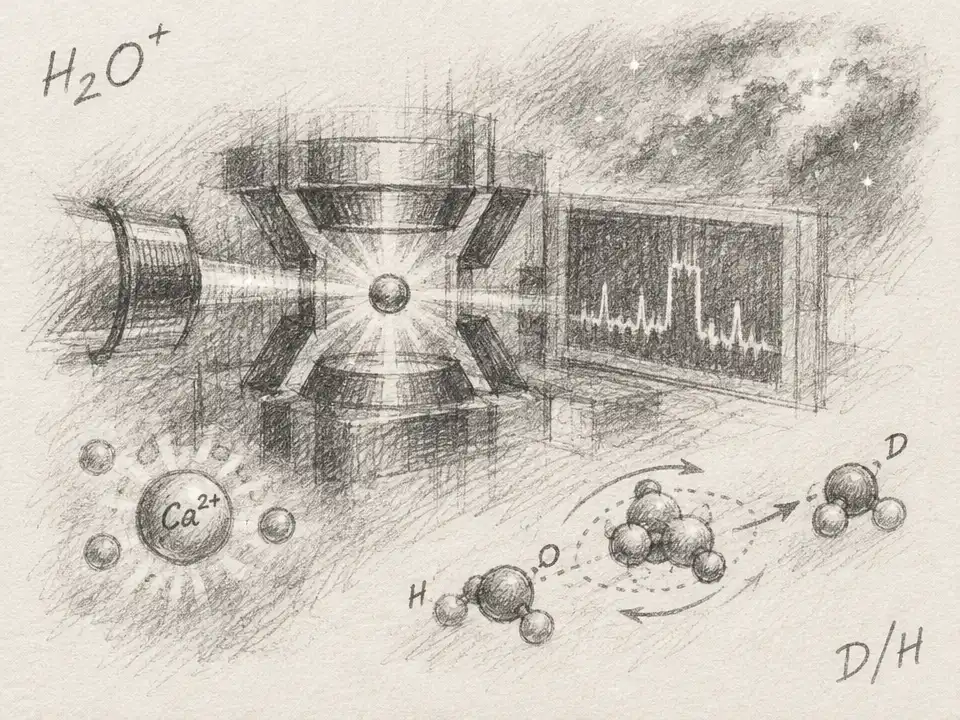
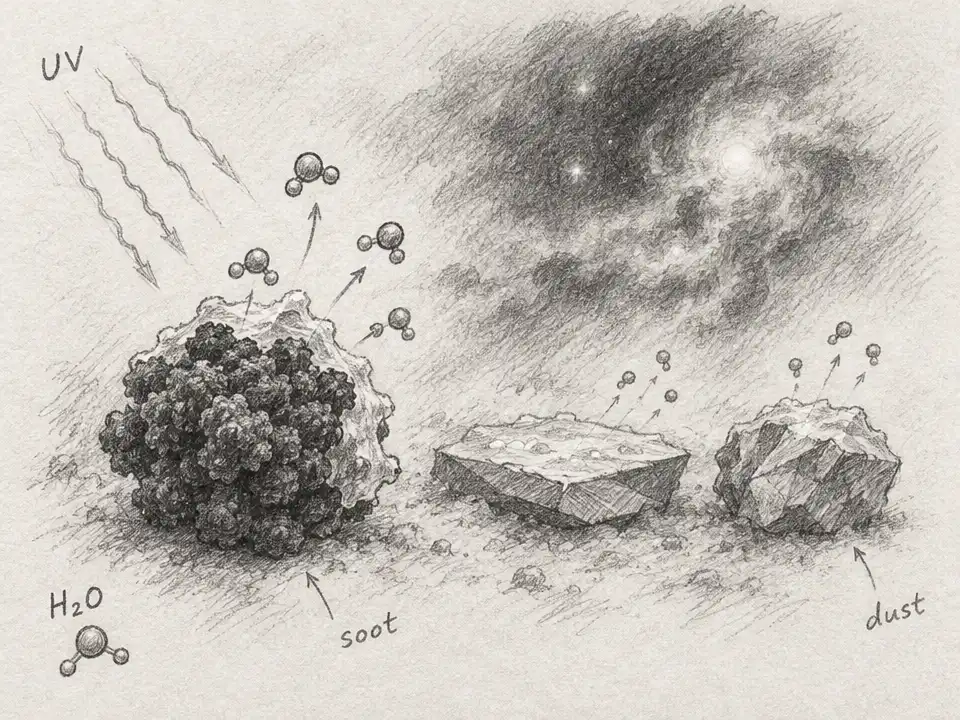
They cooled samples to 12 K and 60 K and coated them with thin films of water ice, between 2 and 6 molecular layers thick. The surfaces included flat gold and olivine, a mineral used as a silicate-grain analog, as well as olivine particles and soot nanoparticles. A microwave-driven hydrogen lamp supplied ultraviolet light. The researchers tracked changes in the ice with two techniques: X-ray photoelectron spectroscopy and infrared spectroscopy.
The flat samples gave familiar-looking results. At 12 K, a film about four layers thick released water at a rate of 1.5 × 10⁻³ molecule photon-1 on gold and 1.8 × 10⁻³ molecule photon-1 on flat olivine. On the rougher olivine particles, the rate was lower: 7.2 × 10⁻⁴ molecule photon-1. On soot, it fell to 7.2 × 10⁻⁵ molecule photon-1—about twenty times below the gold result for this ice coverage.
Across the experiments, the researchers found that soot could suppress water-ice loss by as much as a factor of about 40 compared with gold at 12 K. The two measurement methods both showed weak depletion on soot. That matters because the discrepancy was not just a quirk of one instrument: the water really was holding on more stubbornly under the tested conditions.
Why should a rougher surface change what an ultraviolet photon does? A photon absorbed by ice can set off a chain of molecular events. Water may split into hydrogen and hydroxyl fragments; those fragments can recombine, or a fast hydrogen atom can strike a neighboring water molecule and help knock it free. The energy has to find its way into motion that carries a molecule off the surface. The grain beneath the ice may influence how that energy moves or drains away.
The team tested two straightforward explanations. Perhaps water molecules escaped, hit the walls of pores in the ice, and stuck again. Or perhaps soot’s tiny surface hollows simply trapped them. But compact ice grown on soot at 120 K and then cooled to 12 K still showed strong suppression, so ice porosity alone did not explain the effect. And the soot’s nanoscale depressions were shallow; the weak release persisted even as the ice thickened enough that simple trapping in those hollows seemed insufficient.
One possibility is that soot changes how water ice grows. Rather than spreading into a continuous sheet, the ice may form separate patches. Their edges and contacts with the grain could alter how molecules are bound and how absorbed energy is passed along. The researchers present this as a plausible explanation, not a settled mechanism. More experiments will be needed to see exactly what happens within those microscopic ice domains.
The broader lesson is that an ice film is not necessarily the same material wherever it forms. On a smooth surface, water molecules can assemble one way; on a finely textured grain, they may organize differently. That means a “photodesorption yield”—the number of molecules released per incoming photon—may not be one universal property of water ice. It can depend on the surface and on how much ice has accumulated.
For astronomers, the payoff is a more complicated, and potentially more realistic, picture of water’s journey through space. In cold, dense regions, water is largely held in grain ice; ultraviolet light can return some of it to the gas, while molecules also freeze back onto grains. If realistic dust surfaces slow both release and sticking, models may need to treat those processes together rather than adjusting only the release rate. The experiments do not yet calculate how much the balance changes across a whole cloud. They identify a physical detail that could matter: the texture of the grain.
On a cosmic scale, the grain is tiny. But the study suggests that its surface can help decide whether a water molecule stays frozen, drifts into the gas, or settles back onto dust. To understand water in space, it may not be enough to ask what light does to ice. Researchers may also have to ask what kind of world that ice is sitting on.