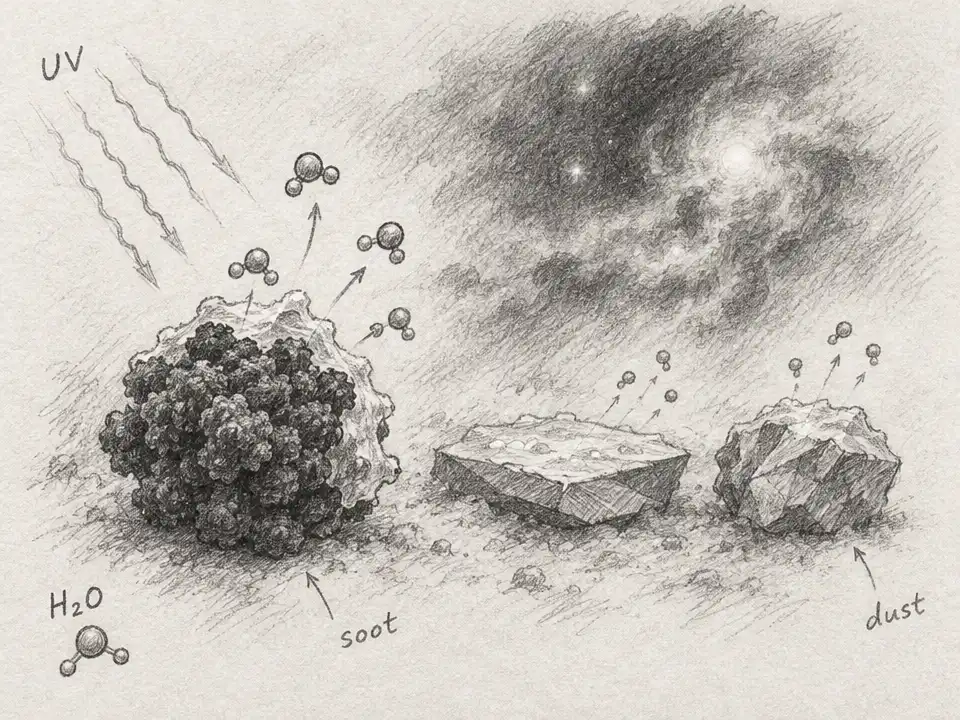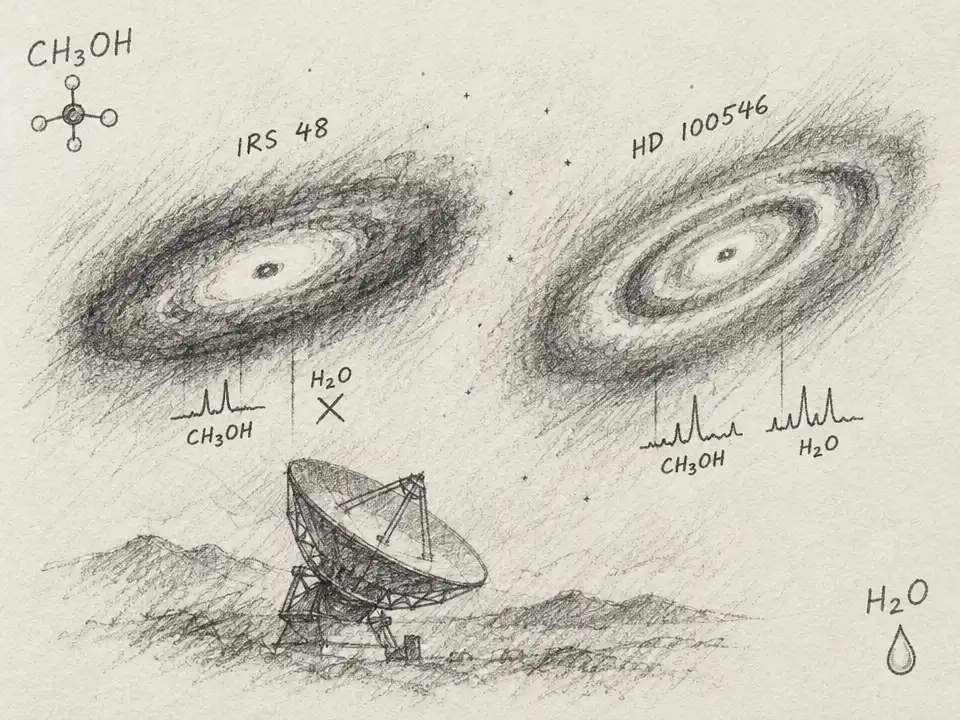
In the cold clouds between stars, sulfur seems to go missing. Its abundance in the gas falls far below what astronomers expect, even though sulfur is common across the cosmos. The atoms may not be gone; they may have slipped into solid material on dust grains, where telescopes struggle to spot them. A new laboratory study points to an unexpected hiding place: sulfur rings built inside water-rich ice.
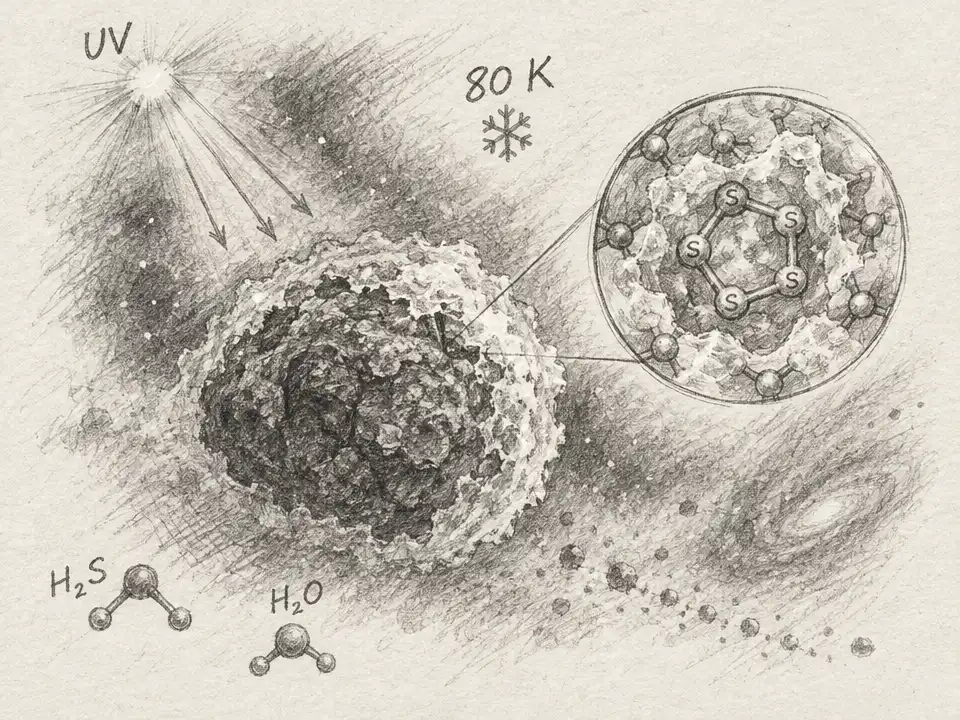
The idea begins with tiny grains, each coated in frozen molecules. Hydrogen sulfide is a likely source of sulfur in these mantles, though it has not been directly identified in interstellar ice. The researchers asked whether ultraviolet light could transform it into durable sulfur compounds—and whether water, often the dominant ingredient in cosmic ice, changes the outcome.
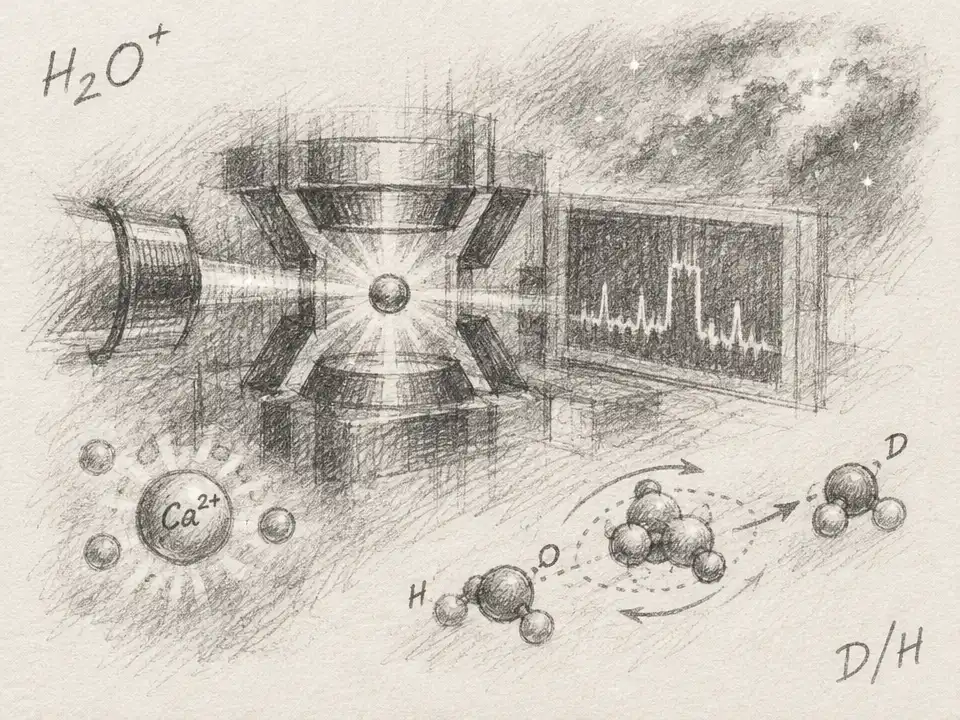
To find out, they recreated the chemistry in a high-vacuum chamber. They deposited ice at about 80 K while irradiating it with ultraviolet light. One mixture contained water and hydrogen sulfide in a 10:1 ratio; another contained hydrogen sulfide alone. After six hours, they warmed the samples to room temperature, leaving behind any material that had not evaporated. The residue was a small, solid record of what the icy chemistry had made.
Water made a striking difference. The team identified sulfur rings containing six, seven, and eight atoms in the residues. In the main comparison, the measured signals for these ring forms were about 50 times higher for the six-atom rings, 40 times higher for the seven-atom rings, and 70 times higher for the eight-atom rings in water-rich ice than in the hydrogen-sulfide-only ice. The eight-atom ring was the most abundant of the three. These are laboratory signal comparisons, not a direct measurement of how much sulfur sits in space; the authors also note that traces of water in the nominally dry experiment could have narrowed the difference.
Why should water matter so much? Ultraviolet light can break apart both water and hydrogen sulfide, producing reactive fragments. The researchers propose that this chemistry creates oxygen-bearing sulfur compounds. In the water-rich ice, charged intermediates can be stabilized by their surroundings, giving sulfur atoms new routes to join together. The team found chemical signals consistent with several such compounds, including short sulfur-oxygen chains and polythionic species—molecules that contain sulfur chains linked to oxygen-bearing groups.
In the proposed pathway, these intermediates act like stepping-stones. Sulfur-containing pieces add to one another, lengthening a chain. Once a chain is long enough, it can bend back and close into a ring. An eight-atom ring is especially stable, the authors argue, so it can become a favored endpoint. The chemistry also has a fork: some chains may form oxygen-rich compounds instead of closing into rings. Those more persistent products could help lock sulfur into a solid residue.
This route is a hypothesis supported by the products found in the residue, not a movie of every reaction as it happens. The key sulfite ingredient proposed in the mechanism was not directly detected in its expected form; related signals appeared instead. And because the ring analysis cannot distinguish all possible molecular shapes, the researchers infer that the rings are the common, favored forms. The experiments also do not establish whether ring closure happened under ultraviolet light, during the later warm-up, or at both stages.
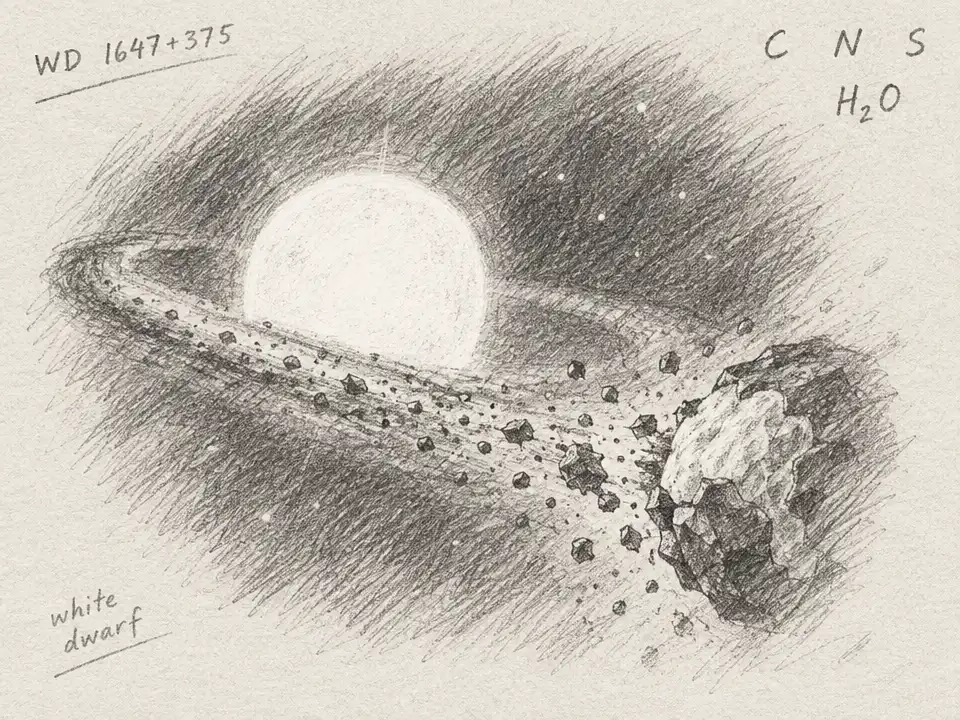
Still, the result offers a possible answer to two connected puzzles. If water-rich ice helps convert sulfur into stable solids, some sulfur that is missing from interstellar gas could be held in dust-grain mantles. Those mantles can later become part of comets, asteroids, and other early planetary material. In fact, sulfur rings and oxygen-bearing sulfur compounds have been reported in meteorites and samples from the asteroid Ryugu. The laboratory residues contain related species, making icy chemistry a plausible link—not proof of a shared origin.
That link could turn sulfur into a clue about ancient environments. If elemental sulfur in primitive bodies tends to form efficiently in water-rich ice, its presence may point to icy conditions in the material’s past. The possibility is appealing: a substance that is hard to see in distant clouds might leave a more durable chemical trace in the small bodies that preserve early Solar System ingredients.
But the clue comes with a price: the same solids that could hide sulfur are difficult to read. The researchers say the infrared features in their residues come from minor products and require relatively thick ice samples to detect. Sulfur-to-sulfur vibrations can be faint, while different oxygenated sulfur compounds can produce overlapping signals. The study used laboratory instruments to extract and identify compounds in a residue; astronomers looking across space cannot handle an ice mantle that way.
The next frontier is to close that gap. More experiments could vary the ice mixture and processing conditions, test whether the proposed reactions proceed under different forms of radiation, and determine which molecular signatures survive in cold ice. Astronomers would then need spectra distinctive enough to separate those signatures from look-alike compounds. If that work succeeds, sulfur could become more than a missing entry in a cosmic inventory: it could help reveal where water-rich ice formed and what happened to it on the long journey from interstellar dust to planetary building blocks.