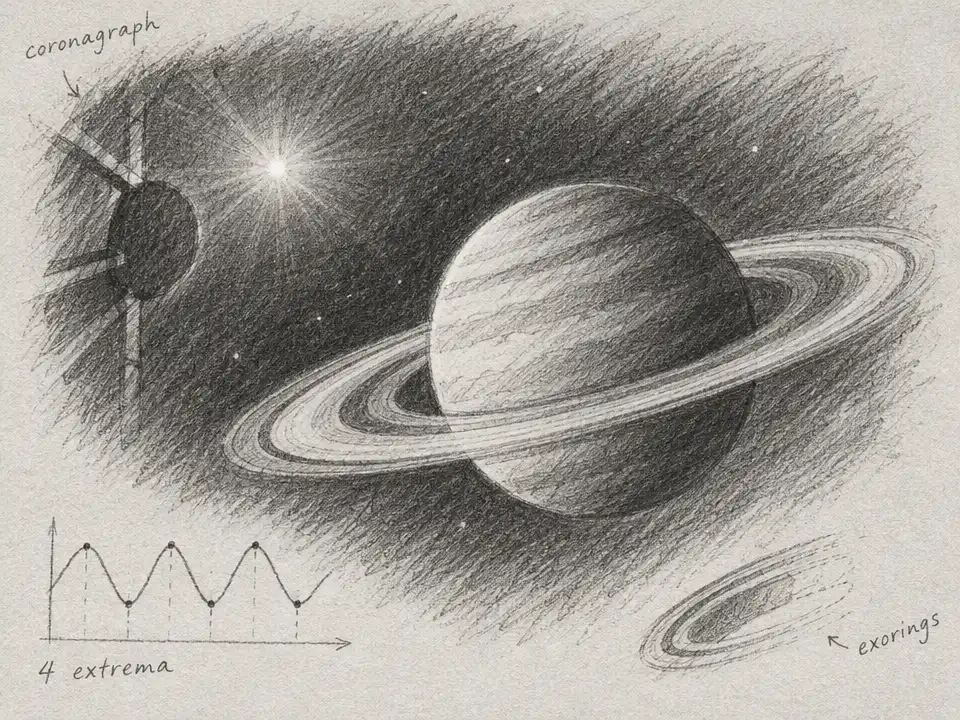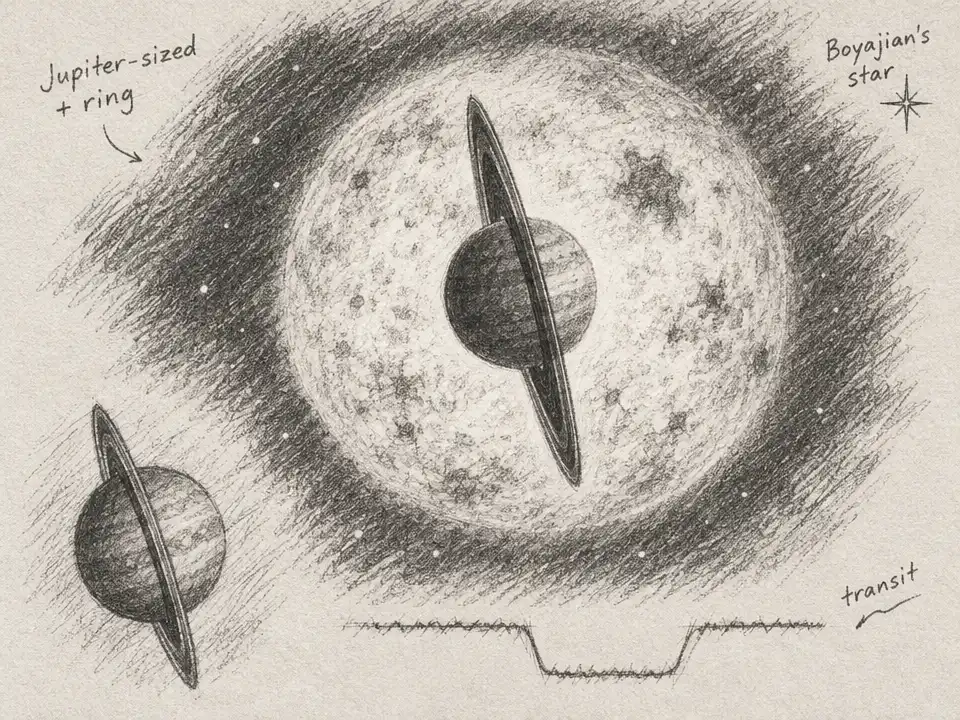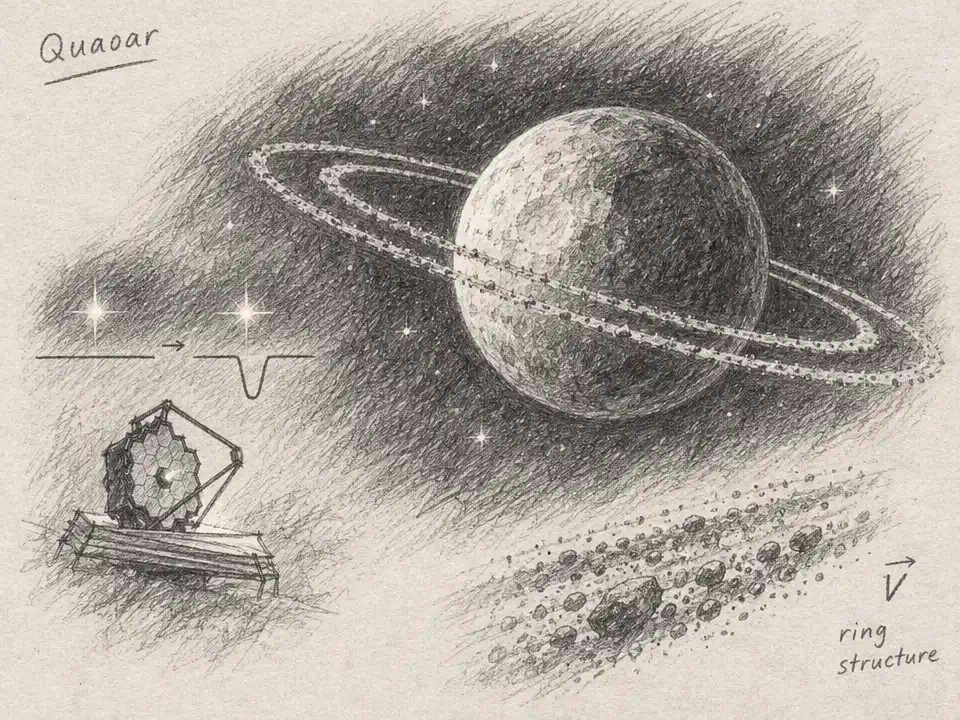
A distant star does not simply blink out when Quaoar passes in front of it. It dims, brightens, then dims again in a pattern that can reveal something far smaller and fainter than the icy world itself: rings circling in the dark. Those brief interruptions have exposed a planetary puzzle. Quaoar has at least two rings, and both orbit beyond the boundary where ring material is expected to gather into moons.
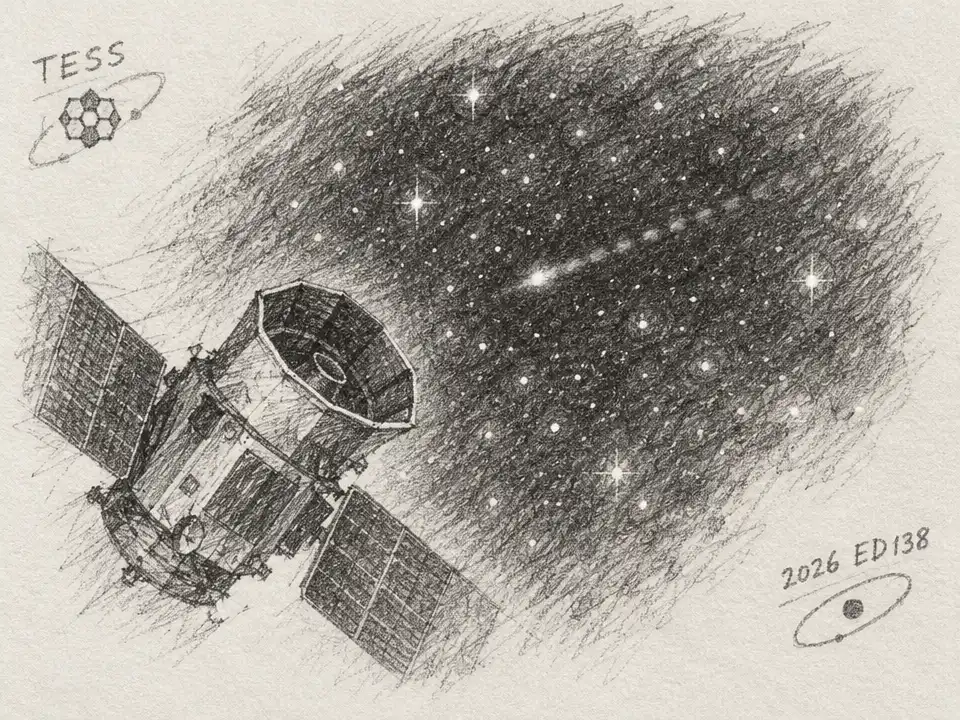
Quaoar is a roughly 1,100 km wide world more than 40 times farther from the Sun than Earth is. From that distance, its rings cannot be photographed as separate bands. Instead, astronomers predict when Quaoar will cross a background star, then watch the star’s light with telescopes along the path of the shadow. A dip in the starlight can mark a ring crossing; the timing of the dip helps locate the material around Quaoar.
In 2022, observations from Gemini North and the Canada-France-Hawaii Telescope caught such dips on either side of the main body. The measurements revealed a second ring, now called Q2R, at about 2,520 km from Quaoar’s center. The outer ring, Q1R, lies roughly 4,057 km out. Those distances are striking because Quaoar’s classical Roche limit—the estimated boundary inside which its tidal pull should prevent orbiting particles from sticking together—falls at about 1,780 km for the assumed icy-particle density. Beyond that limit, particles should be able to clump and grow into moonlets, potentially clearing the rings away on timescales of decades.
The rings are not neat, uniform hoops. In the 2022 observations, Q1R’s denser material stretched across about 60 km, yet its brightest core was only about 5 km wide. Q2R was much fainter, and its estimated width was around 10 km. These details came from watching starlight fade as the rings crossed it, not from resolving the rings directly. The discovery depended on matching dips recorded by different telescopes, helping distinguish a real ring from the vagaries of Earth’s atmosphere.
A later observation with the James Webb Space Telescope gave the puzzle a new angle. As Quaoar crossed another star in 2024, JWST detected both known rings again. But the rings’ signals changed with where the background star crossed them: Q2R, in particular, did not appear equally on both sides of Quaoar. That unevenness suggests the rings contain arcs or other variations in density, rather than forming smooth, identical circles all the way around. The data confirmed the rings’ continued presence, but did not show exactly how their patchy structure formed.
One possibility begins with the cold. At Quaoar’s distance, the rings are in an environment near 30 K. Some models suggest that collisions between icy particles there may be more elastic than expected: instead of losing much of their motion with each bump, particles could retain enough speed to resist settling into moonlets. Resonances—regular gravitational nudges linked to Quaoar’s rotation and its moon Weywot—may also stir the material or help shape its edges. These are plausible ingredients, not a confirmed recipe. The observations do not yet establish which mechanism, if any, keeps the rings from accreting.
A theoretical paper posted in 2026 offers a way to think about the problem. It treats the ring’s particle motions using statistical mechanics and compares the ring-to-moon transition to a change of state: just as heating can keep matter from condensing, a sufficiently broad spread of particle speeds may keep a ring from collapsing into moonlets. The model extends the classical Roche-limit picture to account for those motions, and its predictions agree with earlier simulations of Quaoar’s outer ring. It offers a possible explanation, not a direct measurement of particle speeds in the rings.
The model also makes a more tentative suggestion about the rings’ unevenness. Under its assumptions, the densest patches could behave as if they had negative pressure and shrink, while less dense regions expand. That might help create or accentuate the arcs seen in occultation data. But the theory assumes a kind of equilibrium and small density variations; its author notes that the assumptions may fail in the very dense patches that matter most. More simulations and observations are needed to learn whether this predicted effect operates in Quaoar’s rings.
Future star crossings can test whether the rings’ bright and faint regions shift or persist, while improved measurements of Weywot’s orbit may clarify the role of gravitational resonances. Each occultation turns a distant star into a scanning beam, tracing a new slice of a system too small and far away to inspect directly. For now, Quaoar’s rings survive where the usual rule says they should not. The answer may lie in a balance among cold collisions, orbital nudges, and particle motion—and the next flicker of starlight could help reveal which matters most.