A neutron star’s core may hold a clue to a question that ordinary measurements struggle to answer: Does matter change abruptly into a new state deep inside the star? The boundary, if it exists, would be buried under crushing pressure. But as two neutron stars spiral toward each other, one may briefly make that hidden seam move—and leave a trace in the gravitational waves reaching Earth.
The challenge is that a neutron star’s mass, radius, and response to a companion’s gravity describe the star as a whole. These broad measurements can miss a change tucked into the core, especially if other possible interiors produce similar overall properties. In a recent study, researchers tested another route: instead of treating the star as a static object, look for how it vibrates while its companion’s pull grows stronger.
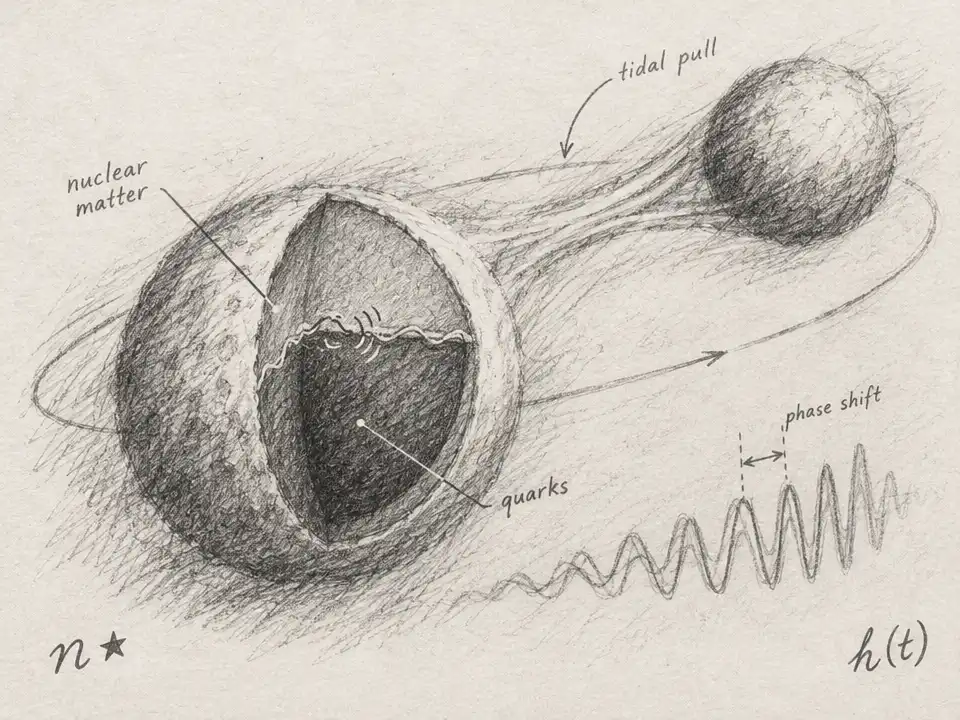
Early in a binary’s slow approach, each star’s gravity gently distorts the other. As the pair draws closer, that tidal pull changes faster. Eventually, it can move in step with a star’s natural vibration. The match is called a resonance. Energy then passes from the orbit into the star’s motion, slightly hastening the pair’s inward spiral. That change can shift the timing of the gravitational-wave cycles—the signal’s phase—without needing a telescope to see inside the star.
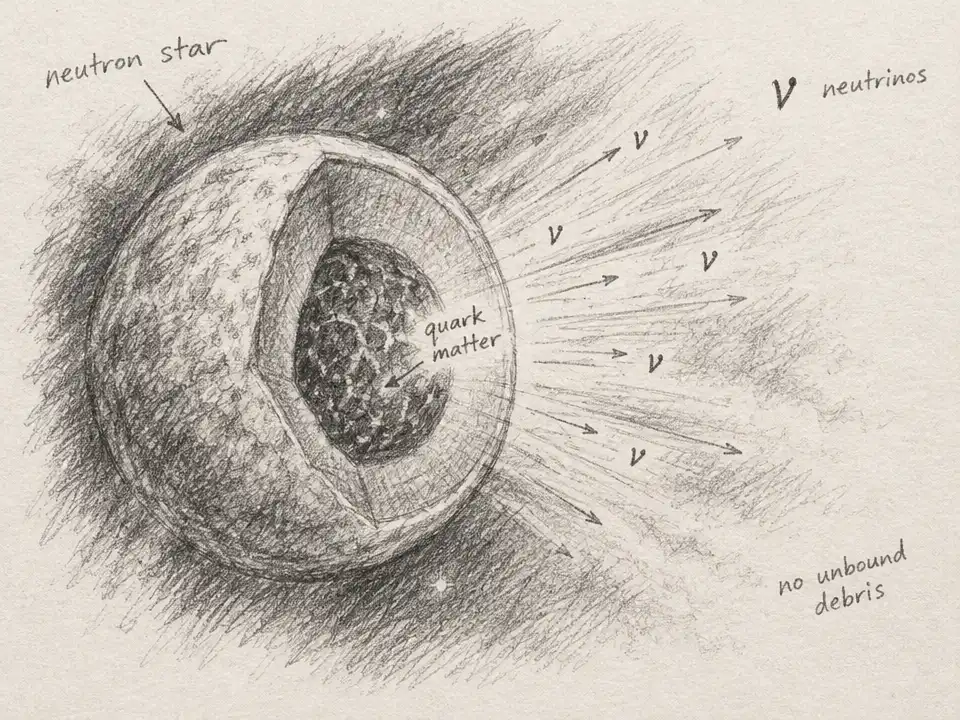
Here is the key clue: a sharp boundary between ordinary nuclear matter and a more exotic core would give the star a special place to vibrate. A parcel of fluid pushed across the boundary would suddenly find itself surrounded by matter with different properties. Buoyancy would push it back. The resulting motion is known as an interface mode, or a discontinuity mode. It is not a sound wave anyone could hear; it is a calculated stellar oscillation that might alter the gravitational-wave pattern.
The distinction matters because neutron stars can have other vibrations, too. Some arise from gradual changes in chemical composition; others may involve the crust or other parts of the star. A signature tied to a sharp core boundary would be especially interesting because it could point to a first-order phase transition—one in which the change between phases happens abruptly. Deconfined quark matter is one proposed possibility, but its presence inside neutron stars has not been established.
To explore the clue, one research team calculated oscillations across a collection of possible neutron-star interiors, using established nuclear physics at lower densities and extending the models into the less certain conditions of the core. They found that the interface mode could couple to the companion’s tide more strongly than some previously studied composition-driven vibrations. In their estimates for a pair of 1.4-solar-mass stars at a distance like that of the famous GW170817 event, most modeled resonances could be within reach of a future LIGO upgrade; nearly all were within the projected reach of next-generation observatories.
That forecast comes with an important warning. The researchers’ estimate of how the resonance changes the orbit uses an approximation for the tidal interaction, and the resonances in their models occur very late—within the final five orbits before merger. In that regime, the stars’ strong gravity and complicated, rapidly changing motion make a simple estimate less dependable. The calculation is a promising demonstration, not a prediction that an existing detector has already found the effect.
A second study approached the same puzzle with general-relativistic calculations of vibrations in stars containing a sharp hadron-to-quark transition. It also found that the transition-related mode could affect the gravitational-wave phase. The researchers searched data from GW170817 for such a feature, but the data did not favor a signal over its absence. That non-detection still let them place limits on some proposed transitions; it did not show that quark matter is present.
There is another obstacle: a phase shift alone would not identify its cause. Other physical processes can leave similar marks, and the studies use different models and assumptions. Comparing the frequency and size of a possible signal with predictions for competing explanations would be essential. If future observations catch similar features in binaries with different star masses, the pattern could help researchers estimate where a transition begins and how abrupt it is.
For now, the hidden boundary remains a possibility, not a discovery. The appealing idea is that a star’s interior might reveal itself not through a clean picture or a single measurement of its size, but through a fleeting response to its companion’s pull. In the last moments before two neutron stars merge, a vibration at an unseen seam could leave the orbit just slightly out of step—and turn a cosmic collision into a test of matter at densities no Earthbound experiment can reproduce.