Imagine a crowd that stays together not by pulling inward, but by edging away from its neighbors at just the right moment. Or a group that keeps its shape by steering toward the neighbors it expects to meet, rather than the ones beside it now. Two computer models of flocking explore these counterintuitive possibilities. They do not explain every bird or fish. Instead, they reveal how very different rules—chemical interactions in one model, anticipation in another—might produce a shared result: coordinated motion without a simple tug toward the group’s center.
The puzzle begins with a familiar recipe. In many classic flocking models, each moving particle turns toward the average direction of nearby particles. That can synchronize motion, but it does not necessarily keep the group together. Small errors in direction gradually carry neighbors apart. Modelers have often added attraction or artificial boundaries to prevent the flock from dispersing. The two newer approaches ask whether cohesion can arise from something less direct.
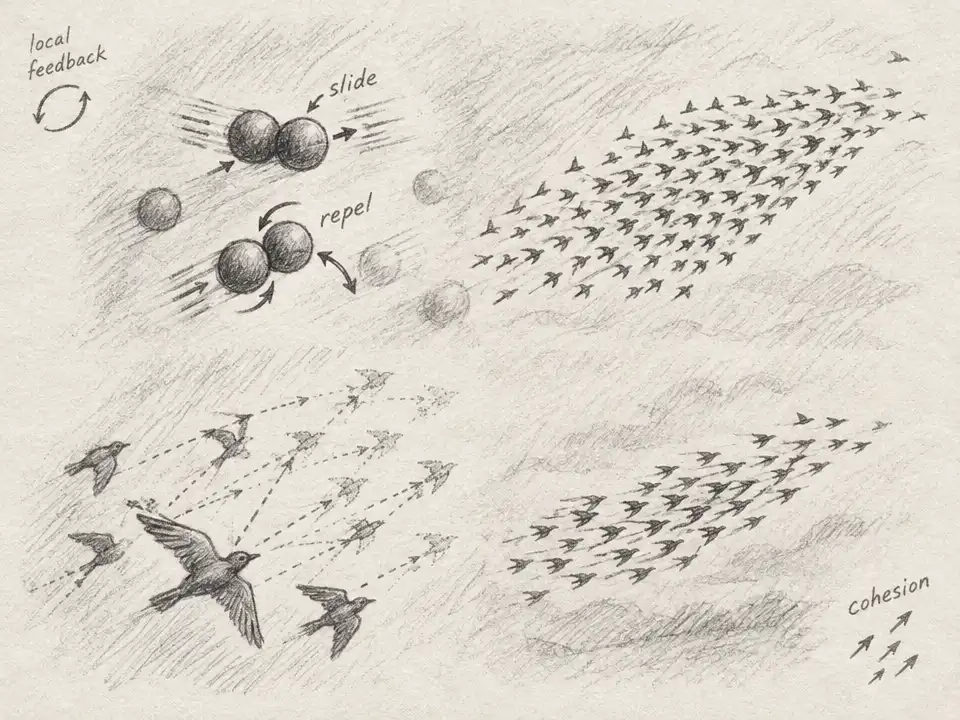
In one model, the players are self-propelled colloids: tiny particles that move through fluid and interact through chemicals they release. A chemical trail creates long-range effects, including a torque—a twist that changes a particle’s heading. The researchers found in simulations that a flock could form even when these chemical torques made particles turn away from one another. The essential ingredients were short-range repulsion, which prevents particles from overlapping, and longer-range, chemically driven turning. There was no need to add a separate chemical force that pushed the particles together.
The key is what happens in a collision. Picture two particles approaching and then sliding alongside one another. Their chemical interaction makes them rotate away, but not instantly. If they slide together for long enough first, the encounter breaks a subtle symmetry between forward and backward motion. Repeated across many collisions, that small bias can organize the group’s overall direction. Too-slow turning lets the particles slide past for too long; too-fast turning makes their encounters too symmetrical. In the model, flocking depends on a middle ground: the chemical response must be timed just right.
That timing gives the story an unexpected twist. Repulsion does not automatically mean dispersal. A turn away from a neighbor can help a pair move in a way that contributes to collective alignment, provided the turn comes after a brief shared slide. The simulated flocks were liquid-like rather than fixed in a rigid arrangement. When the researchers added long-range repulsive forces as well as turning, the particles instead formed a more crystalline flock, with regular spacing. The work also found that the flock could lose stability at higher densities or stronger interactions. This is a specific result from a model, not evidence that real colloids—or animals—use this exact mechanism.
A second model reaches cohesion by a different route. Here, agents still try to align, but they estimate where their neighbors will be after the next step. A candidate turn is judged not only by whether it matches other agents’ headings, but also by whether those agents are likely to remain nearby. In effect, each agent chooses a direction that balances agreement with staying within the neighborhood. That tradeoff creates cohesion without adding an explicit attractive force.
In simulations, predictive agents formed compact, coordinated flocks despite moderate directional noise. The group could also follow a subgroup of maneuvering leaders. But “predictive” describes a rule in the model; it does not establish that birds consciously calculate future positions this way. Nor did the simulations settle whether the rule matches how real animals respond to neighbors. The authors noted that their model’s flocks were unusually dense, with agents perceiving far more neighbors than birds typically track, and pointed to more realistic perception and neighbor selection as open problems.
These are two separate theoretical routes, not ingredients tested together in one system. One relies on the timing of chemical torques during close encounters; the other uses a simple estimate of future neighbors. Their connection is conceptual: a flock may stay coherent without every member being pulled toward the center or merely copying the present direction of the crowd. Local interactions can do more than match headings. They can shape who remains close, and when a turn happens, in ways that add up across the group.
The next challenge is to find out whether either mechanism operates in real materials. Experiments with chemically interacting colloids could track individual paths and test whether brief sliding encounters precede collective alignment—and whether changing the chemical response changes the flock. For animal groups, researchers would need to test whether observed turns are better explained by current neighbors or by anticipated ones. Until then, the models offer a useful reminder: sometimes the secret of staying together is not to move toward everyone else, but to respond to the meeting that is about to happen.