Imagine trying to identify a distant landscape from a single, faint glow. A telescope collects the planet’s light, but that light has traveled through—or bounced off—everything between the surface and space. A dip in the spectrum might come from a gas in the air. Or the clue might be in the ground.
That uncertainty matters when astronomers study rocky worlds beyond our solar system. Their spectra can reveal atmospheric gases and temperatures, but many models have treated the surface as a simple, featureless backdrop. A new study brings a different kind of evidence into the picture: laboratory measurements of real rocks. The geology helps astronomers ask a sharper question of a planet’s light: what part came from its air, and what part came from its crust?
The study’s researchers updated an exoplanet analysis tool called POSEIDON so it can model light interacting with a rocky surface and an atmosphere together. The surface data include wavelength-dependent measurements drawn from laboratory rock and mineral samples. Instead of assuming every surface behaves like a uniform blackbody, the model can give a planet terrain with the spectral character of, for example, granite-like rock or basalt.
Here the fields meet in a particularly useful way. Geologists measure how materials reflect light across wavelengths; astronomers use patterns in starlight to infer what distant planets are made of. A rock sample in a lab is not an alien world, of course. But its measured spectral fingerprint gives the astronomical model a more realistic vocabulary for interpreting rocky terrain.
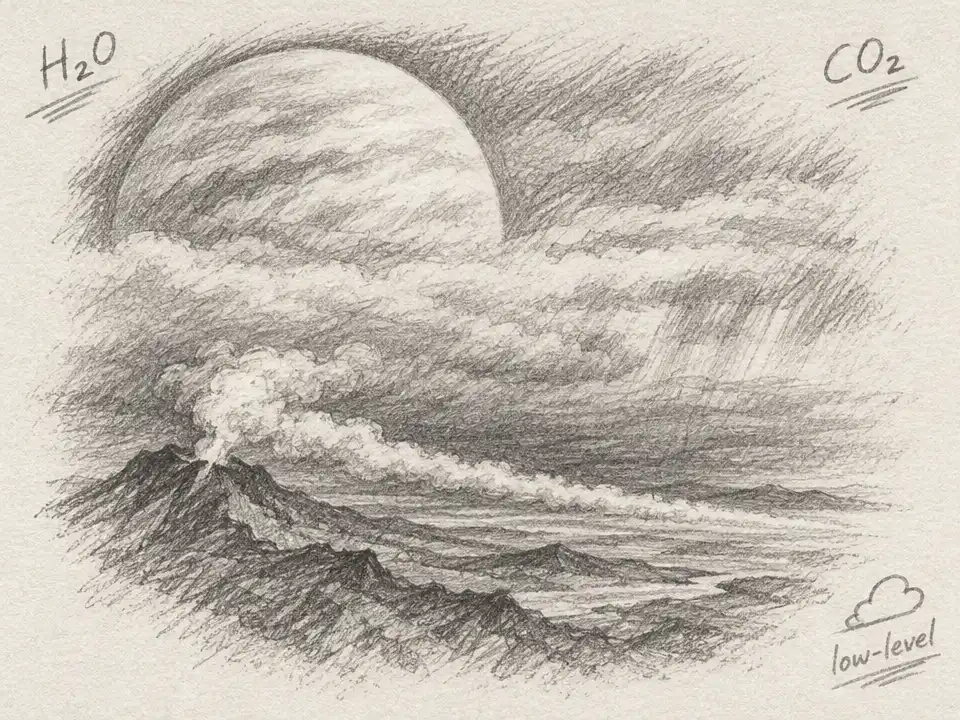
Why does the surface matter so much? A planet’s atmosphere can absorb or emit light at particular wavelengths, leaving features in the spectrum. But minerals can leave features too. In the mid-infrared, silicate-rich rocks have distinctive signatures. The model shows that a bare or thinly veiled planet can therefore display surface features that might be mistaken for atmospheric ones if the ground is ignored.
The reverse confusion is possible, too. A thick atmosphere can dominate the observed spectrum and hide the terrain beneath it. Between those extremes, gas and rock can both contribute. In the researchers’ models, surface features also appear in wavelength ranges where atmospheric gases let light pass through. And in some cases, the interaction between the surface and atmosphere can make an absorption feature look like an emission feature—an effect that might otherwise be read as a change in atmospheric temperature.
That makes the surface more than scenery. It can complicate an atmospheric reading, but it can also help constrain the atmosphere. If a model accounts for both the planet’s air and its rock, the relative strengths of their spectral fingerprints can help distinguish a thin atmosphere from a thick one.
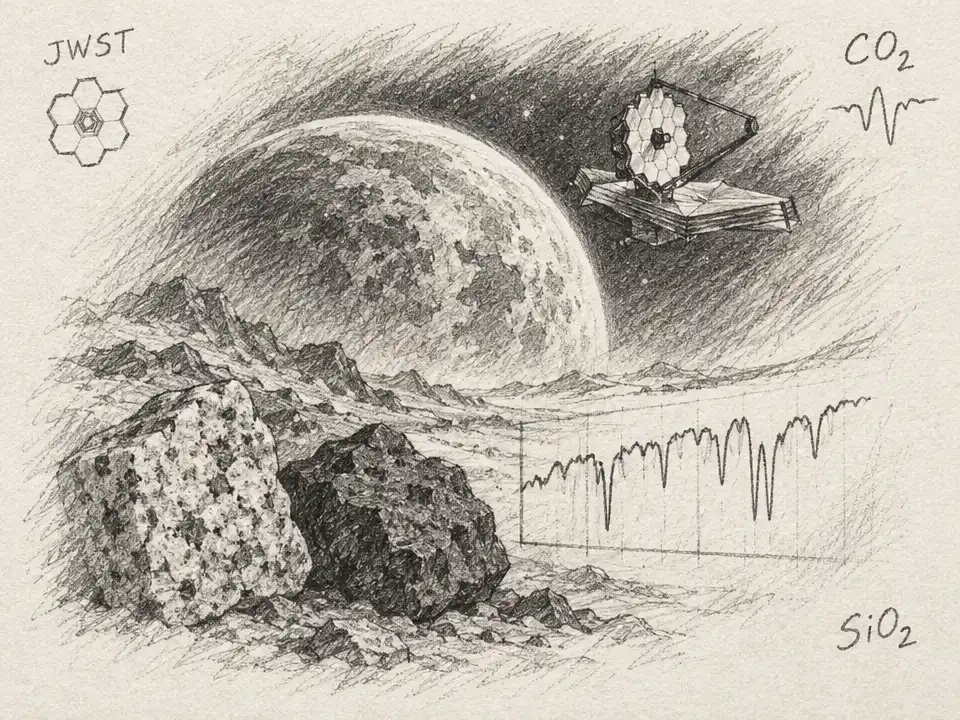
The team tested the updated model against published JWST observations of two hot rocky planets, TOI-1685b and 55 Cancri e. For TOI-1685b, the data favored a relatively thin atmosphere, consistent with previous work suggesting the planet may be close to bare rock. For 55 Cancri e, the model favored a thicker atmosphere, with carbon dioxide absorption helping support that interpretation. The authors note that the atmosphere of 55 Cancri e remains disputed: different observations and analyses have not settled the question.
Then comes the tantalizing next step: could the same approach reveal what the ground is made of? The researchers tested that possibility using simulated JWST observations, not an actual detection of an exoplanet’s geology. They modeled a planet like TOI-1685b and asked whether observations from JWST’s mid-infrared instrument could distinguish granite-like terrain from basaltic terrain.
In that specific simulation, the answer depended on the rock and the number of observations. With the model’s assumptions and noise levels, about five simulated eclipses could identify a granite-like surface, while basalt required about 15. An eclipse here is the moment the planet passes behind its star, briefly removing the planet’s own light from the combined signal. Comparing the starlight just before and during that passage lets researchers isolate the planet’s contribution.
The two rocks leave different clues. The modeled granite-like surface has a strong feature around 8–9 micrometers, associated mainly with quartz. The basalt signal is broader, spanning roughly 8–12 micrometers. Those differences could eventually let researchers compare alien crusts with familiar kinds of terrestrial geology.
But a spectral match would not be a geological biography written in plain language. Granite on Earth is closely linked to the recycling of crust through plate tectonics. A granite-like signal elsewhere would not, by itself, prove that a planet has Earth-style plate tectonics. Similar-looking material might arise from a different starting chemistry or a different sequence of melting and resurfacing. Basalt, granite, and other rocks are clues to a planet’s history, not a single-answer diagnostic test.
The study also marks how early this kind of planetary geology remains. Its rock-identification test uses idealized models and simulated data, and the required observations depend on the chosen target and signal quality. Real surfaces have textures, grain sizes, weathering, and temperature variations that can alter their spectra. The researchers describe their database and classification scheme as a starting framework, not a complete atlas of every possible alien landscape.
Still, the idea changes the way a rocky planet’s spectrum can be read. The air is not the only storyteller. A planet’s crust can shape the light that escapes it—and, if astronomers learn to tell rock’s signature from gas’s, that light may eventually reveal something about how distant worlds cooled, melted, and built their surfaces.