Electrons do not naturally settle into a neat line. Each one carries the same negative charge, so each pushes its neighbors away. In a flying pulse, with no trap holding the particles together, that mutual shove should turn a tidy arrangement into a spreading blur. So how could a handful of electrons briefly organize like a crystal while racing through an electron microscope?
The question is more than a puzzle about tiny particles. Electron microscopes depend on controlling their beams: unwanted interactions can blur the beam’s energy and timing, complicating measurements. Researchers have long treated electron-electron repulsion as a nuisance. But in a new study, Valerio Di Giulio, Rudolf Haindl, Armin Feist, and Claus Ropers ask whether the same force might sometimes create order instead.
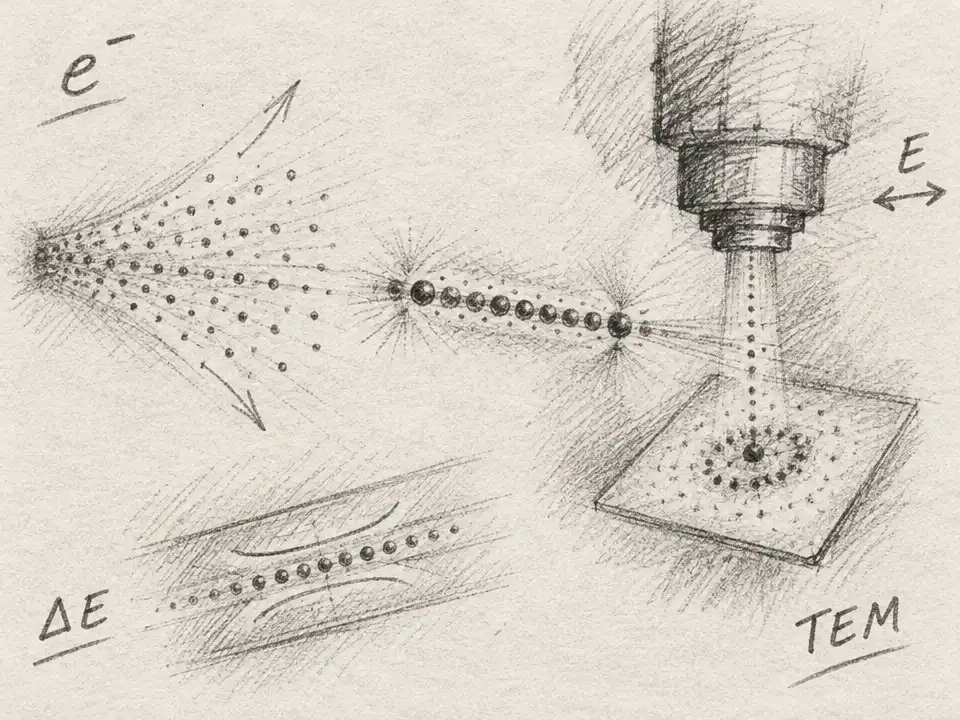
The team released pulses containing several electrons from a tungsten-based Schottky emitter, accelerated them through a transmission electron microscope, and measured the energy of each electron in a pulse. The camera did not photograph a crystal in flight. Instead, the researchers searched for a telltale pattern in the electrons’ final energies: if particles had temporarily lined up during propagation, their later energy correlations could preserve traces of that earlier order.
The first clue appeared in the gaps between energies. The leading and trailing electrons in a pulse tended to remain well separated in energy, even as the number of particles grew. In the interior, however, the energy gaps associated with orderly spacing gradually filled in. Maps comparing pairs of electron energies showed a lattice-like pattern for pulses with four and five electrons. As the particle count rose, that pattern blurred; by eight electrons, the map approached what the researchers expected from a disordered beam.
But could ordinary statistics create apparent gaps when several energies are sorted from each pulse? The researchers checked by building an uncorrelated comparison: they assembled pretend pulses from electrons taken from different measured events. This “event mixing” accounts for the way sorted values bunch together even without interactions. The excess separation between the outermost electrons survived the comparison, while the inner electrons’ extra spacing weakened as the pulses grew larger. That contrast pointed to a physical role for the pulse’s two ends.
Here is the counterintuitive clue. In a long, narrow pulse, the leading and trailing electrons can push the particles between them inward. Their repulsion acts like a temporary boundary: an interior electron is repelled away from either end and toward the middle. The outer particles are not fixed in place, and the beam is expanding, but for a short interval the ends can move slowly enough, relative to the interior’s rearrangement, to behave as if they were holding a cage open.
The researchers tested this explanation with many-particle simulations and a simpler one-dimensional model. Both point to a brief window when the pulse is narrow, dense, and orderly enough for its interior electrons to arrange themselves. In the modeled five-electron pulse, the initial aspect ratio—the pulse’s length compared with its width—was about 100. The pulse current was about 3.5 microamperes, and the longitudinal thermal energy was about 0.1 millielectronvolts. Under those conditions, simulations put the ordering time near 20 picoseconds.
That window does not last. Coulomb collisions heat the beam, while its width and length evolve; the pulse eventually leaves the conditions that favor a crystal-like chain. The simulations predict that adding electrons makes the challenge harder: stronger internal repulsion speeds expansion, and the time spent in the order-favoring region falls. In the experiment, the energy correlations support transient ordering for pulses with four, five, and six electrons. At larger counts, the inner pattern fades even though the outer pair remains distinct.
There is an important limit to the claim. The experiment measured energy correlations after the electrons had traveled through the microscope; it did not take a direct snapshot of a crystal in flight. The researchers’ interpretation connects those measured patterns to an earlier, short-lived spatial arrangement, and their simulations reproduce the observed trends. That is evidence for transient Coulomb crystallization, not a claim that every pulse becomes a lasting crystal—or that a free beam can hold its shape indefinitely.
Could the order be made to last longer? The team explored that question in simulations by adding weak transverse guidance, which keeps the pulse narrow for longer without directly arranging the electrons along its length. A modeled guiding stage 20 millimeters long could sustain crystal-like correlations in pulses of up to 10 electrons under the study’s conditions. Those larger guided crystals are a prediction, not a result of the microscope experiment.
The researchers also modeled continuous beams, where electrons keep arriving rather than leaving as one finite pulse. With transverse confinement, their calculations predict that repulsion could produce periodic bunching along the beam and, under suitable conditions, enhance coherent light emission. Reaching that state would require a careful balance: high electron density, low energy spread, small beam size, and weak divergence. Current beam heating remains a significant obstacle.
The puzzle, then, is not how repulsion disappears, but how it changes jobs. For a fleeting moment, the electrons at the ends of a pulse may turn a force that usually scrambles a beam into a boundary that helps its center line up. The microscope’s energy data preserve hints of that brief order after it has vanished. What else might a beam organize for itself, if researchers can keep its self-made cage intact long enough to find out?