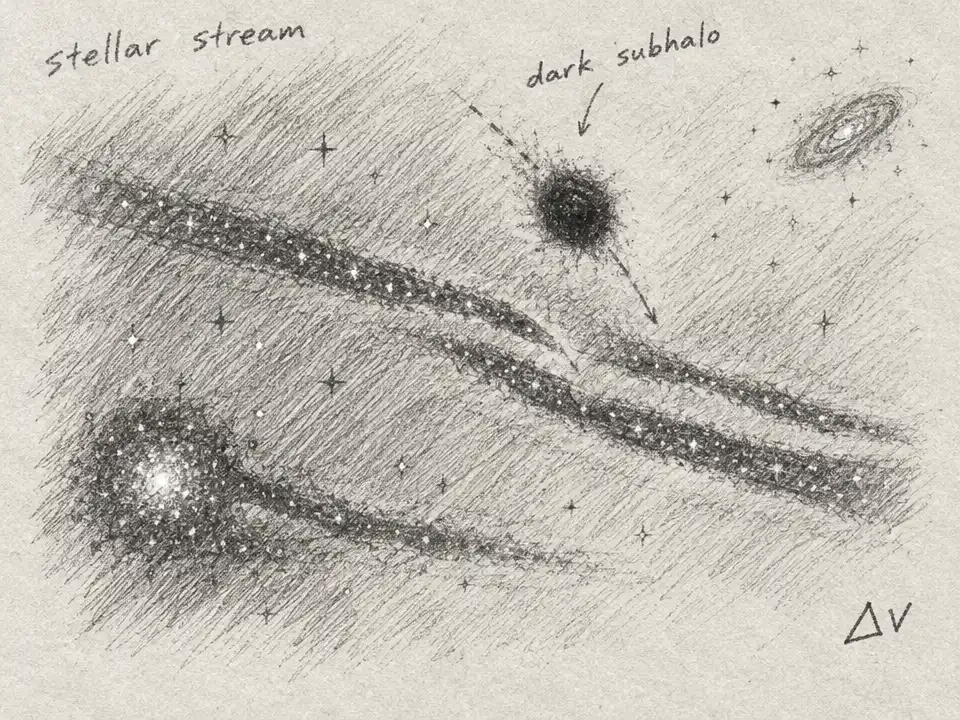
A faint river of stars can keep a record of an encounter with something that never shone. The clue may not be a hole punched in the stream, the signature astronomers have often hunted for, but a second, nearly parallel ribbon. In computer simulations, a dark object passing through a stellar stream can pull one trail apart and leave what looks like two.
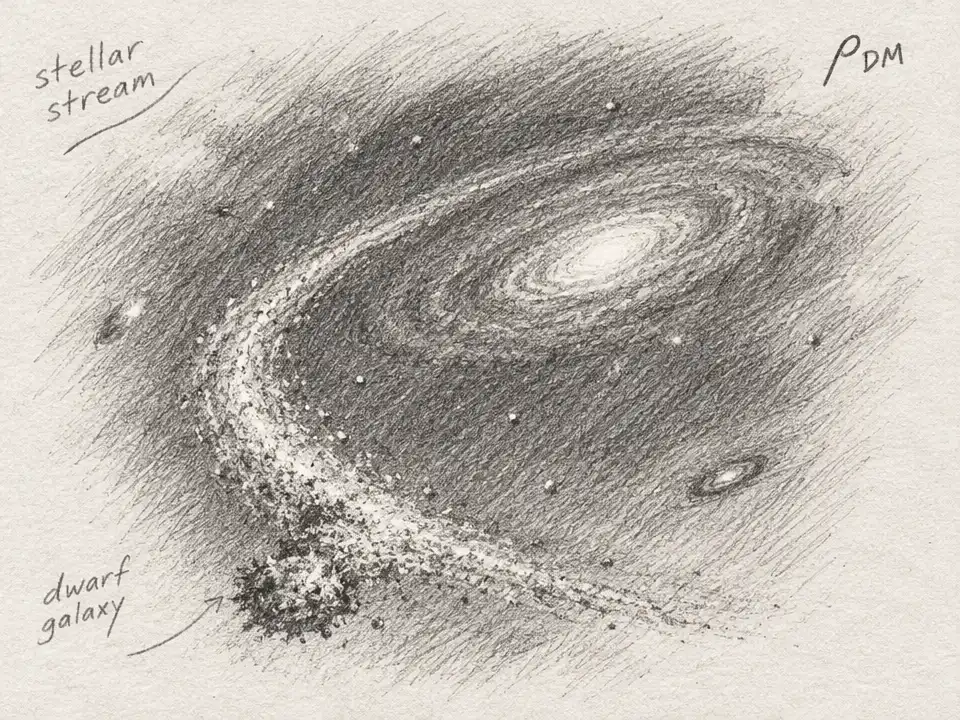
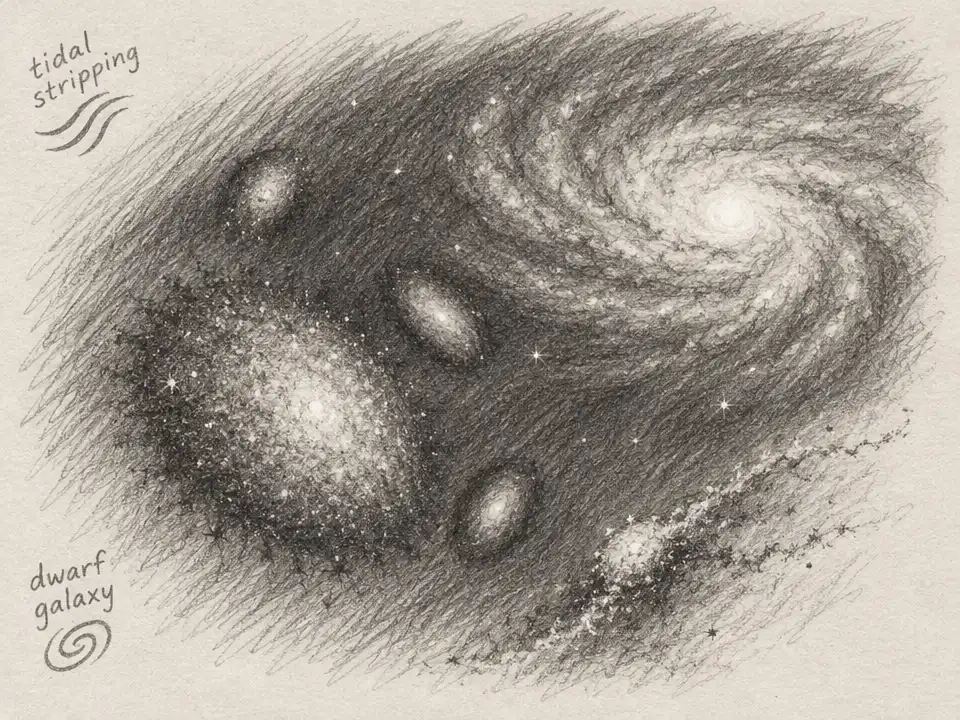
Stellar streams begin when a galaxy’s gravity tugs stars out of a globular cluster or a small galaxy. The escaped stars spread along the parent object’s orbit, forming long, thin trails across the galactic halo. They are dynamically cold: their stars move in similar ways, so a modest gravitational nudge can stand out against the stream’s orderly flow.
That makes a stream something like a cosmic recording strip. A passing object can change the stars’ paths, leaving a density gap, a spur, or a bend. Dark matter is especially intriguing because it does not emit light, yet its gravity can still disturb the stars. Until now, the best-known picture of a dark subhalo’s calling card has been a gap along a stream. A new set of simulations explores a less familiar possibility: the disturbance can spread sideways instead.
The idea starts with a close flyby. A dark matter subhalo—a smaller clump within a galaxy’s larger dark matter halo—crosses a stream and tugs on its stars. The pull is not identical from one star to the next. Some stars receive a stronger change in motion than others, shifting onto slightly different orbits. As the stream continues around its host galaxy, those differences can grow into two strands that run alongside each other.
The researchers tested this picture with mathematical modeling and simulations that follow millions of particles. Their results show that a split depends on the intruder’s mass, compactness, speed, and approach. Too gentle a tug can disappear into the stream’s natural spread of stellar motions. A stronger encounter can separate the debris into parallel tracks; an extreme one may disrupt the stream altogether. The split is not a universal outcome, but one possible response in a particular range of encounters.
The model offers a possible explanation for a striking sight in the halo of Andromeda: two observed structures, called Stream C and Stream D, that lie nearly parallel to one another and have similar widths. The simulated split can resemble them from a suitable viewing angle. That resemblance is a clue, not a verdict. The study does not establish that a dark object made those specific streams, and the structures could have other origins.
That caution matters because the sky can stack unrelated things on the same line of sight. Two separate streams might simply happen to appear side by side. Or one long, wrapping stream could overlap itself, creating a double track in a map. The researchers suggest checking how the stars move, not just where they appear. In their simulations, a stream split by a perturbation leaves a different pattern in the stars’ orbital energy and angular momentum than either an overlapping tail or two streams with separate origins.
For streams in the Milky Way, that test draws on the kinds of information Gaia can provide: positions, distances, motions across the sky, and line-of-sight speeds. Together, these measurements can help reconstruct how the stars travel through the Galaxy. The proposed diagnostic is promising, but it still has to be tested on real candidate streams, where measurements are incomplete and the Galaxy’s own disk and other structures can complicate the story.
Another recent study tackles a practical question: which known streams might be the best places to look for dark matter’s gravitational fingerprints? Its simulations followed 24 Milky Way streams and modeled their encounters with dark subhalos over billions of years. For the ten streams predicted to be most disturbed, the researchers estimate roughly two to twelve significant encounters apiece. The Jet stream, along with ATLAS-Aliqa Uma, GD-1, and Palomar 5, stands out as a promising target. These are forecasts from models, not a tally of confirmed dark matter impacts.
Finding a disturbance is only part of the puzzle; astronomers also need enough detail to identify what caused it. In a separate detectability study, researchers estimated that a GD-1-like stream could reveal a subhalo of about six million solar masses in a Gaia-based scenario. Under an optimistic model of ten years of LSST sensitivity, that threshold falls to around 800,000 solar masses. Those estimates concern modeled impact signatures and depend on the stream and observing conditions; they are not a guarantee that every split or gap will expose an object at that mass.
The stakes reach beyond spotting dark clumps. Their abundance and structure depend on the nature of dark matter, so a reliable census of their gravitational effects could help test competing ideas about how small-scale structure forms. But the obstacles are real: stars must be assigned to the correct stream, their motions measured precisely, and ordinary gravitational influences separated from the dark ones. Researchers also need better predictions for how many subhalos should be present and how their encounters reshape each trail.
For now, a pair of parallel star streams is not a dark matter detection. It is a fresh forensic clue: a shape that a hidden gravitational visitor might leave behind. If future observations can distinguish that scar from a chance alignment or an overlapping loop, the long, delicate trails around our Galaxy may do more than map where stars have been. They may reveal what passed through, even if the passerby left no light at all.