Imagine being handed a list of roughly 125,000 numbers and asked what a machine sees. No pictures. No chance to run the network. No labels explaining what its outputs mean. In a recent experiment, a language model was given just that kind of numerical blueprint and asked to identify the image classifier behind it.
At first, the exercise looked like a glimpse of a new kind of x-ray vision for artificial intelligence: perhaps a language model could inspect another neural network’s inner workings and tell what it had learned. But when researchers checked the answers against the networks themselves, the more revealing pattern was less like reading a mind and more like recognizing a familiar accent—and sometimes confidently putting the wrong words in its mouth.
The study, posted to arXiv on November 5, 2026, examined what researchers call weight-space programming: the idea that a model might read or manipulate a neural network’s weights directly. The author tested one general-purpose model, Claude Opus 5.5, on small image-classifying networks trained on five datasets. The networks had about 125,000 parameters apiece. The model received the parameters as text, without tools, examples of the images, dataset names, or class labels; it could not run the networks to see what they did.
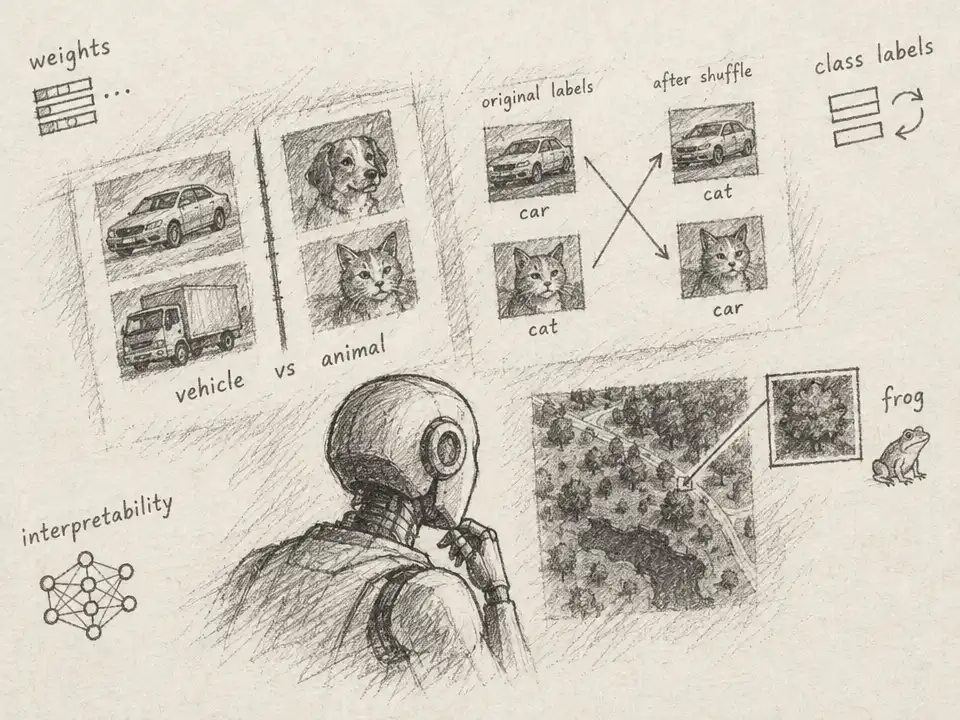
Some of its deductions were genuinely sharp. In one test, the model noticed patterns in a network’s batch-normalization statistics and inferred that the network had taken about three optimizer steps. The researchers had deliberately stopped that network after three updates. In another, it identified a grouping in the final layer of a CIFAR-10 classifier: outputs associated with vehicles clustered apart from those associated with animals. Those clues were present in the numbers, not supplied in the prompt.
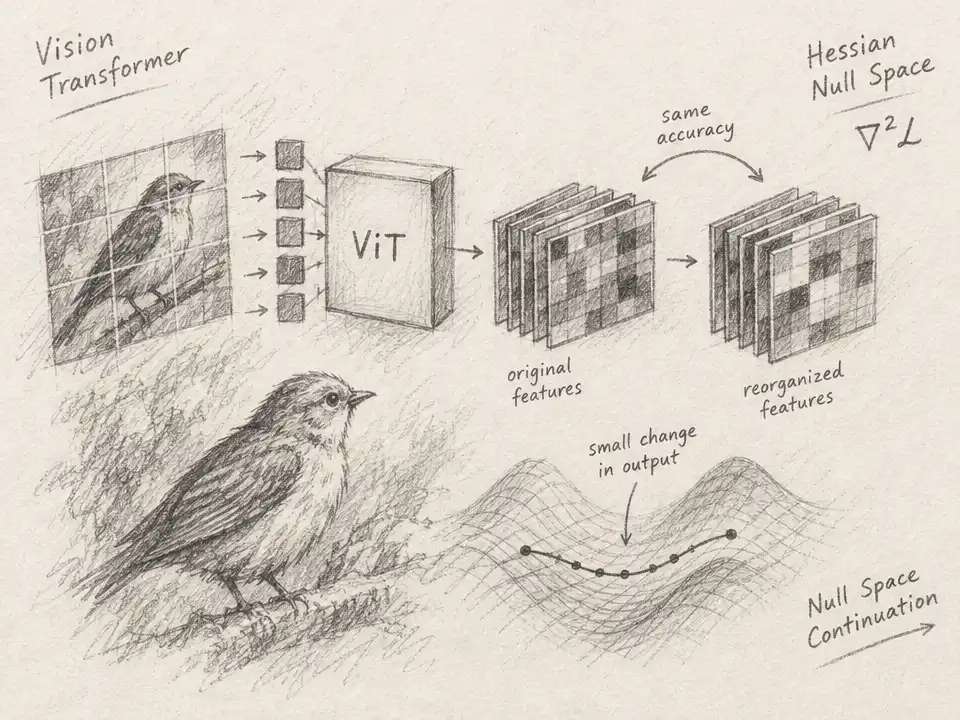
Then came the test that separated finding a pattern from knowing what it meant. The researchers kept a CIFAR-10 network’s learned structure and accuracy intact but reassigned which output number corresponded to which class. The vehicle outputs moved to different positions. The model still found the vehicle-versus-animal grouping—but interpreted the new output numbers using CIFAR-10’s familiar, original class order. All nine class pairings it named were wrong.
That mismatch matters. A system following the network’s learned signals all the way from pixels to final outputs should, in principle, be able to track which newly numbered outputs represent which kinds of images. Instead, the model appeared to combine a real numerical observation—the outputs fell into two groups—with a remembered template for the well-known dataset. Its arithmetic survived the label shuffle; its interpretation did not.
The error became almost cinematic in a separate test. A network trained on SAT-6, a dataset of satellite images sorted into six land-cover classes, reached 99.57% test accuracy. Asked what it recognized, the language model described animal photos and guessed a CIFAR-10-like set of classes. It called output 4 “frog.” But that output represented trees. A feature the model described as green really did correlate with greenness, and the researchers found that it fired most on tree images. The model had picked up a meaningful clue, then attached it to the wrong familiar story.
More examples pointed in the same direction. Networks trained on Japanese characters in KMNIST were called MNIST, the better-known dataset of handwritten digits. Three networks trained on fast-food images were all labeled CIFAR-10, even though none had been trained on that dataset. A network’s familiar input dimensions and number of outputs could help cue an answer, but did not tell the model what the pictures actually contained.
The results do not show that the model was simply guessing. It made real calculations from the weights, including identifying output-layer patterns and estimating properties connected to training. The surprise is that those skills did not reliably add up to a faithful account of the network’s internal computation. The paper’s evidence suggests a split: local numerical clues could be read, while broader meanings were often supplied by associations with familiar datasets and software conventions.
That distinction is important for interpreting claims about AI inspecting AI. Naming a dataset correctly is not, by itself, proof that a model has traced how another network processes information. A familiar benchmark may leave recognizable fingerprints—image dimensions, output counts, or characteristic patterns—without revealing exactly what its neurons represent. To test deeper understanding, the researchers argue, it helps to scramble the familiar clues and check whether an interpretation still holds.
There are substantial limits to this experiment. It tested one language model and one family of small image classifiers, and most conditions were run once. The researchers did not ask the model to compute a network’s exact output for a specific input, which would have been a more direct test of whether it could follow signals through every layer. The model’s accounts of its own reasoning were also not direct measurements of its internal process. The findings therefore do not establish how other models would perform, nor do they disprove separate reports of models editing or writing network weights.
Still, the label-shuffling result offers a useful lesson for anyone tempted to treat fluent explanations as evidence of internal access. An AI can spot a real pattern in a tangle of numbers, then lean on what it has seen before to explain that pattern—and be wrong about the world it describes. In this experiment, the numbers offered a clue to trees. The model recognized the greenery. But when it had to name the thing at the other end of the network, it saw a frog.