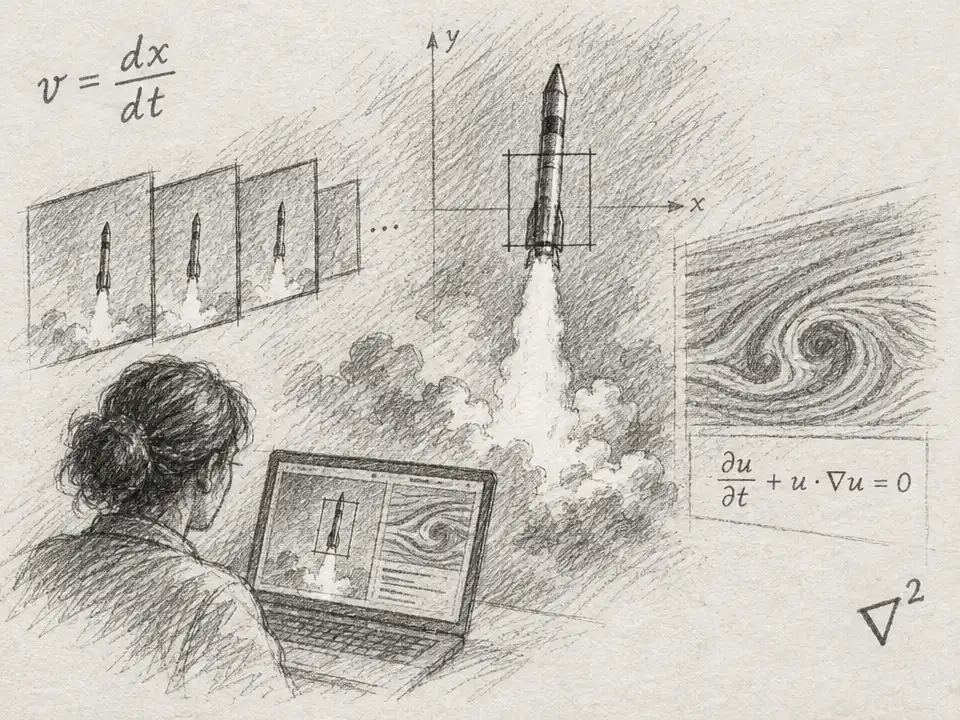
Imagine asking a computer to discover why a rocket moves by showing it a video—and nothing else. No labels mark the rocket’s position. The camera image is warped, and smaller rockets dart across the frame as distractions. Before the computer can find a law of motion, it faces a more basic puzzle: Which pixels matter, and what should count as a position?
That puzzle points to a quiet but consequential shift in scientific machine learning. A useful model is not just one that predicts what happens next. It should also describe the pattern in a form people can inspect: a compact equation. To get there, some researchers are combining neural networks, which can pick patterns out of data, with methods that search for simple mathematical rules.
The search for an equation from examples is called symbolic regression. Feed a system measurements and ask it to find a concise expression that matches them. The challenge is that countless equations can imitate the same observations, especially over a limited range. A complicated expression may fit the data beautifully while telling us little about the system. A shorter one may reveal a genuine regularity—or merely overlook something the data never showed.
One strategy, known as AI Feynman, turns the hunt into a sequence of simplifications. It checks whether physical units can reduce the number of independent variables. It looks for symmetries: for instance, whether shifting two positions together changes nothing, suggesting that only the distance between them matters. It also searches for separable pieces that can be solved independently. A neural network helps test for these patterns; once the problem is simplified, the algorithm searches for an equation.
That is more like taking apart a knot than guessing a formula in one leap. In a benchmark built from 100 equations in the Feynman Lectures on Physics, the method recovered all 100. On a separate set of 20 more difficult physics equations, it recovered 90%; the comparison software tested by the authors recovered 15% of that bonus set. These are impressive results, but the test was deliberately built from known equations. The algorithm was recovering answers from a prepared collection, not discovering a new law from an unfamiliar experiment.
There is another hurdle when the evidence is a video. A neural network can compress each frame into a smaller set of numbers, or coordinates, and use those numbers to predict the next frame. But the same images can be encoded in many different ways. One encoding might track the rocket’s horizontal and vertical position. Another could warp those coordinates into a tangle, while still allowing accurate predictions. A good forecast, by itself, does not guarantee a simple explanation.
Researchers tackling this problem built a system they called pregression. It was tested on simulated videos of a small rocket moving under five kinds of conditions, including gravity, a magnetic field, and spring-like forces. The team trained an encoder to turn each frame into a compact internal representation, then encouraged the representation to make the motion’s rules as simple as possible. A second stage searched that representation for equations.
The tests made the coordinate problem concrete. In some trials, the researchers distorted the images with a generalized lens effect. In others, they added as many as ten small, distracting rockets to each frame. The system still learned a compact representation that focused on the large rocket. Across the simulated cases, it recovered the equations used to generate the videos, with a small discrepancy in the coefficient for one of the more complex motions. The result is a demonstration on controlled, synthetic footage—not proof that the method can already extract laws from ordinary real-world video.
A different approach shows what happens when the moving scene is far more complicated than a single rocket. In work on sparse identification of nonlinear dynamics, researchers looked for a small number of important terms that could explain how a system changes. Their examples included flow around a cylinder, where fluid peels away in a repeating wake. A detailed simulation represented the flow across 292,500 grid points. Rather than try to write a separate rule for every point, the researchers compressed the motion into a few broad patterns, then searched for a compact model of how those patterns changed.
The method recovered important features of the simulated wake—but also revealed a warning. When the training data included only the flow’s familiar repeating motion, the model could miss how the system behaved away from that pattern. Including those less familiar transitions helped recover a more complete description. In other words, an elegant equation can still be wrong beyond the situations its examples cover.
That is the price of simplicity. These methods need sensible candidate building blocks, measurements rich enough to expose the dynamics, and tests that challenge the resulting model. Sparse methods assume that a system can be described with relatively few important terms. Video-based discovery so far has demonstrated its promise on carefully constructed examples. A model that fits a demonstration is a starting point, not a certificate that nature follows the same rule everywhere.
Still, the direction is compelling: instead of asking a neural network only to predict, researchers are asking it to help choose a representation in which a rule can be written down. If that approach continues to improve, it could help scientists sift through sensor readings, images, or complex simulations in search of compact descriptions. The essential move is easy to miss. Before a machine can tell us what a system is doing, it may first have to learn how to look.