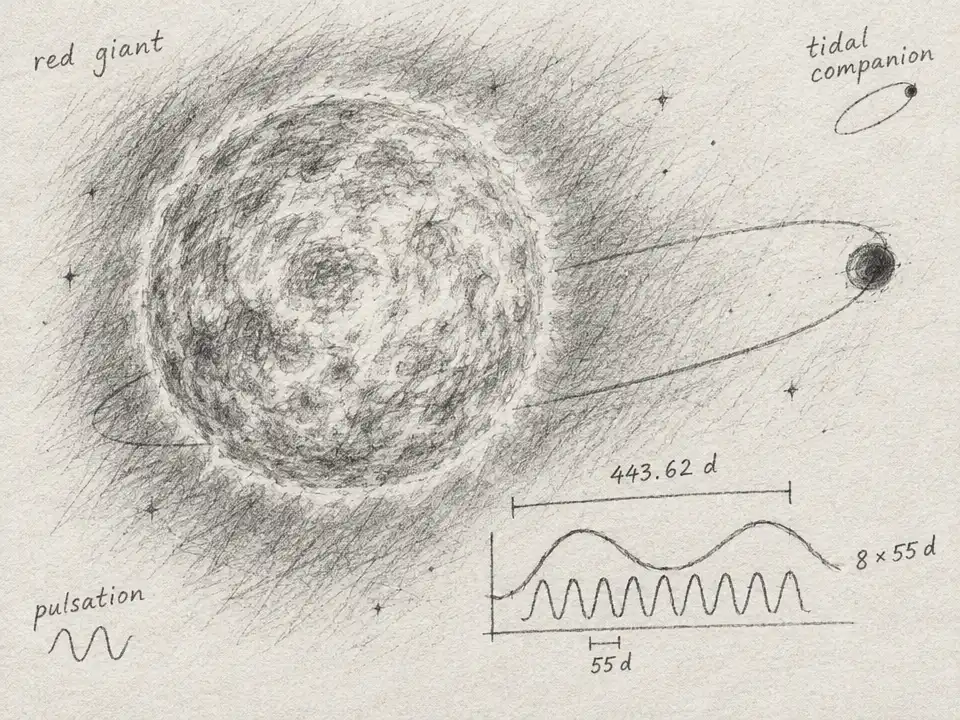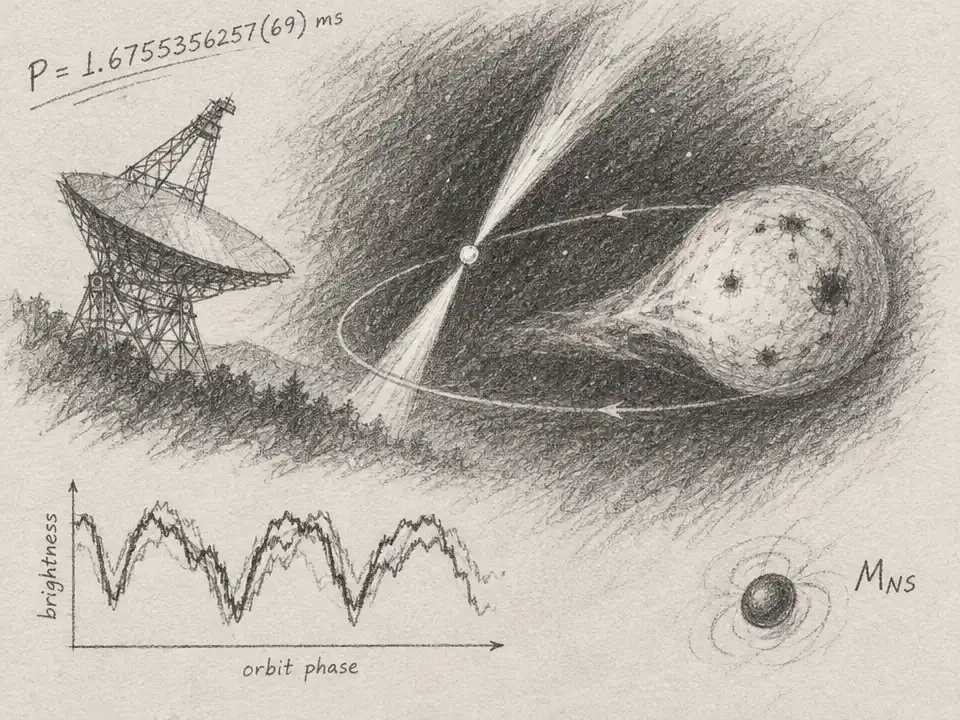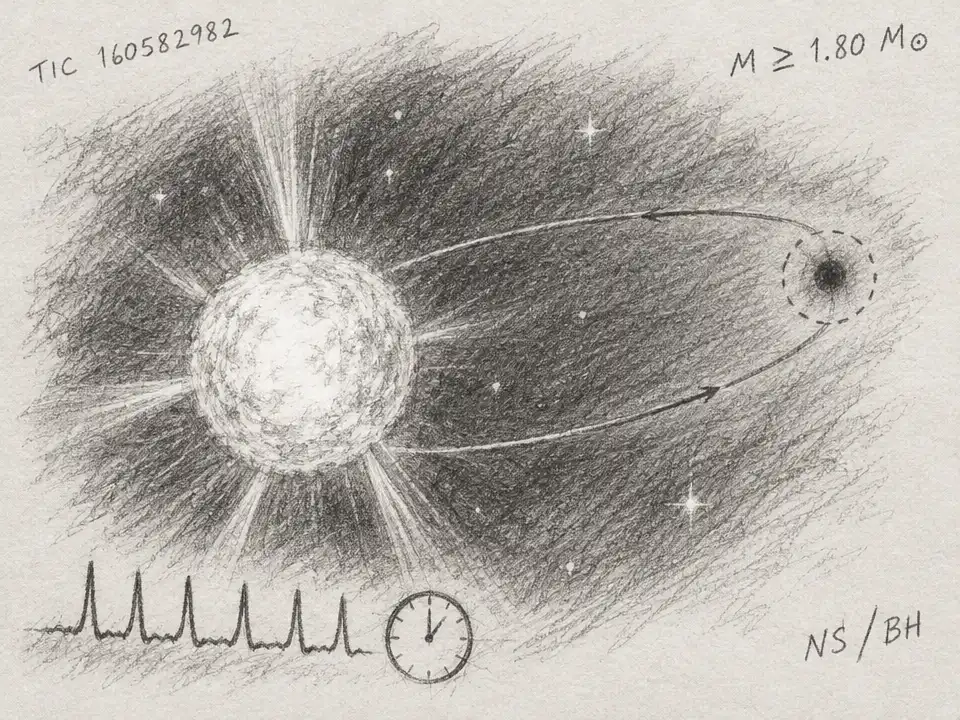
Some stars keep time by trembling. Their surfaces brighten and dim as sound-like waves ripple through their interiors, repeating with a steadiness that can turn a distant star into a clock. In the system TIC 160582982, those pulses have done something more: they have traced the motion of mass that gives off no obvious light.
The star itself is easy to notice. It is a rapidly rotating A-type star, about 263 parsecs away, with the short, regular pulsations of a δ Scuti variable. What is harder to see is the arrangement around it. The visible star follows an eccentric orbit lasting about three months, yet observations have found no clear luminous companion beside it. The orbit’s pull says something heavy is there. The empty-looking light says it should be hard to see.
The key was to listen to the star’s rhythm not for changes in its interior, but for changes in when its pulses arrive. If a star moves toward us, its light has a shorter journey; if it moves away, the journey takes longer. A pulsation that began at a steady beat therefore reaches Earth a little early or late as the star travels around its orbit. The delay is tiny, but a dependable stellar pulse can act like a stopwatch carried along on a moving platform.
Researchers analyzed light recorded by NASA’s TESS satellite. Across 12 observing segments spanning about 352 days, the data contained 194,661 usable measurements, taken at two-minute intervals. Among the star’s many variations, the team identified six high-frequency pressure modes—interior vibrations that push and pull through the star. Each mode provided its own clock. Their timing shifts told the same orbital story, a useful check that the signal came from the star’s motion rather than from one wandering pulse.
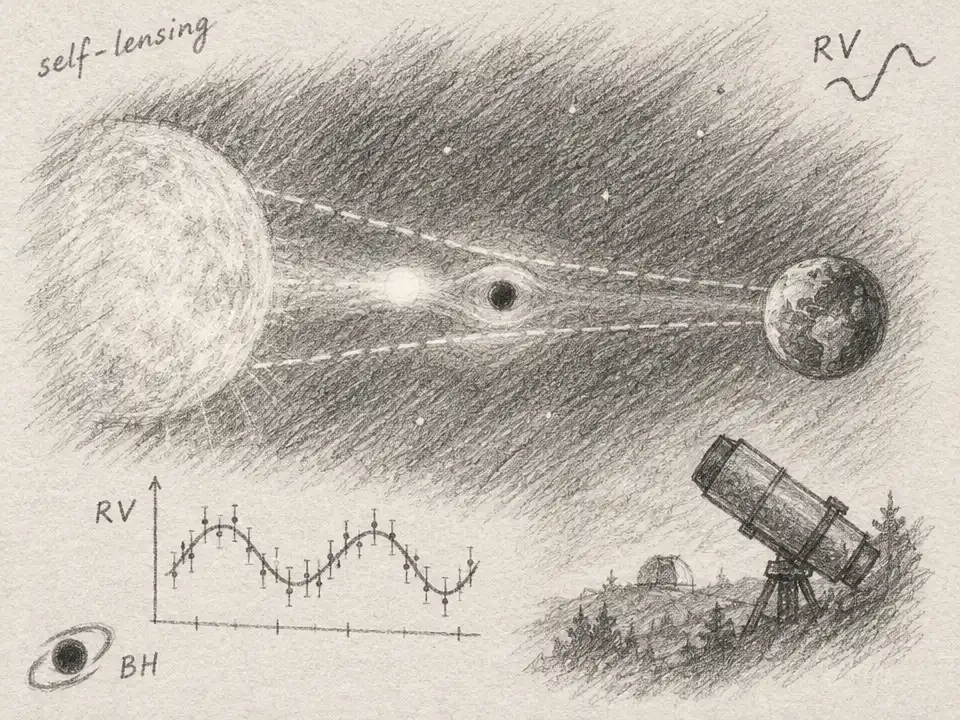
The timing pointed to an orbit of 89.29 ± 0.19 days, with a substantial eccentricity of 0.539, with reported uncertainty of −0.037 to +0.040. The visible star’s travel time along our line of sight varied by 145.6 seconds, with uncertainty of −3.4 to +3.7 seconds. That delay corresponds to a timing-inferred radial-velocity semiamplitude of 42.2 km/s, with uncertainty of −1.8 to +2.2 km/s. In other words, the star is not merely flickering: it is moving briskly under the influence of an unseen partner.
A second route through the same data strengthened the case. Orbital motion leaves a recognizable pattern in the frequencies around the strongest pulsations, like side notes clustered around a musical tone. An analysis of two of those modes produced an orbital period of 89.36 ± 0.19 days, consistent with the timing result. The agreement matters because it links the inferred orbit to two distinct signatures of the star’s motion.
From that motion, the team calculated a mass function: a way of using the orbit to set a lower bound on the companion’s mass, even before its identity is known. For the estimated mass of the visible star, the companion must be at least about 1.80 times the mass of the Sun in the most favorable, edge-on geometry. If the companion is a single ordinary main-sequence star, the study’s conditional estimate is about 2.19 solar masses, though the uncertainty is broad and depends on that assumption.
But that ordinary-star explanation runs into a simple problem: brightness. A main-sequence star massive enough to meet the orbital requirement should contribute a noticeable share of the system’s optical and infrared light. Instead, the measured light is well described by one A-type stellar atmosphere, and available spectra show no conspicuous second star. The team’s estimate suggests that a single companion near the minimum mass would supply roughly 20–25% of the optical and near-infrared light—difficult to hide in the observations.
There is another way to hide the same weight. The companion could be a compact remnant, such as a neutron star or a stellar-mass black hole, which contributes little visible light. Or the object traveling around the visible star could itself be a close pair. Two stars of about 0.90 solar masses each could supply the minimum required mass while giving off much less light together than a single star of equal total mass. In the Gaia G band, the paper estimates, such a pair would contribute about 3.8% of the light, compared with roughly 20–25% for one star of similar total mass.
That leaves a genuine mystery, not a confirmed black hole. The current measurements strongly disfavor an ordinary, unobscured single star as the companion, but they cannot distinguish a compact remnant from an unresolved inner binary. Nor do the existing spectra provide a full orbital record. The next clues may come from high-resolution observations taken at different points in the 89-day orbit, or from future astrometry that helps pin down the system’s orientation and total mass.
There may even be a second clock at work. The visible star shows a slower pulsation whose strength varies with orbital phase and reaches a maximum close to the companion’s nearest approach. The researchers treat it cautiously: it could be a gravity-influenced mode affected by the orbit, but the photometry alone cannot establish that tidal forces excite it. If confirmed, it would offer a glimpse of how the companion’s pull reaches inside the star.
For now, the remarkable shift is one of scale. A tiny delay in the arrival of a stellar pulse—measured in seconds across a journey of hundreds of parsecs—reveals the orbit of hidden mass. The companion remains unseen, but its gravity has left a rhythm in the light. What the clock has found is not yet a name for the object. It is a precise invitation to look again.