For decades, one star has kept time like a clock: every 3.76 days, its light and spectral lines shift in a repeating pattern. The star, WR 6, is a Wolf-Rayet star—a massive, evolved star wrapped in a dense, fast wind. But what makes that wind change on schedule? One possibility is a hidden companion, orbiting close enough to stir the outflow. Another is stranger in a quieter way: the star itself may be turning, carrying persistent disturbances around with it.
The distinction matters because the two explanations tell different stories about what is happening near the star. A companion could plow through the wind and create a localized disturbance. In the alternative, a changing patch on the star’s surface launches a structure into the wind. As the star rotates, that structure winds into a spiral-like pattern, known as a corotating interaction region, or CIR. Astronomers had clues favoring the second idea, but the wind’s inner regions were difficult to resolve directly.
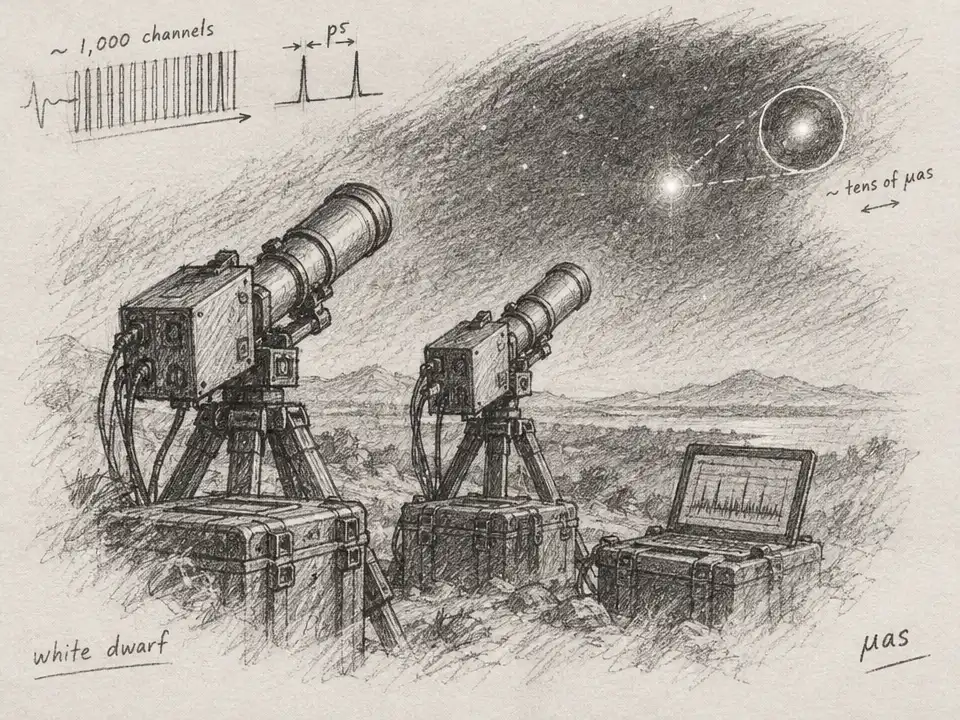
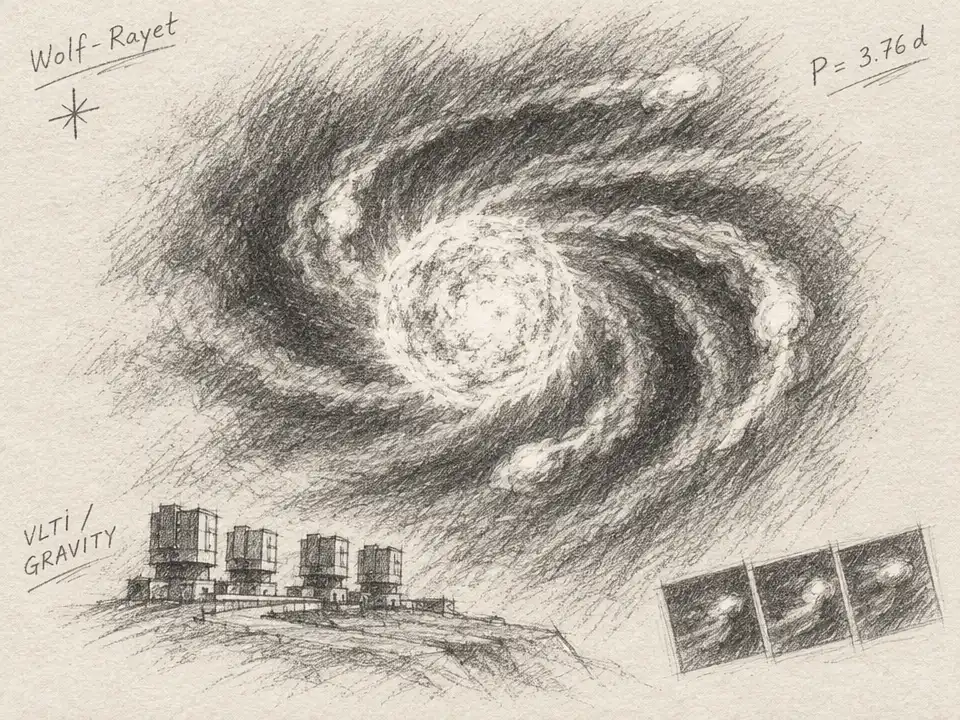
A new study takes the puzzle to the star’s doorstep. Over six observing sessions between October 2025 and April 2026, researchers used the GRAVITY instrument at the Very Large Telescope Interferometer in Chile. Its four telescopes can combine their light as if they were one much larger telescope, with baselines reaching 202 meters. The team did not obtain a conventional close-up picture. Instead, they measured how the combined light changed with wavelength and direction—subtle signals that reveal whether different parts of the wind appear spread out or offset from the star.
The first clue seemed to favor simplicity. Across all six sessions, the overall signal looked almost like a single, nearly symmetric object. A search for a wide companion found none above the study’s sensitivity limit, corresponding to about 6 solar masses for a main-sequence star. But that was not a clean acquittal for the wind-only explanation—or a decisive rejection of a companion. A proposed lower-mass companion would sit less than 0.1 milliarcseconds from WR 6, far below the roughly 1 milliarcsecond resolution of those measurements.
The more revealing clues were hiding in the starlight’s spectral lines. Different chemical forms of helium emit light at different wavelengths, and the lines arise at different depths in the wind. The helium I feature around 2.11 micrometers showed a strong sign of being spread across the sky. The helium II line around 2.19 micrometers came from a region that was much less spread out overall. Yet within that line, GRAVITY detected narrow, changing signals that appeared to come from small regions offset from the star’s apparent center.
Those offsets are a little like watching a bright crowd from far away: even if you cannot distinguish every person, a shifting bright spot can tell you where activity is concentrated. In this case, the team modeled the signals as one to three compact emission features in the wind, seen at different places and wavelengths across the six sessions. The features changed from one epoch to another. Their changing positions and Doppler shifts—the wavelength shifts that reveal motion toward or away from us—made a single, stable disturbance hard to maintain as an explanation.
A second clue came from observations made at the same time as the fifth interferometry session. In a helium line observed with a separate spectrograph, the researchers saw two changing traces: one on the blue-shifted side, associated with material moving toward us, and one on the red-shifted side, associated with material moving away. Matching those traces to the features seen by GRAVITY pointed to counterclockwise motion across the sky. It was a glimpse of the wind’s choreography, though not yet a complete map.
The most tempting test came from the first three sessions, taken on three consecutive nights. If a feature simply rode outward in the wind while the star rotated every 3.76 days, its apparent position should shift in a predictable way from night to night. The expected rotation is about 96 degrees per day. But when the researchers tried to connect the features across all three nights, no tested geometry fit every condition. The closest match required a structure’s inferred direction to change rapidly—something not suggested by the star’s other observed variations.
That failure does not erase the evidence. It narrows what the observations can safely say. The team’s model represents complicated wind structures as compact points, and the measurements may not have captured every feature at every phase. The researchers also note that a feature’s modeled offset depends on assumptions about its strength. In other words, the locations are useful clues, not a direct photograph of a spiral arm.
Still, the overall pattern gives the CIR explanation the stronger hand. The number and positions of the detected features vary, rather than behaving like one stable structure tied to a companion. The observations also fit the earlier picture of a star whose rotation organizes parts of its wind. The team therefore favors corotating interaction regions, while stopping short of claiming that the companion possibility has been ruled out.
The next move is not a bigger telescope alone, but better timing. The authors suggest observing at least twice per night, with measurements separated by at least 4.5 hours, over at least five nights within a month. That cadence could follow the wind as it changes and test whether separate features trace a common rotating pattern. For now, WR 6 leaves astronomers with a rare kind of clue: not merely that its wind is structured, but that the structure shifts too quickly and too irregularly to fit the simplest orbiting-companion story. The clock still ticks. The wind is beginning to show why.