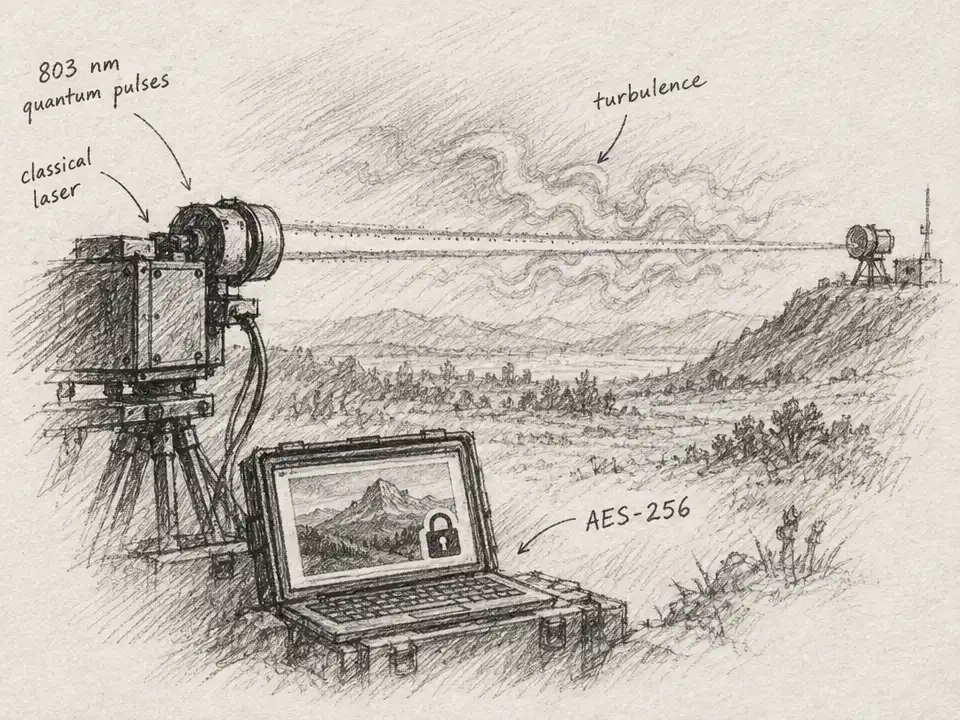
On one end of a 10.31-kilometer stretch of open air, a transmitter sat inside a vehicle. On the other, a receiver waited atop a tower. Between them, the atmosphere shimmered and stirred the light. The experiment’s quiet surprise was that two very different kinds of communication had to survive that same journey together: messages carried by ordinary laser pulses, and a secret key built from the behavior of individual photons.
The research team’s system sent both through one shared optical aperture. The quantum signal traveled at 803 nanometers, just beyond visible red light. Classical signals traveled in the opposite direction at 640 nanometers and forward at 660 nanometers. Rather than giving each signal its own telescope and alignment system, the researchers coaxed all three wavelengths onto a common path. A beam expander launched them toward the distant receiver; a telescope gathered what it could on the far side.
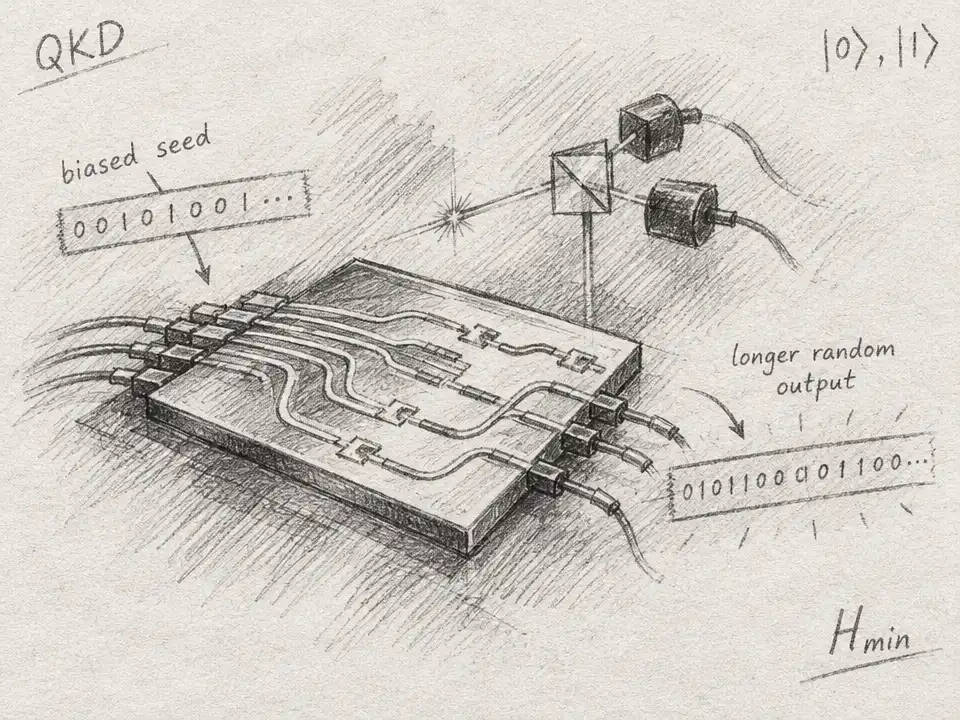
That arrangement matters because quantum key distribution is not a secure message in a beam. It is a way for two parties to make matching secret bits and test whether an eavesdropper might have disturbed the signals. Here, the team used a version of the BB84 protocol. In simplified terms, the transmitter encodes bits in photon polarization, choosing between different ways of setting that polarization. The receiver makes corresponding measurements. Later, the two sides use a classical channel to compare some of their choices and estimate how much noise or interference affected the exchange.
The pulses came from weak laser sources, not a machine that releases exactly one photon on demand. Some pulses contain no photons; others may contain one or more. The researchers used the decoy-state method, varying pulse intensities so they could estimate how many secure bits came from single-photon events. That estimate is essential: it turns a stream of imperfect detections into a smaller, carefully bounded supply of secret key material.
Meanwhile, the classical channel carried the coordination that makes the quantum exchange usable. It transmitted protocol data for sorting and correcting the key, then carried an encrypted image. The division of labor is easy to miss: quantum light helps establish a key; ordinary laser communication carries much of the conversation around that process and the eventual ciphertext. The image was encrypted with AES-256 using 256 bits of the distilled key. It was not an image encoded directly into single photons.
Getting the beams to share a route demanded unusually careful optics. Different wavelengths bend by different amounts in glass, which can bring them to focus at different places. The custom beam expander limited the focal shift between the quantum and classical signals to less than 0.17 millimeters. At the receiver, filters rejected more than 80 decibels of unwanted classical light, helping keep the much fainter quantum detections from being swamped.
Then the atmosphere took its turn. The transmitted beam spread to about 450 millimeters across by the time it reached the receiver, whose collecting mirror had an aperture of about 155 millimeters. Much of the light missed the mirror. Across 20 trials, the fraction of the beam captured at the receiver averaged 15.6 ± 10.8 percent, with individual results ranging from 2.2 percent to 39.3 percent. Beam wander caused by atmospheric turbulence helped make that coupling fluctuate. The trial took place in clear conditions, with visibility greater than 20 kilometers and wind below 1 meter per second—not in every kind of weather a real network might face.
The two channels also had different jobs and different performance. The classical system used a self-synchronizing signaling method and retransmitted damaged packets. It achieved an average packet error rate of about 0.4 percent and a net payload throughput of 1.866 megabits per second. The quantum side produced a measured average quantum bit error rate of 2.512 percent. After sifting, error correction, and privacy amplification—the steps that discard uncertain bits and reduce what an eavesdropper could know—the researchers reported 687 secret bits from a 1.0666-second quantum transmission window, equivalent to 644 bits per second.
Those numbers reveal the hidden work behind a headline-grabbing distance. The quantum pulses crossed the link quickly, but completing the reported key-processing exchange took 759 seconds: 650 seconds to transfer the supporting data over the prototype classical link, followed by 109 seconds of computation. The team processed that data in batches. They estimate that faster commercial optical transceivers could reduce the supporting-data transfer time to under one second, but that is a projection, not what this field trial achieved. “Real time” describes parts of the demonstration, including the image encryption and transmission; it should not be mistaken for a continuously running, instant end-to-end system.
The demonstration did complete a striking loop: the researchers used the distilled key to encrypt an image of a vehicle, sent the ciphertext along the optical link, and recovered the image at the tower. But the result is not a claim that the system is invulnerable. Quantum key distribution can help protect the key against certain forms of interception, under the protocol’s assumptions. It does not prevent someone from blocking the beam, disrupting the equipment, or exploiting a weakness in the devices around it. Nor did this test show a vehicle communicating while driving: the transmitter was vehicle-mounted, but the outdoor trial linked it to a stationary tower.
Look closely and the experiment’s scale changes. At first, it seems to be a story about a lone photon crossing ten kilometers. In practice, the photon is only one part of a larger choreography: wavelength-matched optics, atmospheric tracking, filtering, classical messages, statistical checks, and painstaking error correction. The achievement is that a shared beamline brought those pieces together outdoors. The next challenge is to make the arrangement faster and more reliable when the air, distance, and moving platforms are less forgiving.