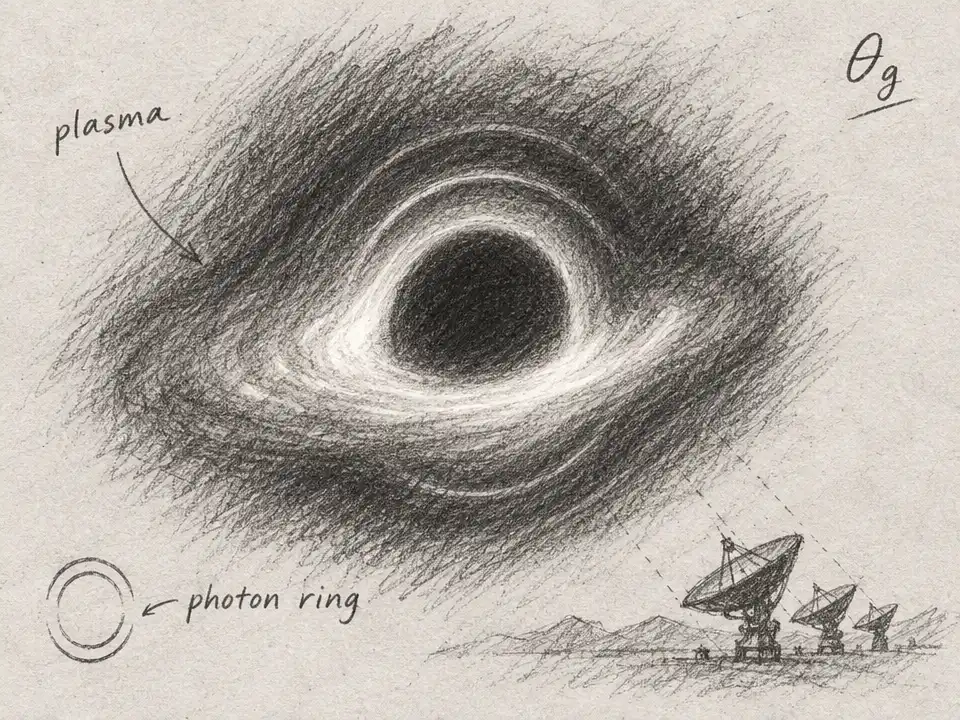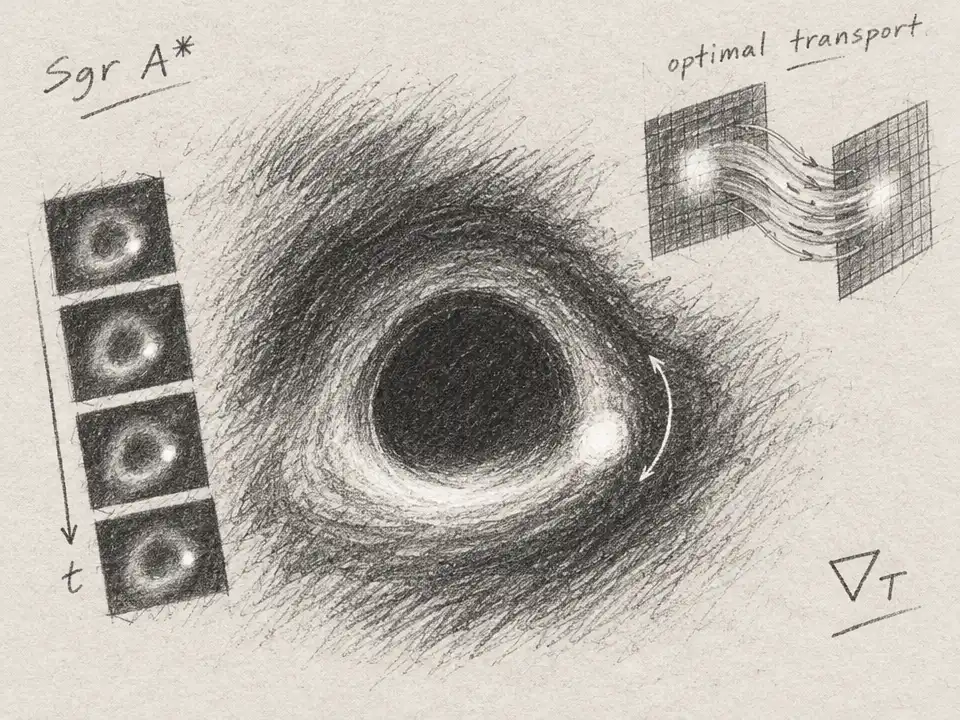
A telescope usually makes a picture by collecting light. The Event Horizon Telescope, which links radio observatories across the planet, faces a stranger task: it samples the sky in fragments, then researchers use those measurements to reconstruct an image. When the target changes while they observe it, the challenge gets harder. Around Sagittarius A*, the supermassive black hole at the center of the Milky Way, bright radio-emitting gas can change on minute-long timescales. A sequence of images must capture not just what is there, but how it moves.
That is where a quiet assumption in image-making becomes important. Many reconstruction methods encourage neighboring frames to resemble one another. This helps steady a noisy sequence, but it can also treat movement as a problem: a bright patch that shifts across the image leaves one set of pixels and lights up another. The image changes even if the patch has moved smoothly. How can a reconstruction distinguish a coherent journey from a jumble of flickering pixels?
A team led by Andy Nilipour proposes a different guide: optimal transport. Imagine each image as a map of brightness, with every pixel holding a little parcel of light. To compare one frame with the next, the method asks how those parcels could be redistributed across the image grid at the lowest total cost. Moving brightness a short distance costs less than moving it far. The resulting transport map helps the reconstruction favor patterns that flow between frames, rather than simply rewarding frames for looking alike.
The idea has an unexpected history: optimal transport is a way of comparing distributions by working out how one could be rearranged into another. Here, the distributions are successive images. The researchers use a computationally efficient version called the Sinkhorn distance to calculate the redistribution and its effect on the reconstruction. In practical terms, the method gives the image-making process a way to account for apparent motion without requiring every bright feature to follow one fixed, predictable path.
That flexibility matters near a black hole, where the changing glow comes from hot material in a turbulent accretion flow, not from a neat set of objects orbiting like clockwork. And the telescope data do not arrive as a ready-made movie. The EHT’s separated antennas measure how radio signals relate across pairs of stations. Those measurements constrain the image, but do not specify every detail. Researchers must solve an inverse problem: find a changing set of images that fits the measured data while avoiding patterns that are merely noise or artifacts.
For a proof of concept, the team tested its method on simulated observations modeled on the EHT’s coverage of Sagittarius A* on April 11, 2017, from 10.89 to 14.04 UT. One simulation placed a bright hotspot on a ring-shaped glow and let it circle clockwise with a period of 80 minutes. A second used a more physically detailed model of the gas, based on general-relativistic magnetohydrodynamics, with a hotspot added. The tests also included simulated effects such as noise, scattering, and errors in the antennas’ measurements.
The comparison was revealing. In the more complete test, the optimal-transport reconstruction tracked the simulated hotspot with an average position-angle error of 6.3°, versus 21.1° for a standard reconstruction. In 80% of frames, the new method placed the hotspot within 10° of its simulated position; the standard method did so in 55%. It also recovered more of the hotspot’s brightness: 84% of the new method’s frames retained more than 0.8 times the simulated hotspot flux, while the standard reconstruction never reached 0.4 times that flux. The average reconstructed hotspot flux was 0.084 Jy, compared with approximately 0.097 Jy in the simulated source and 0.016 Jy in the standard reconstruction.
These numbers describe a reconstruction test, not a newly observed orbit around Sagittarius A*. The team generated synthetic data from models with known answers, then checked how well the method recovered them. That distinction matters: the study demonstrates that a new approach can preserve motion in difficult, incomplete measurements, but it does not establish that the black hole’s real emission contains the simulated hotspot. In the tests, some small-scale brightness patterns were still blurred or shifted, even when the larger-scale motion came through.
There is another built-in assumption. The method normalizes consecutive images so their total brightness is equal, then redistributes brightness between pixels. That is a useful approximation when the total emission changes modestly. If a feature becomes much brighter or fades rapidly, the method may need a more flexible version that allows brightness to appear or disappear, rather than only move.
Even with those limits, the conceptual shift is striking. Instead of asking only whether two frames look alike, researchers can ask whether the brightness in one could plausibly flow into the brightness in the next. Nilipour and colleagues have added the approach as an extension to the EHT imaging software. Applying it to real observations—and testing how well it holds up when the source’s motion and brightness are not known in advance—will be the next step. The immediate achievement is more modest, and more useful: a new way to make faint motion count as evidence rather than noise.