The oldest light in the universe has been traveling for billions of years. It began its journey when the cosmos was young and hot, and electrons and protons were joining to make the first atoms. Most of that light crossed the newly transparent universe without further interruption. But some photons brushed past those atoms—and that small detour may carry a clue to how the early universe worked.
A new study explores whether this faint effect, called Rayleigh scattering, could help cosmologists test ideas about the universe’s expansion. The crossover is between atomic physics and cosmology: a photon’s interaction with a hydrogen or helium atom may reveal details about the moment the universe became transparent.
The cosmic microwave background, or CMB, is the afterglow of that transition. Before atoms formed, free electrons scattered light so often that photons could not travel far in a straight line. As the universe cooled, electrons joined atomic nuclei. The scattering eased, and light streamed outward. The CMB preserves a pattern of hot and cold regions, along with a polarization pattern, that records conditions around this last-scattering era.
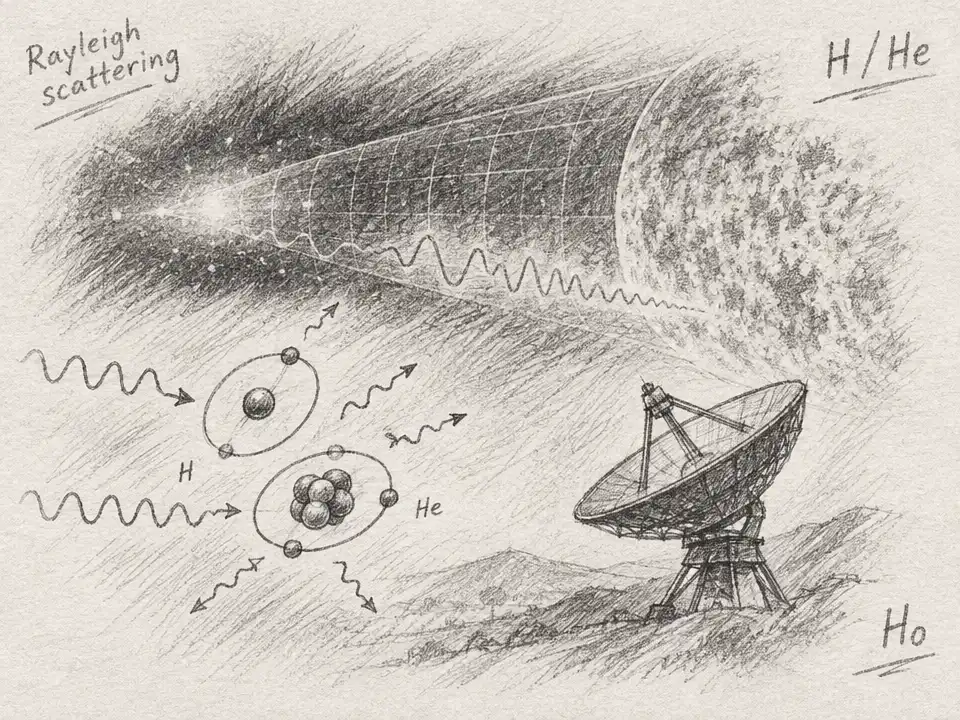
Cosmologists usually focus on how CMB photons scattered from free electrons. The new work looks at what happened next: some photons also scattered from neutral hydrogen and helium. This is Rayleigh scattering, the same basic kind of interaction that helps explain why Earth’s sky looks blue. For the CMB, though, the effect is subtle—and grows rapidly with photon frequency, approximately as the fourth power of frequency.
That frequency dependence is useful. Ordinary CMB signals look different across the sky because of their physical origins, but Rayleigh scattering adds a particular change that becomes more noticeable at higher frequencies. In the study’s calculations, its imprint matters most around 200 to 800 gigahertz. By comparing observations across frequency bands, researchers could gain extra information about when neutral atoms appeared and how quickly recombination unfolded.
Why care about the timing? One unsettled question in cosmology is the Hubble tension: estimates of how quickly the universe expands today do not agree, depending on how they are made. Some proposed explanations change physics in the early universe. For example, a heavier electron or a different value of the fine-structure constant could alter atomic binding energies, making recombination happen earlier. That would change the sound horizon—the distance sound waves traveled before atoms formed—and could shift the expansion rate inferred from the CMB. These ideas remain possibilities, not established explanations.
Rayleigh scattering offers a way to check such scenarios from a different angle. If atomic properties changed, they would affect not only the timing of recombination but also how photons scattered from the newly formed atoms. The resulting signal would vary with frequency. That gives researchers another set of clues, partly independent of the familiar CMB pattern made by free electrons.
The authors did not report a detection. Instead, they modeled how sensitive future observations might be, including realistic assumptions about instrumental noise and foreground light, such as emission from dust. Their forecasts compare a proposed PICO experiment configuration with a combination of LiteBIRD and Planck measurements. The results are predictions about what these observations could constrain, not measurements from an experiment that has already seen the signal.
In the standard cosmological model, where the history of recombination is fixed by standard atomic physics, adding the Rayleigh signal improves some predicted parameter constraints by up to about 7 percent for the PICO configuration. The larger payoff appears when the models allow recombination or fundamental constants to vary. In one such scenario, the forecasts show roughly 31 percent tighter constraints on the Hubble constant and the varying atomic parameter. When the analysis consistently accounts for how a changing electron mass affects scattering itself, the details shift: the electron-mass-related degeneracy improves by about 30 percent, while gains for a varying fine-structure constant are smaller.
Those distinctions matter. The signal is faint, and the forecast depends on the capabilities assumed for future instruments, as well as on how well foregrounds and atomic processes are modeled. For LiteBIRD combined with Planck, most predicted improvements are below 2 percent, though the study finds larger gains in a particular electron-mass degeneracy. Rayleigh scattering is not a shortcut to resolving the Hubble tension; it is a way to test some proposed explanations more carefully.
The appeal is that the young universe may have left more than one kind of record in its oldest light. A subtle interaction with atoms can add a frequency-dependent trace to the CMB, turning atomic physics into a probe of cosmic history. If future observations can extract that trace, the universe’s first atoms may help scientists distinguish between competing accounts of how expansion began to take shape.