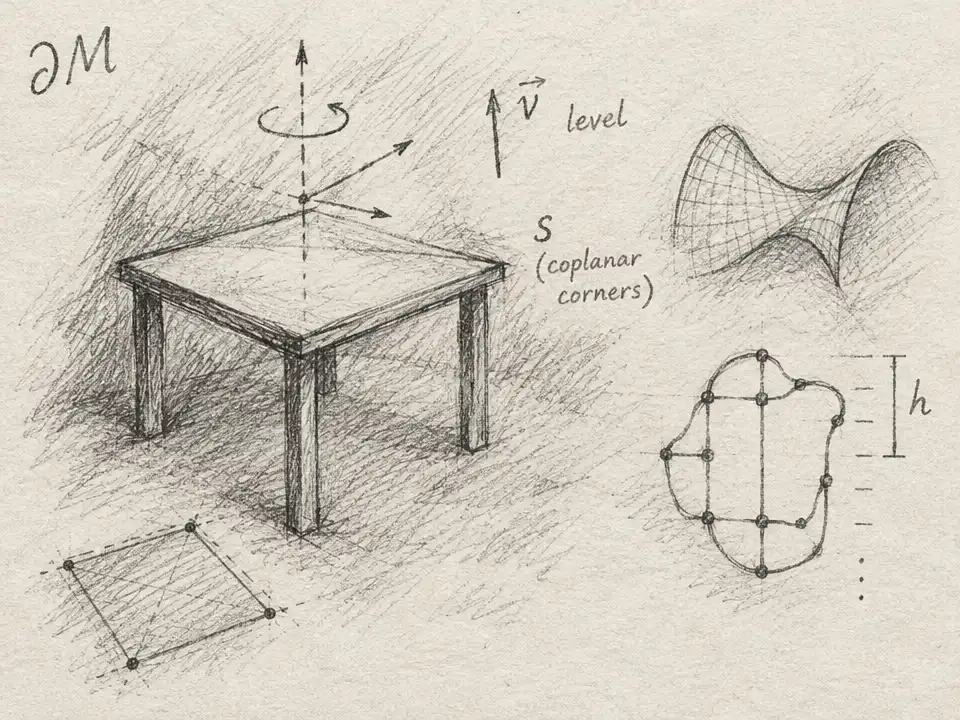
Set a four-legged table on an uneven floor and it rocks. Turn it, shift it, try again: somewhere, intuition suggests, there ought to be a placement where all four feet meet the same height. But how could you prove that such a placement exists when the floor may be an irregular, continuous landscape?
Mathematicians have studied this as the square-table problem. A paper by Xiao-Song Yang and Xuan Zhou offers a fresh route through one important version of it: instead of tracking every possible table placement directly, it turns the search into a question about zeros, curves, and an odd count that cannot be paired away.
The result they revisit is Fenn’s square-table theorem. Imagine a bounded, convex patch of ground surrounded by a flat region. The height varies continuously inside the patch, never dips below the surrounding level, and returns to that level outside it. Under those conditions, a square table of any chosen side length can be placed with its center over the patch so that its four corners meet the surface at the same height. The tabletop is then horizontal.
Fenn had already proved the theorem. Yang and Zhou’s contribution is a different proof, built around a change of viewpoint. A square’s placement has two things to adjust: where its center sits and which way its sides point. The researchers let those choices roam through a three-dimensional space: two coordinates for the center and one for the angle.
Now they give the placement two tests. First, imagine a plane passing through the surface points beneath three corners. The vertical gap between that plane and the fourth corner tells whether all four points lie in one plane. If the gap is zero, the square’s corners are coplanar—but the plane might still tilt.
For the second test, they look at the plane’s normal, an arrow perpendicular to it. A horizontal tabletop has a vertical normal, so the arrow’s horizontal component must vanish. The clever part is to combine the normal information from four versions of the square, each turned by a quarter-turn. When the first test says the corners are coplanar, these versions share the same plane. Their four normal components then reinforce one another rather than obscuring the tilt. A zero in both tests means the corners lie in a horizontal plane.
That still sounds like a search over infinitely many placements. The proof’s turning point is to follow the square’s orientation only through a quarter-turn. At the two ends of that angular interval, the combined normal test returns to the same value: a square turned by a quarter-turn has the same set of corner directions. Meanwhile, the coplanarity test has a seesaw property: at the two ends, its values have opposite signs unless they are already zero.
Here topology enters—not as a picture of the ground, but as a way to keep track of what must happen to zeros. The combined normal test is a two-component quantity that changes as the center and angle vary. On the boundary of the allowed center region, convexity makes it point outward. That boundary behavior forces its zeros on an end face to occur in an odd number.
As the angle changes, the places where this two-component test is zero form curves through the space of placements. Their endpoints lie on the beginning or ending face; they cannot slip out through the boundary of the center region. If every curve paired endpoints with the same sign of the coplanarity test, the endpoints with positive sign would come in pairs. But their total number is odd. At least one curve must connect endpoints with opposite signs. Along that curve the coplanarity test has to pass through zero, while the two-component test remains zero. There is the sought-after horizontal square.
The argument is a kind of topological bookkeeping: it does not calculate the winning center and angle, but shows that the conditions cannot avoid meeting. It also works even when the surface has no smooth slopes. The authors first give the geometric argument in a smooth setting, then extend it to continuous surfaces by approximating the relevant maps while preserving the properties needed for the zero-counting argument.
The paper also changes the boundary conditions and still gets a guarantee. If the surface has one sign outside the patch and the opposite sign close to its boundary, a level square is assured for side lengths smaller than the boundary-band width divided by the square root of two. That limit matters: this version does not promise a square of every size.
On a more specialized landscape, the proof becomes almost startlingly simple. The authors define a saddle surface whose height rises as you move farther from its center along one coordinate direction and falls as you move farther along the other. Those rules force the surface to mirror itself across both central axes. Put a square centered at that point with sides parallel to the axes, and each corner has a mirror partner at exactly the same height. Every square size works.
There is another, distinct route to level shapes in the paper. For a smooth surface of Fenn’s type, almost every height between the surrounding level and the highest point is a regular height. At such a height, a level curve forms a smooth closed loop inside the patch. A known geometric result says that such a loop contains a rectangle similar to any prescribed rectangle. Since all four corners lie on one height curve, the corresponding points on the surface are level. The authors stress that this gives a similar rectangle on almost every level—not a fixed-size rectangle guaranteed anywhere on the surface. That stronger fixed-size question remains open.
The lasting appeal of the new proof is its shift in what gets measured. Rather than trying to flatten an unknown landscape by brute force, it separates the problem into two tests—coplanarity and tilt—and lets parity force them to vanish together. A table’s level placement is hidden somewhere in a continuous sea of possibilities. The proof cannot point to its exact coordinates, but it shows why the search cannot come up empty.