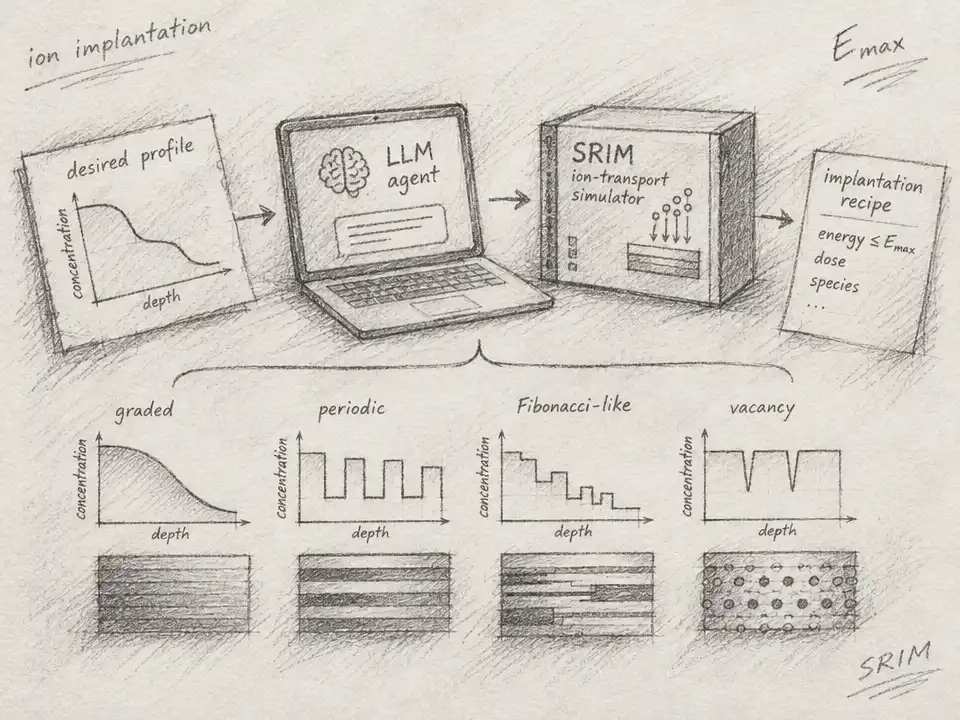
Start with a sketch of what you want inside a piece of silicon: perhaps a gradual rise in implanted atoms, a flat stretch, then a sudden step. The drawing describes the destination, not the route. To make it real, someone must work out which ions to fire, at what energies, and in what amounts. Researchers have now built a system that tries to solve that backward problem: give it a target pattern, and it uses a physics simulator to design a possible ion-beam recipe.
Ion implantation is a familiar way to modify materials. An ion’s energy helps determine how deeply it travels; changing the energy changes the distribution of stopping points. Combine implants at different energies and their distributions can add up to a more complicated pattern through a material. But designing that recipe has often meant repeated simulation and human judgment: try a set of beam settings, inspect the result, adjust, and try again.
In the new approach, a language-model agent operates the ion-transport simulator SRIM/TRIM. Researchers can provide a numerical target or a hand-drawn profile. The agent translates the sketch into data, selects ions and beam settings, runs simulations, checks how closely the resulting profile matches the target, and revises its plan. It can also account for stated constraints. The system is not an autonomous laboratory, however: people helped build its connection to the simulator, supplied goals and updates, and remained responsible for physical decisions.
One test began with a two-step gradient drawn to a depth of 20 µm. The agent designed a simulated recipe for implanting bismuth into silicon, using 28 ion energies with nonzero fluence, from 2.0 to 195.8 MeV. Its predicted profile had a normalized root-mean-square error of 7.86% against the digitized sketch. That number describes agreement between a target and a computer model—not a measurement of a manufactured sample. The team did not implant the recipe and then check the result in real silicon.
The researchers also asked the system to design patterns that are ordered but not all alike. For a regular sequence of five implanted-ion peaks, the target spacing was 5 µm. An independent simulation of the proposed recipe produced a mean spacing of 5.04 µm, within 1% of the target. For a more unusual pattern, they requested a Fibonacci sequence: a quasiperiodic arrangement that follows a rule but never settles into one repeating interval. The simulated long-to-short spacing ratio was 1.60, within 1.2% of the target value.
That ability to compose a pattern from several simulated implants matters because material structure can influence how a material behaves. A repeated or graded arrangement of atoms, or a designed pattern of vacancies—missing atoms in a crystal—could be useful for exploring material properties. In a vacancy-profile test involving silicon and germanium, the agent proposed a recipe using 18 energies from 20 to 260 MeV. The simulated profile’s error was 6.61%. The model attributed 97.6% of the vacancies to recoil cascades: collisions in which the incoming ions transfer energy to atoms in the material, which then knock other atoms out of place.
The system’s limits became visible when the researchers gave it a target that the available beam could not reach. In one test, krypton ions were limited to 1.5 MeV in an alumina film. The simulator estimated that ions at that maximum energy would travel an average of 545 nm, while most of the requested pattern lay deeper. Instead of pretending the full target was achievable, the agent fitted the accessible region, from 0 to 540 nm. This is a useful feature of the approach: a recipe can be judged against constraints, not just against an ideal drawing.
In another test, the desired depth profile was shaped like the letters “MIT.” The predicted distribution formed the M and I legibly, but failed to reproduce the T. The result is a vivid illustration of both the system’s reach and its boundary: it can search for a complicated pattern, but physics and the available implantation profiles determine which shapes can be approximated. The researchers also converted a recipe requiring separate energy settings into a proposed continuous energy sweep at constant ion flux, a step intended to make a design easier to carry out.
Every result in the paper remains a simulation. SRIM/TRIM makes simplifying assumptions about how ions move through matter; among other things, it treats the target as amorphous and at 0 K, and does not model effects such as channeling, diffusion, or material changes from high-dose implantation. Those simplifications can make a simulated depth profile differ from what an experiment produces. The authors therefore describe the output as an experimental plan, not a validated manufacturing method.
Still, the change in direction is important. Instead of asking only, “What pattern does this recipe produce?”, a researcher can begin with, “What pattern do I want?” The paper points to possible future uses, such as embedding an invisible code in a material or making a single sample span a range of compositions. These are possibilities, not demonstrations. First comes the harder check: carrying out the proposed recipes and measuring what the ions actually leave behind. If that holds up, sketching a material’s internal structure could become a practical starting point for experiments once reserved for trial and error.