Run the same quantum experiment again and again, and the starting setup can be identical each time. But measure part of the system, and the result may leave the rest in a different state on every run. Those outcome-dependent states form an ensemble: a collection of quantum possibilities, each with its own chance of appearing. The twist is that researchers may want to learn not just the average behavior of the collection, but what each individual possibility is like.
That question matters for studying phenomena such as measurement-induced entanglement, where measurements can reshape the connections between parts of a quantum system. One useful clue is a property called purity, which can reveal how entangled a state is. But purity is nonlinear: it depends on comparing a state with itself, rather than measuring a single copy and averaging the results. In practice, researchers often need two matching copies of the same outcome-dependent state to probe such properties.
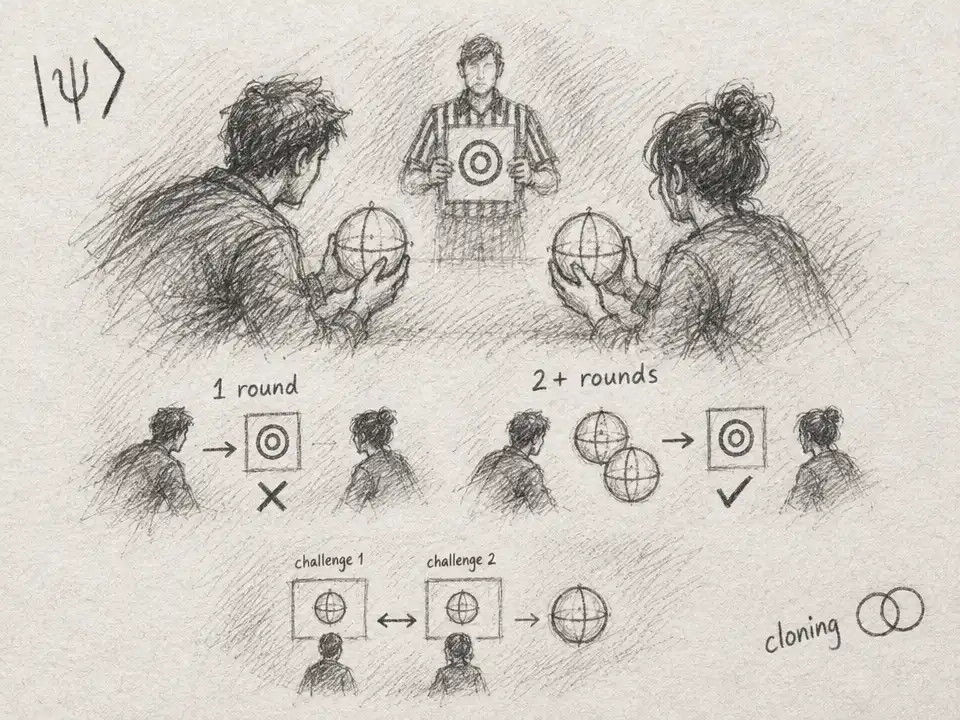
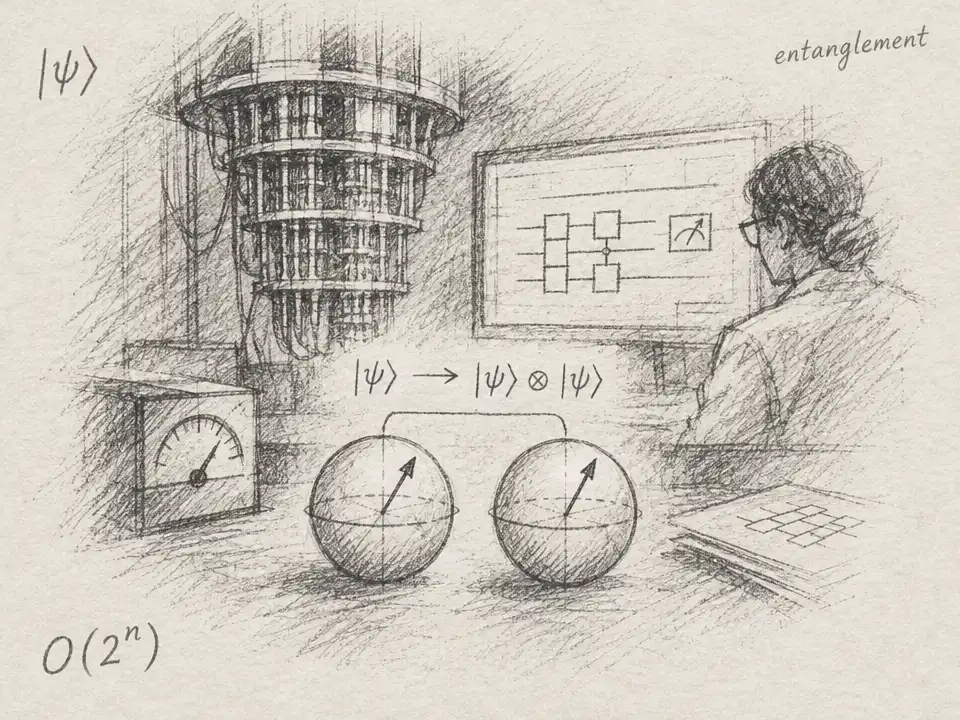
Here “matching” is doing important work. Two independent runs can produce two different measurement outcomes and, therefore, two different states. The researchers instead ask whether a quantum device can take one particular outcome from the ensemble and produce two copies of the state associated with that very outcome. The authors call this ensemble cloning. It is not simply the familiar no-cloning rule applied to one unknown particle; it is a new question about the states produced by random measurements.
The tempting expectation is that access to the larger system before measurement might help. If the full system can be prepared repeatedly, perhaps a powerful quantum processor could coordinate operations across several copies and recover the information needed to make matching pairs. Du, Cheng, Zhao, Ma, and Yuan show that this hope fails in general. For an unknown ensemble, they prove that even access to many copies of the larger, unmeasured quantum state does not make ensemble cloning or certain nonlinear measurements efficient in the worst case.
The obstacle is not merely that researchers lack a clever enough measurement. Random outcomes can create an enormous range of possible states, and the system does not conveniently hand over the same outcome twice. The paper’s lower bound grows exponentially with the number of measured qubits. Under the conditions of their theorem, even a quantum algorithm allowed to perform joint operations on its inputs cannot get around that sample burden. The authors also show that the difficulty can arise when the remaining system is just a single qubit, if the space of possible measurement outcomes is large enough.
That is the first reversal: adding quantum control does not automatically turn a random collection of possible states into a reusable supply of identical ones. The result also puts a limit on how easily experiments can inspect nonlinear features of measurement-generated ensembles. A measurement may reveal one outcome and leave a state behind, but the same act does not provide a second copy of that state for comparison.
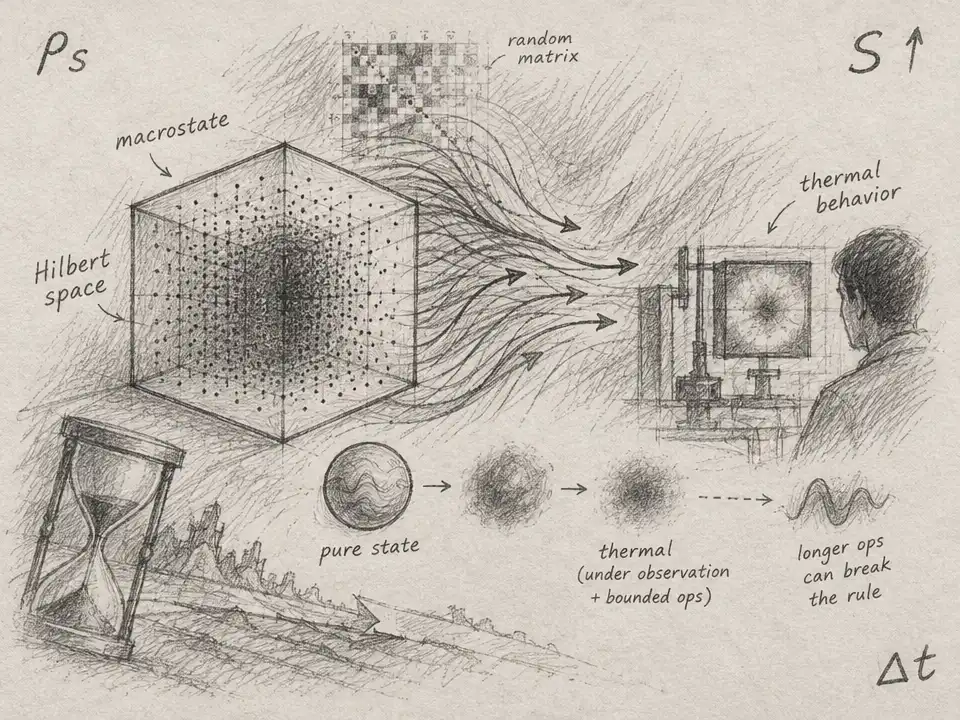
Then the story turns again. Lab experiments rarely begin with a completely mysterious quantum system. Researchers usually know how they prepared it: the state is generated by a finite circuit, a planned sequence of quantum operations. The authors show that this kind of prior knowledge can bypass the exponential sample barrier. If the preparation circuit has a manageable size, a sample-efficient method can learn a description of the ensemble’s higher-order properties using a number of copies that grows polynomially with circuit size and the desired accuracy.
But escaping the sample bottleneck does not mean the problem is solved. The method’s classical post-processing can become intractable for circuits that are too difficult to simulate on a conventional computer. More sharply, the authors prove that, under standard assumptions from computational complexity, certain nonlinear ensemble properties can still require super-polynomial computational effort—even when the full circuit description is known. These are conditional theoretical results, not measurements of a physical device, and they concern hard cases rather than every quantum experiment.
The distinction is the paper’s central surprise. Knowing how to prepare a state can make it possible to gather enough data, yet still fail to make the desired answer efficiently computable. The challenge shifts: first, how do you obtain enough repeated information about the same measurement outcome? Then, even if you have that information and know the preparation recipe, can you process it without an impractical calculation?
The authors do not claim that all measurement-induced phenomena are impossible to study. Carefully structured dynamics can make some properties easier to estimate, and existing experiments have probed such effects in particular regimes. But those simplifying structures can also exclude behaviors researchers want to investigate or make the system easier to solve by classical methods. The broad result is a warning against assuming that a concept that can be defined mathematically must also be straightforward to verify in the laboratory.
For quantum physics, the boundary is subtle. Measurements create a rich spread of possible states, and that spread may contain signatures of entanglement and other distinctly quantum behavior. Yet the randomness that makes the ensemble interesting can also make its properties hard to extract. In this work, the unexpected barrier is not just that unknown quantum states resist copying. Even a well-described preparation circuit may leave researchers facing a harder question: how do you efficiently learn what its individual measurement outcomes are capable of becoming?