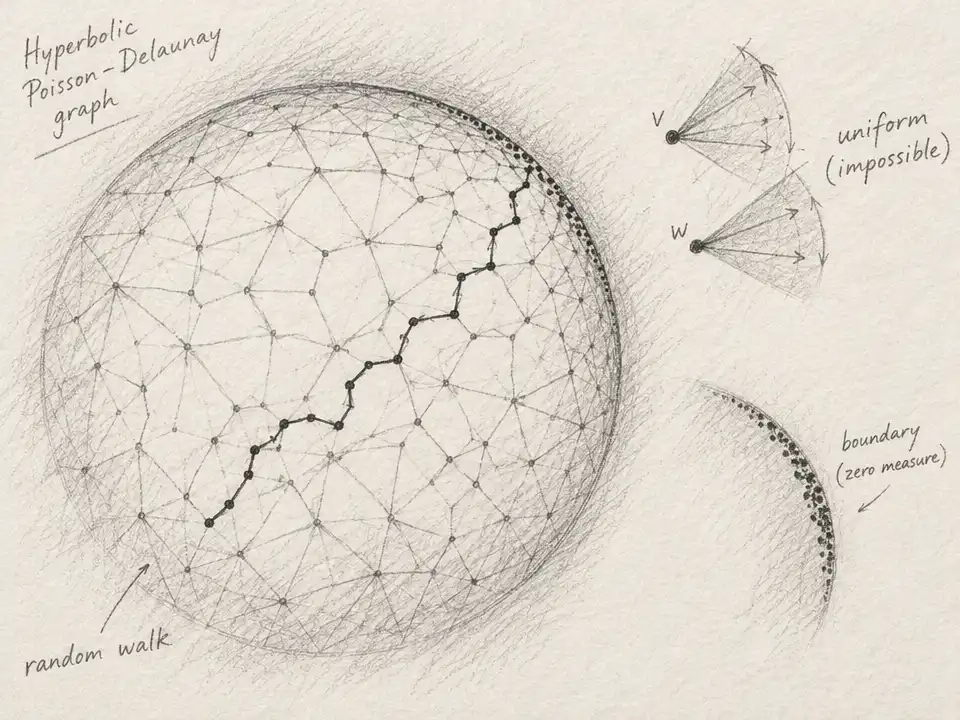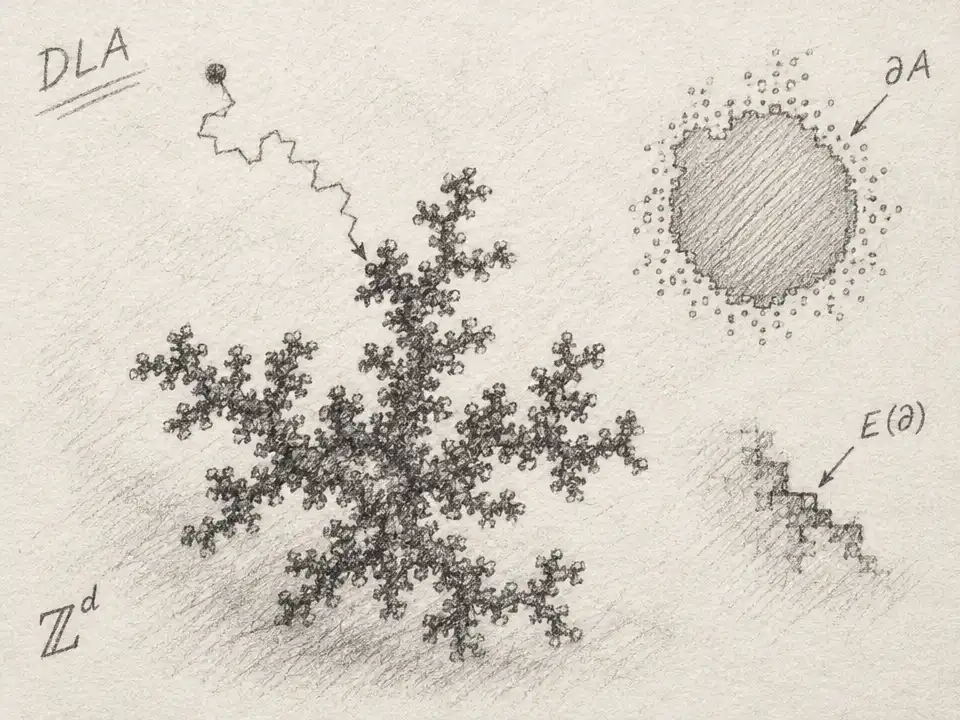
Picture a single speck in a vast, quiet space. Far away, a particle begins a random walk. It wanders, doubles back, and eventually sticks to the speck. Another arrives. Then another. This is diffusion-limited aggregation, or DLA: a growth rule simple enough to describe in a sentence, yet capable of producing clusters with tangled, branching outlines.
Those branches invite a deceptively simple question. Given enough time and enough particles, could the cluster fill out a solid shape—a ball, perhaps, or some other bounded region? A new mathematical preprint answers no for a broad class of shapes. Its result does not reveal exactly what DLA becomes. It draws a firm line around what it cannot become.
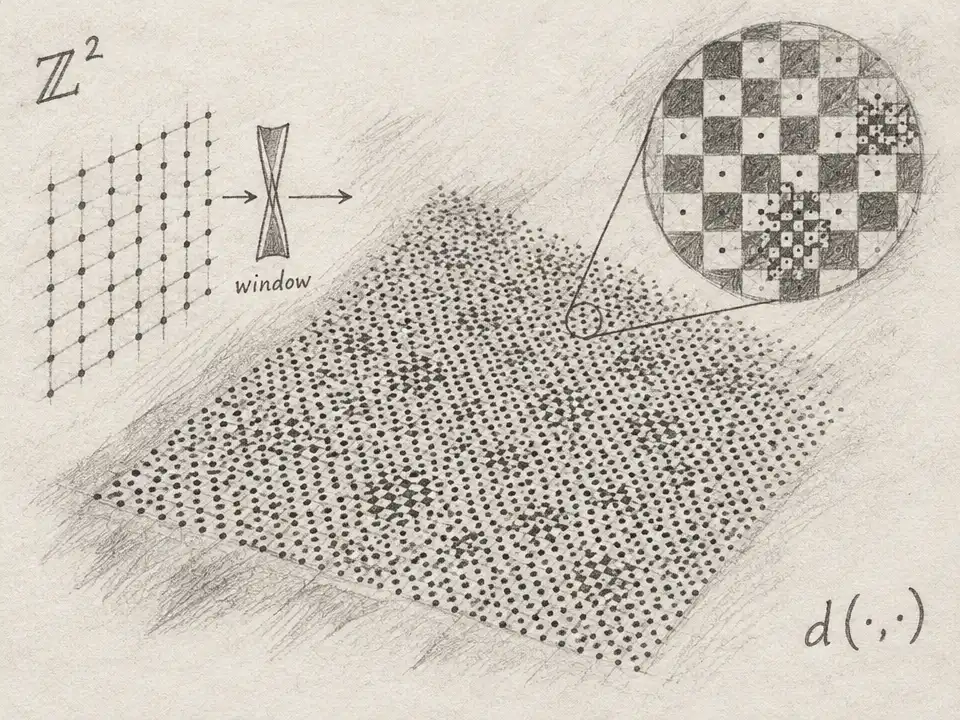
For lattice DLA in every dimension two or higher, the authors prove that the cluster cannot grow so close to any bounded, filled region with a boundary of zero volume that only a vanishing fraction of its sites lie outside. No matter which eligible region is proposed, a positive fraction must remain beyond it, even in the limit of very large clusters. The guaranteed fraction depends on the dimension, but the theorem says it is strictly greater than zero.
The scope is unusually strong. The same probability-one event works for all such regions, and the candidate shape can even be chosen after the entire random growth history is known. In other words, the cluster cannot evade the result because someone guessed the wrong shape. Whatever smooth-sided container is picked, after the fact or before, a substantial part of the cluster refuses to fit.
That is a striking answer because rigorous knowledge of DLA’s overall geometry has been scarce. Physicists have long studied its fractal-looking patterns, but a vivid simulation is not a proof about the shape of an enormous cluster. The new result does not establish that DLA has a fractal scaling limit, or tell us its dimension. It establishes a more modest-sounding fact with sharp consequences: the aggregate cannot settle into ordinary bulk, with only a thin fringe of irregularity around it.
The proof begins by giving each occupied site an invisible mathematical “field.” Think of the field as a carefully designed shadow cast by the aggregate. It is built from a function that behaves harmonically along the random walk: before a walker sticks, the expected field value at its next step matches the current one. Since the walker starts far away, where this particular field fades toward zero, the rule forces a precise cancellation at the eventual attachment point.
That cancellation lets the authors keep an energy ledger as the cluster grows. One part of the ledger measures how much the aggregate’s field differs from the field of a proposed filled shape. Another records pairwise interactions among occupied sites. Each new attachment adds a nonnegative amount, in expectation, to the difference between these quantities. A nearly filled comparison region has almost no field mismatch—but it still carries a positive interaction energy for every site. The ledger cannot make both facts fit if DLA is too close to that region. Some substantial part of the growing cluster must be elsewhere.
The method also forces a second kind of roughness into view. On the lattice, the number of exposed boundary edges grows at least in proportion to the number of occupied sites. These edges include those around internal holes, not just the outer rim. A compact object with a smooth boundary would have far fewer boundary edges relative to its volume as it grew. DLA, by contrast, keeps a linear supply of edge, like a coastline that refuses to become a neat outline.
The story extends beyond lattice walks, but not yet to every dimension. In Euclidean DLA, particles are unit balls whose centers move according to Brownian motion and attach when they reach the existing cluster. The paper proves a similar exclusion of filled shapes in dimensions two, three, eight, and twenty-four. Here the route is different: attachment geometry is combined with sphere-packing bounds. The Brownian walker is unlikely to attach at certain delicate contact points, while an optimally dense packing requires many neighbors arranged in just the right way. The gap between those demands forces a loss of density inside any proposed solid region.
Why eight and twenty-four? Those dimensions have unusually powerful, sharp results on sphere packing, including Fourier-based bounds that identify the distances allowed in optimal arrangements. In two and three dimensions, local neighbor counts and packing geometry do the needed work. The Brownian attachment estimate itself applies in every dimension at least two; what stops the proof from covering the others is the lack of packing comparisons with enough quantitative force. That is a limit of the available argument, not evidence that the shape-exclusion effect disappears elsewhere.
So what does this unlock? It turns a visual impression—“DLA looks ragged”—into a structural constraint that simulations and future theories must respect. Models that predict a smooth, filled bulk with only minor edge irregularities can be ruled out for these settings. The work also shows how a probabilistic growth rule can leave a lasting geometric fingerprint: each attachment obeys a local harmonic constraint, and the accumulated constraints prevent global smoothness.
The price of this new certainty is that the destination remains out of sight. The theorem does not identify the cluster’s limiting shape, prove a scaling limit exists, or settle whether its apparent fractal character persists at every scale. For Euclidean growth, it covers only four dimensions. What it offers instead is a boundary around the unknown: DLA may still surprise us in countless ways, but it cannot quietly grow into a conventional solid and hide its disorder at the edges. The next frontier is to discover what shape can survive the walk.