On the International Space Station, a small muscle-tissue experiment was meant to run for 14 days. It ended after 10. Flow readings had become uncertain, and imaging brought temperature spikes. Researchers on the ground chose preservation; crew members moved the sample into cold storage. The team recovered usable molecular material. This was not an AI-controlled experiment. But it raises a question a future autonomous scientist may have to answer: when a measurement looks wrong, is the sample failing, is the sensor lying, or has the experiment become impossible to interpret?
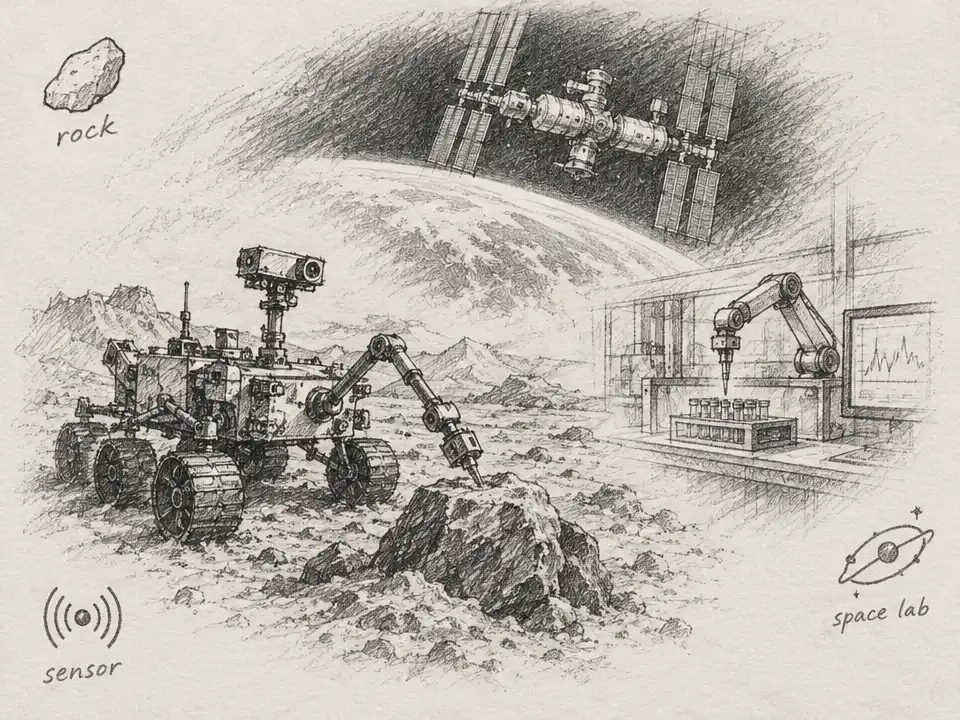
That question sits where two fields meet: machine-guided experimentation, which can decide what to try next, and space robotics, which must make that next step physically possible. On Earth, a self-driving lab can suggest a trial, run it, measure the result, and adjust. In orbit or on another planet, a promising decision is only the start. A machine may need to point an instrument, move a sample, preserve it, or recognize that the equipment cannot do what the science now requires.
A recent critical review of AI and space science brings these traditions together. It surveys work in orbital laboratories and planetary fieldwork, from biological experiments to Mars rover instruments. Its central point is not that a fully autonomous space laboratory already exists. Rather, useful pieces of the puzzle have appeared separately: systems that analyze data, instruments that make limited choices, dedicated devices that carry out procedures, and humans who step in when the plan stops matching reality.
On Mars, one working piece is target selection. AEGIS software scans rover images, ranks candidate rocks against preferences set by scientists, and directs an instrument toward a target. In an evaluation across 2.5 km of previously unexplored terrain, it selected requested material in more than 93% of cases, compared with approximately 24% expected without intelligent targeting. It then acquired geochemical measurements. That result shows the value of choosing a useful target while an opportunity is available—not that the system independently discovered what the rocks mean.
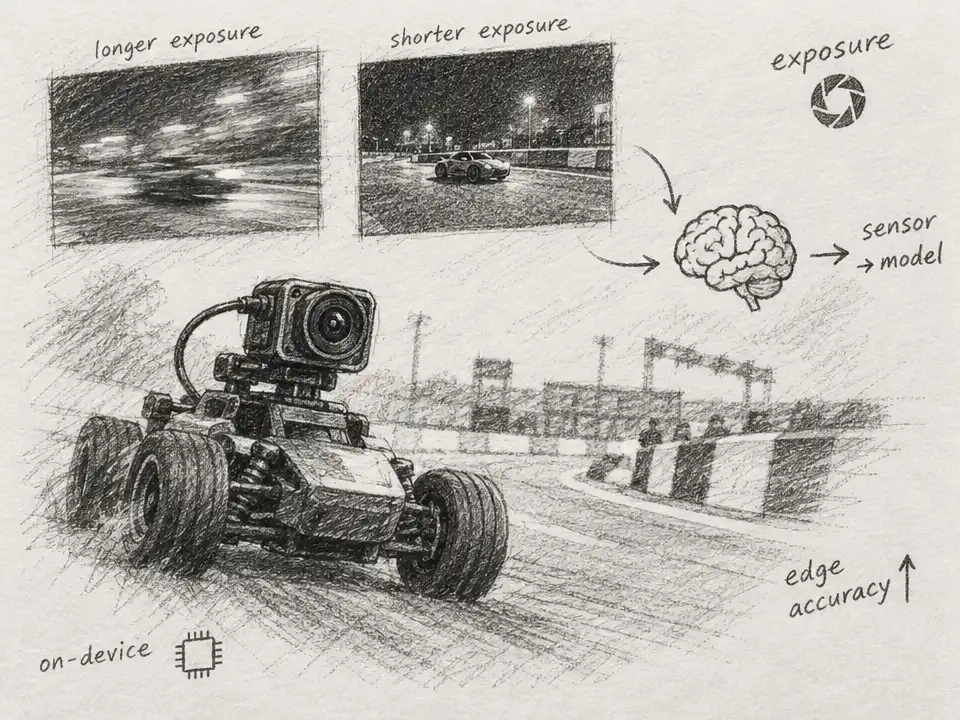
Perseverance’s PIXL instrument demonstrates another step: letting evidence change how much evidence the instrument gathers. Its onboard rules can extend a typical 10-s measurement to 40 s total when the spectral signal suggests a longer look may help. In the analyzed measurements, extra counts revised some phosphate estimates and removed spurious detections of elements including Zn and Y. The improvement was selective: some carbonate measurements changed little, and the instrument had a limited budget for longer readings. Even a narrow, rule-based adjustment can make a difference, but the science depends on what the instrument sees and what resources remain.
These examples illuminate the crossover with self-driving laboratories. In both settings, an AI system is most useful when a prediction can shape a real experiment. But space makes the physical chain unusually visible. A command can be sent without the intended action being confirmed; a sample can be handled without preserving its history; a measurement can be recorded without proving that it answers the original question. The review argues that scientists should distinguish a decision, the action that carries it out, and the evidence that shows whether the result is valid.
The muscle-chip experiment makes that distinction tangible. Uncertain flow readings did not reveal whether perfusion had stopped or the sensor had become unreliable. A future controller might need to compare independent checks, decide whether to continue, and preserve the sample if its history cannot be trusted. The review sketches such a system as a proposal for testing, not as a capability already demonstrated in flight. Crucially, the right response might be to stop. Preserving a sample with an honest record of what is unknown could be more scientifically valuable than pressing ahead and treating an ambiguous result as clean data.
A second case shows how easily a machine can complete steps without producing an interpretable result. An ISS platform tested microbial conversion of a plastic-derived substrate, but only part of its planned fluid-transfer schedule was carried out. Interruptions, incomplete records, and uncertainty about how much liquid had actually been delivered meant researchers could not calculate product yield. A system might report that it resumed operation; science still needs to know what happened to the sample and whether the measurement supports a conclusion.
That is why the review’s proposed measure of autonomy is not simply whether a robot finishes its checklist. It is whether the full campaign produces valid scientific results, across its planned tasks and resource limits. Comparisons should track which results were usable, which remained unresolved, what was abandoned, and how much human support was needed. A fixed pump, a specialized sample cartridge, a rover instrument, or a robot arm might each be the right tool. The review argues for adding robotic capability only when the science requires a physical action that existing mechanisms and timely human help cannot provide.
The deeper connection is between two kinds of scientific intelligence: deciding what to learn and knowing whether the experiment actually taught it. Spaceflight gives that problem sharp edges—limited supplies, interruptions, long waits for help, and samples that cannot always be replaced. Today’s systems already make constrained choices, from rover targeting to adaptive measurements. Linking those choices to physical action and trustworthy evidence remains a research challenge. The next milestone may not be a machine that never needs help, but one that can explain when to continue, when to preserve, and when the evidence no longer supports the claim.