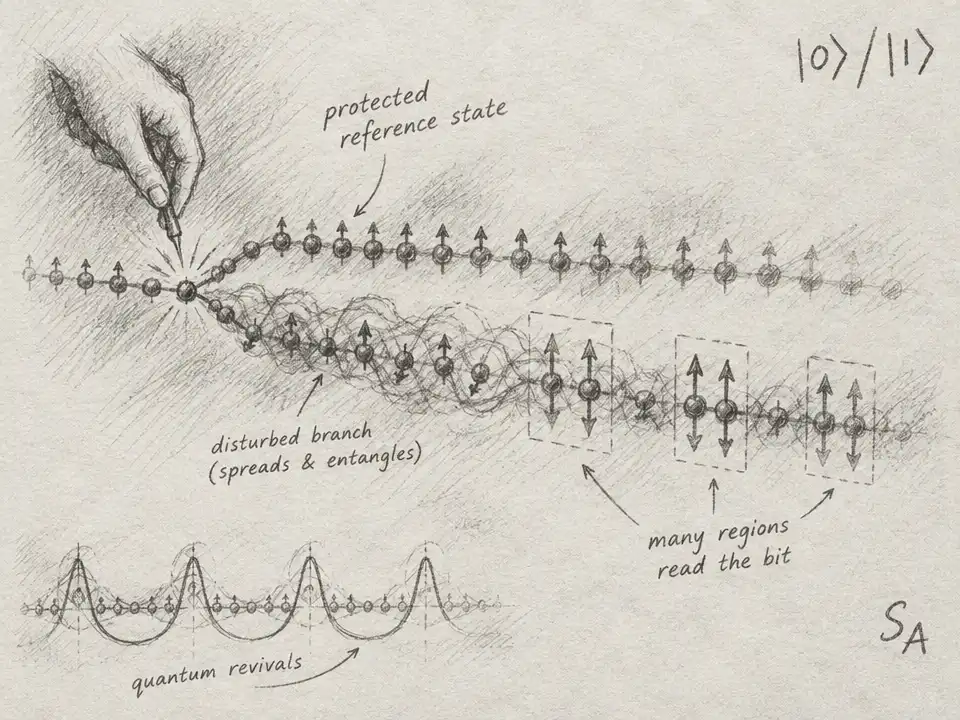
Picture a row of quantum spins, each measured along the same direction. Every snapshot gives a crisp string of results: up here, down there. Take enough snapshots and you can map patterns in that direction with impressive detail. But some important properties remain off-camera. In particular, a site’s energy can depend on spin components that this fixed measurement never sees.
Researchers have ways to get around that blind spot, including changing the measurement basis or reconstructing the quantum state. Those options can demand extra control or substantial analysis. Jie Ren, Andrew Hallam, Luheng Zhao, Huanqian Loh and Zlatko Papić explore a different route: let the system’s own relaxation do some of the translating. Their method, called quantum snapshot thermometry, uses visible measurements and a separately calibrated equation of state to infer hidden conserved quantities.
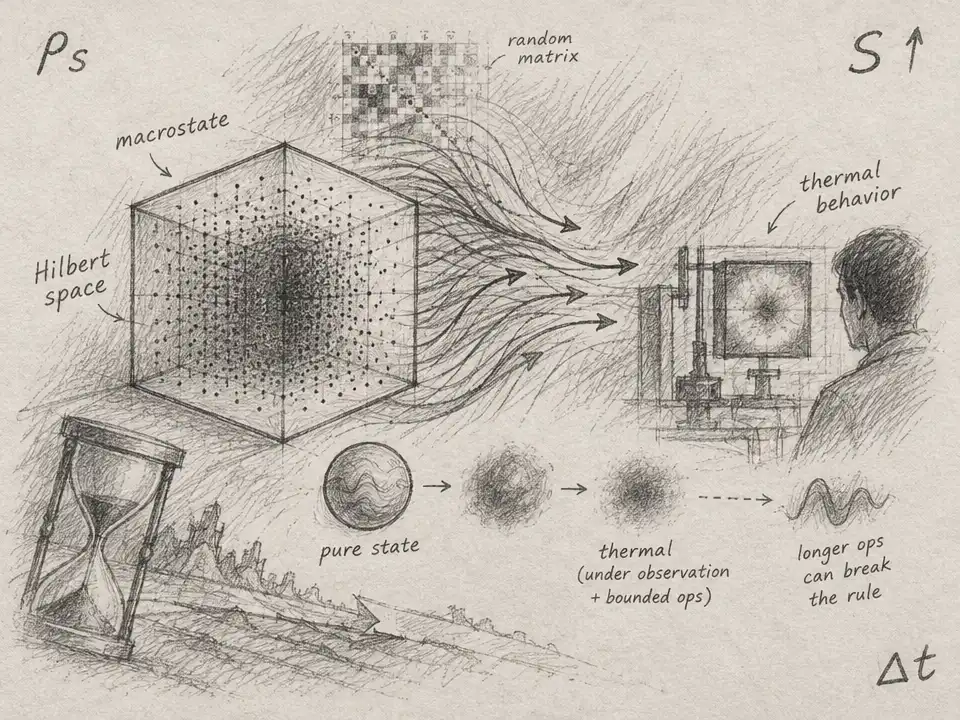
The idea borrows from an ordinary thermometer. A thermometer does not reveal temperature by displaying every microscopic motion of every molecule. Instead, it measures a quantity that changes predictably with temperature. Here, the researchers first calibrate how an accessible, measurement-friendly observable behaves in uniform equilibrium states with different energy densities. Once a changing system has locally settled into a similar relationship, the measured observable can act like a thermometer for the energy nearby.
That phrase, locally settled, carries real weight. The method does not assume the entire system has reached equilibrium. It needs small regions to approach the calibrated relationship while the larger pattern—the spreading energy front, for example—is still changing. The researchers also need the calibration to be reliable and the relationship to be invertible over the range they want to measure. It is an inference based on the system’s behavior, not a direct reading of any hidden quantity.
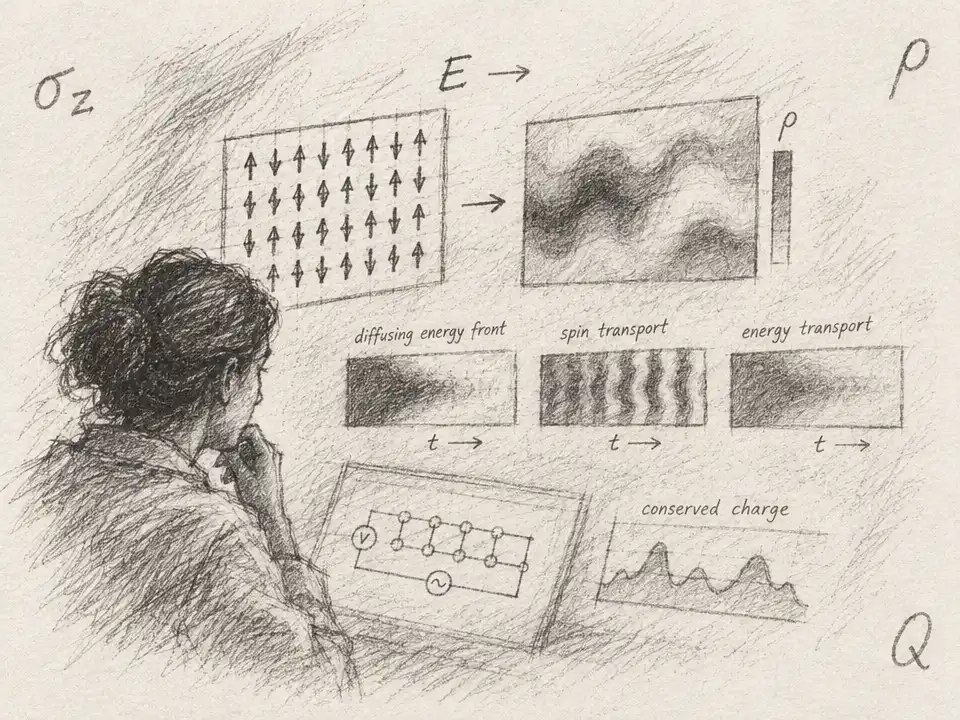
In one numerical demonstration, two halves of a one-dimensional spin chain begin at different temperatures and are joined. Energy starts spreading from the boundary. The local energy includes a transverse spin component that cannot be read directly from snapshots taken along the chain’s standard measurement direction. But after a short transient, the researchers find that the visible magnetization follows a calibrated relationship with energy. They can therefore use the measured magnetization to reconstruct the energy front without rotating the spins into a new measurement basis.
The simulations recover energy profiles at times 12, 36 and 60 using 8,192 snapshots. From how the reconstructed front broadens, the team estimates a diffusion constant of 1.420 ± 0.039 in the model’s units, consistent with an independent benchmark. This is a numerical result, not a reported measurement on a physical quantum device. Its significance is the demonstration that fixed-basis snapshots can, under the right conditions, reveal more than their directly visible spin patterns.
A second example shows why reading out more than one quantity can matter. In a spin chain that conserves both energy and magnetization, the same snapshots provide local magnetization and neighboring-spin correlations. Together, those visible clues can be matched to a calibrated equilibrium relationship to infer energy. In the modeled regime, spin spreads diffusively while energy spreads ballistically—two distinct patterns recovered from the same kind of measurement data. The researchers report using 32,768 snapshots per time step for this comparison.
The approach also reaches beyond systems that conserve energy. In a periodically driven, spin-1 circuit, the researchers study a conserved charge that is not directly diagonal in the measurement basis. Once local relaxation establishes the relevant equilibrium relationship, the probability of a particular spin measurement can reveal the charge density. In their numerical example, 2,048 snapshots help reconstruct the charge profile in a 20-site chain. The measurement does not have to name the hidden quantity; a calibrated relationship can supply the translation.
But no thermometer works without knowing what its readings mean. Symmetries can make a calibration curve ambiguous: two different energy densities may produce the same visible measurement. In one example, the snapshots reveal the energy’s magnitude but not its sign. Knowing the prepared spatial pattern lets the researchers choose the appropriate branch of the curve. Near points where the calibration changes only weakly, small measurement errors can also become large errors in the inferred energy.
Local equilibrium is another important boundary. Some systems have extra conserved quantities that a simple thermal calibration does not capture. For one integrable spin-chain example, the authors estimate an upper bound of approximately 4.7% of the reservoir energy contrast for the error in a simplified readout. The broader lesson is not that snapshots can expose anything whatsoever, but that their limits can be analyzed: the calibration’s sensitivity, the number of independent observables, departures from equilibrium and the available prior information all shape what can be reconstructed.
The work’s promise is practical as well as conceptual. Many quantum simulators already produce site-resolved snapshots, but may have limited ability to perform additional measurement operations. Snapshot thermometry suggests that a familiar readout can sometimes yield a richer account of transport—provided the system itself supplies a dependable local relationship between what is seen and what is hidden. The spin pattern is not the whole story. As the system relaxes, it can become a map to quantities the measurement could not see directly.