In a computer simulation of a quantum system, the long wait can be the point. Researchers often let a model evolve in “imaginary time”—a mathematical version of time used to filter out higher-energy states and reveal a system’s ground state or low-temperature behavior. But when the calculation must reach very far into that time, a familiar strategy becomes a bottleneck: take one small step after another, at a steady pace.
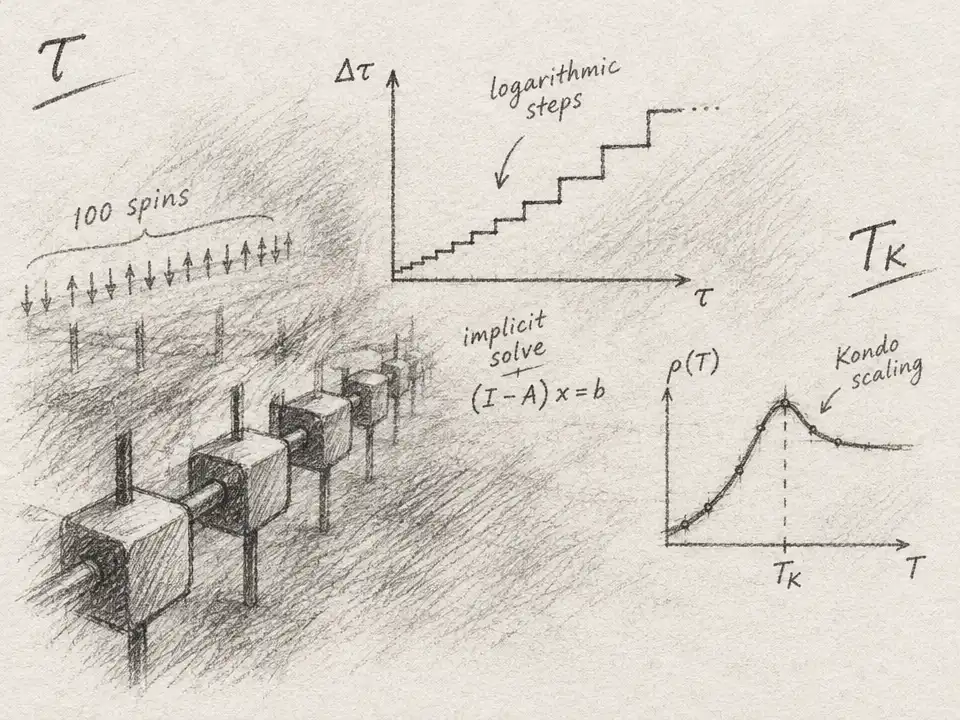
A new tensor-network method changes the pace. Instead of spacing every step evenly, it places them on a logarithmic grid: close together at first, then farther and farther apart. The trick is to take advantage of what imaginary-time evolution does. Rapidly changing, high-energy components fade early. Later, the state changes more slowly, so the calculation can safely take longer strides.
This is not a proposal to make physical time run differently, or to skip information a simulation needs. Imaginary time is a computational tool, not a clock ticking inside a laboratory. The researchers’ goal was to use fewer steps while still resolving the state accurately—and to keep the calculation stable even when those later steps grow large.
The challenge is that a large step can make a numerical method misbehave. A straightforward explicit method can accidentally amplify high-energy components that should be shrinking. Rather than letting the calculation leap and hoping for the best, the team used an implicit stepping method: each new state is found by solving a linear system. Their trapezoid-rule method is stable even for large steps, though stability alone does not guarantee accuracy. The grid still has to resolve the changes that matter.
To make this approach practical for many interacting particles, the team represented the quantum state as a matrix product state, a compact way of encoding a complicated many-body wavefunction, and the system’s energy operator as a matrix product operator. The update relies on familiar tensor-network tasks: applying an operator and solving a linear system. In tests, the cost of each solve appeared roughly independent of the step size. That observation is important to the speedup—but it is an empirical result for the systems studied, not a guarantee for every problem.
The first test was a chain of 100 spin-½ particles, linked by antiferromagnetic interactions. Starting from a Néel state—a pattern in which neighboring spins point in opposite directions—the researchers evolved the chain toward its ground state. They compared their method with a standard time-dependent variational principle approach using uniform steps. For the new method, the number of steps grows roughly with the logarithm of the maximum simulated time, rather than in direct proportion to it. In this test, the authors reported several orders of magnitude in speedup over the standard approach; a spectral version of their method completed the full evolution in about 100 seconds.
The improvement was not simply a matter of accepting a rougher answer. The team compared the evolving states with a well-converged reference and checked how the error changed as they increased the number of steps. For their trapezoid method, doubling the number of steps improved accuracy by about a factor of four, as expected for a second-order method. They also tried an explicit stepping scheme on the expanding grid. Once its steps crossed a stability threshold, the calculation became unstable—an illustration of why the larger strides need a carefully chosen method.
Then came a tougher test: a single magnetic impurity coupled to a metallic bath. In this Anderson impurity model, interactions can make the Kondo temperature, the scale at which the surrounding electrons screen the impurity’s magnetic behavior, exponentially small. Reaching that regime demands evolution to very long imaginary times, precisely where uniform stepping becomes expensive.
The researchers combined their method with a technique called METTS, which estimates thermal properties by repeatedly generating and measuring specially prepared quantum states. They examined interaction strengths U = 8, 10, 12, and 15, with inverse temperatures β from 2 to 1024. They used a bond dimension of 200 and collected about 50,000 samples at the highest temperature, down to 15,000 at the lowest. Across this range, the average computing time per METTS calculation grew logarithmically with β in their test.
The calculation tracked double occupancy: the chance that two electrons occupy the impurity together. When the researchers plotted the results against temperature measured relative to the Kondo temperature, curves for different interaction strengths collapsed onto a common scaling curve. Their fitted Kondo temperature decreased exponentially with interaction strength, with a fit of about 0.057 multiplied by the exponential of −0.21U. The result agreed with numerical renormalization-group calculations on a similar model. The new method did not discover the Kondo effect; it provided a more efficient computational route to resolving its very low energy scale.
There are limits to what these demonstrations establish. The tests cover two models, and the apparent step-size independence of the linear-solve cost was observed in those cases. Other systems may demand more memory, larger tensor networks, or different numerical choices. The authors suggest that the approach could be useful in broader calculations, including other low-temperature simulations and some models of systems relaxing toward steady states, but those applications remain possibilities to investigate.
The central idea is a change in what counts as a sensible step. Uniform pacing treats the beginning and distant end of imaginary time as if the state were changing at the same rate. A logarithmic grid recognizes that the early calculation must catch fast motion, while the later one can slow its own schedule as the quantum state settles. With a stable solver to make those longer steps safe, a difficult stretch of computation can become a much shorter route to the physics.