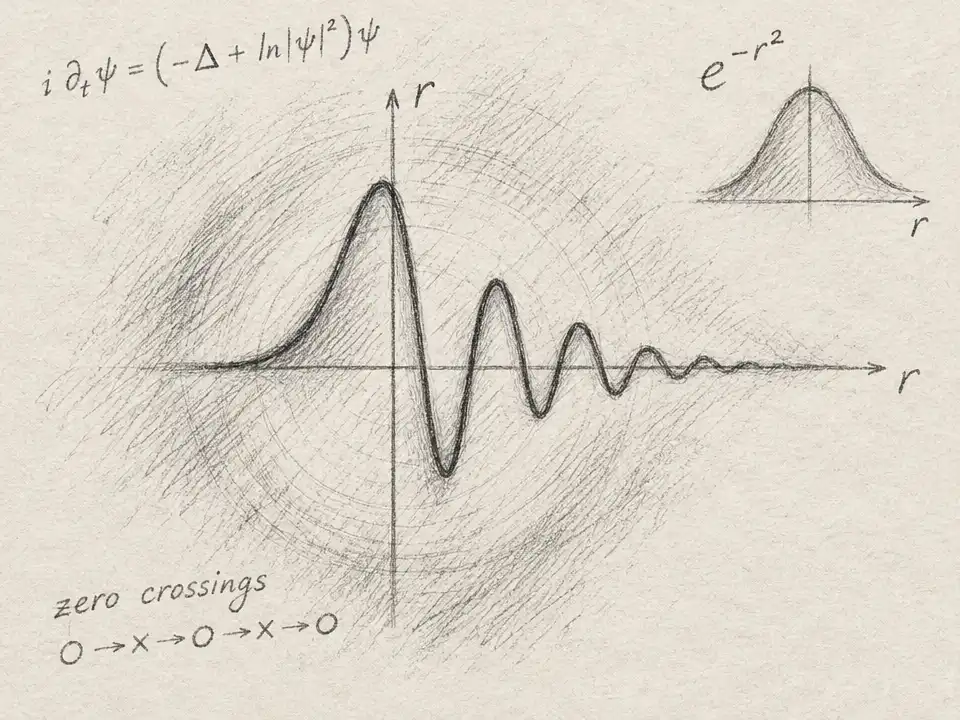
Imagine turning a dial that sets the height of a mathematical wave at its center. The profile spreads outward, rising and falling as it goes. It may cross zero several times, making a series of concentric shells. But far away, a bound state must fade to nothing. The surprise is that for each possible number of crossings, exactly one starting height produces a profile that does both.
The result concerns a stationary form of the logarithmic Schrödinger equation, a nonlinear model studied in mathematical physics. “Radial” means the profile depends only on distance from its center, not on direction. A “node” is a radius where the profile crosses zero and changes sign. A bound state is a localized profile that belongs to a finite-energy class and dies away at large distances.
Such profiles are not all simple, smooth humps. The equation already has a well-known positive ground state: a bell-shaped profile called the Gausson. More complicated states can alternate between positive and negative regions before fading. Earlier work had shown that profiles with any chosen number of nodes exist. The unresolved question was whether a given node count might belong to several different bound states—or just one.
That question had been open since mathematician Michael Troy posed it in 2016 for sign-changing radial solutions in dimensions greater than one. It also connects to a broader conjecture by Haïm Berestycki and Pierre-Louis Lions: for certain nonlinear equations, there should be exactly one bound state for each prescribed number of nodes. The new work confirms that prediction for the logarithmic equation, in every spatial dimension two or higher.
The theorem is precise. For each positive integer number of nodes, there is exactly one radial bound-state profile, apart from moving its center or flipping its overall sign. Each node corresponds to a spherical shell in space. So a profile with three nodes has three such shells; a profile with seven has seven. In each case, only one shape makes the full journey from its central value, through those crossings, to a fading tail.
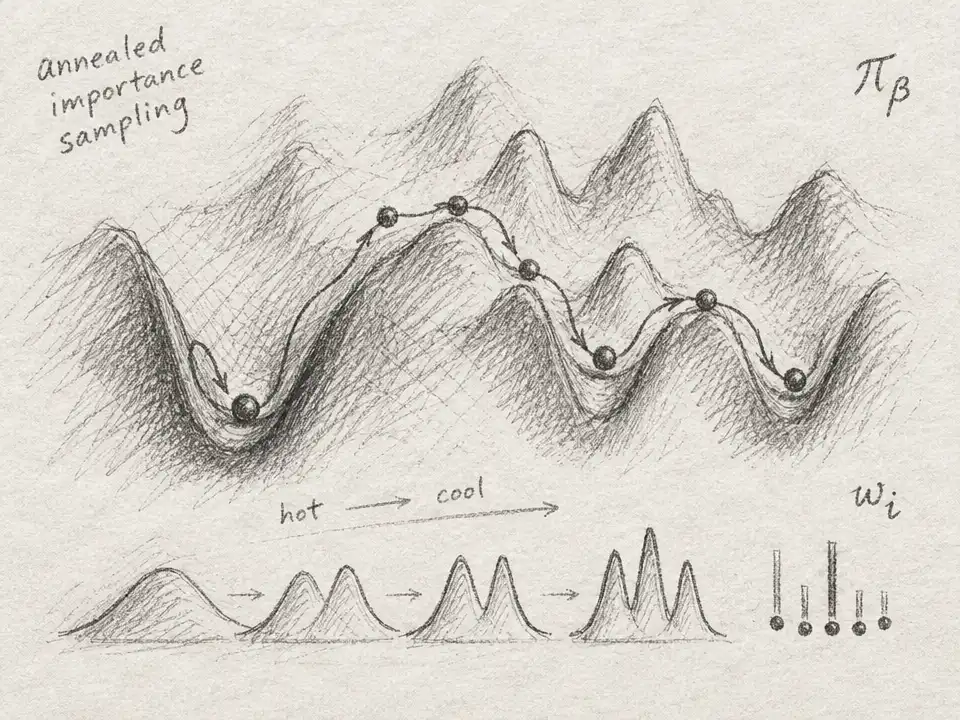
Finding one such profile is different from proving that no rival exists. The authors use a mathematical version of a shooting method. Start at the center with a chosen height and zero slope, then follow the equation outward. Changing the starting height changes the whole trajectory. Some choices produce profiles that do not decay to zero; others can keep oscillating around a nonzero level. The challenge is to identify the special starting height that yields a finite-energy bound state—and prove that no second choice does the same job.
To keep track of how a trajectory responds when its starting height changes, the researchers study a sensitivity profile: the infinitesimal change in the solution caused by a small change at the center. Its sign carries information about how neighboring trajectories separate. The proof establishes a strict pattern: for a bound state with several nodes, this sensitivity changes sign exactly once between consecutive nodes, and once more beyond the last node. That control helps rule out two distinct starting heights producing bound states with the same node count.
But a familiar shortcut was unavailable. Near zero amplitude, the nonlinear term itself tends to zero, yet its slope becomes unbounded. That makes the equation behave differently from the smoother cases where standard uniqueness tools apply. The tail was especially troublesome: earlier methods relied on decay assumptions that do not hold in this logarithmic setting. The authors therefore first prove new results about how bound states approach zero at large distances.
Those results reveal a sharp Gaussian-scale fade. In normalized units, the profile’s size falls roughly like a Gaussian whose exponent has coefficient one-half. The theorem states this through bounds with arbitrarily small margins, rather than claiming every profile is exactly a Gaussian. Crucially, the same tail behavior holds for every bound state, no matter how many times it crossed zero. This gives the proof the precise far-field control needed to complete the uniqueness argument.
The outcome overturns a plausible expectation: many possible interior patterns do not mean many localized solutions for the same pattern. Node count acts like a label that selects one radial bound state. The theorem does not say that every starting height creates a bound state, nor that every solution of the equation is radial. It settles uniqueness within the specified class of radial, finite-energy profiles.
The work is mathematical, not a report of a newly observed physical wave. Still, understanding the equation’s stationary profiles matters because the logarithmic Schrödinger equation is studied as a model of nonlinear wave evolution. The positive Gausson also plays a role in a sharp logarithmic Sobolev inequality, a result connecting how spread out a function is with how quickly it varies. The new theorem extends that picture beyond the single, smooth ground-state hump.
In the shooting picture, the far edge of the profile is not a minor detail. A trajectory can look promising through several crossings and still fail to vanish at infinity. By proving what happens both as the central dial changes and as the tail recedes, the researchers turn an open-ended search into a one-to-one correspondence: choose a positive node count, and there is one bound-state shape to match.